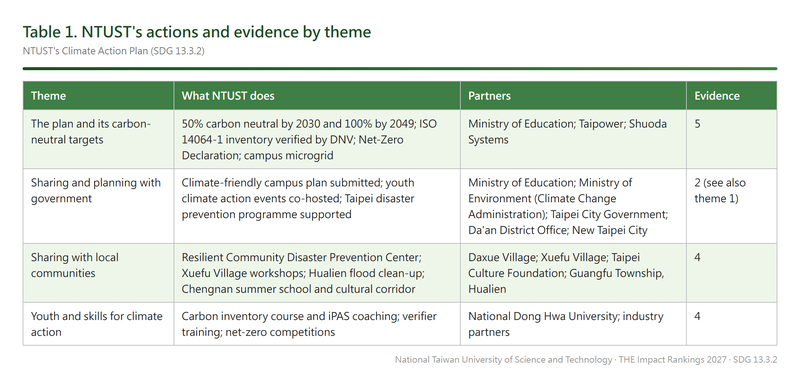
NTUST's climate action plan is part of its mid- to long-term development plan and is led by the Center for Sustainable Development and Institutional Research. Its targets are 50% carbon neutrality by 2030 and 100% by 2049. This report draws on 15 news stories and public documents from 2022 to 2026, grouped into four themes:
- The plan and its carbon-neutral targets: Since 2023, NTUST has run greenhouse gas inventories under ISO 14064-1, verified by DNV. It issued a Net-Zero Declaration in 2025, and in 2026 opened Taiwan's first urban campus microgrid on its Huaxia campus.
- Sharing and planning with government: NTUST submitted its climate-friendly campus plan to the Ministry of Education, co-hosted youth climate action events with the Ministry of Environment, and has supported Taipei City's Disaster Prevention and Protection Programme since 2010. Its microgrid backs up a New Taipei City emergency shelter.
- Sharing with local communities: The university's USR team built a Resilient Community Disaster Prevention Center with Daxue Village and ran resilience workshops in Xuefu Village. Using the Chengnan area as a classroom, it shares green energy and local sustainability with high school students and residents.
- Youth and skills for climate action: NTUST brings carbon inventory and verification into the classroom, co-ran greenhouse gas verifier training for 245 people with National Dong Hwa University, and its student teams win net-zero competitions year after year.
The table below summarises what NTUST does under each theme and the supporting evidence:
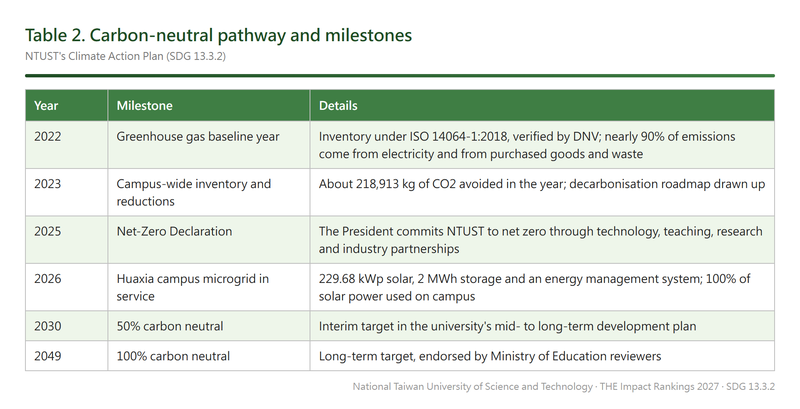
NTUST, National Taiwan University, National Taiwan Normal University and other universities formed the Taiwan Sustainability Governance University Alliance. President Yen Chia-yu announced NTUST's low-carbon targets: 50% carbon neutrality by 2030 and 100% by 2049, now part of the university's mid- to long-term plan. The Commercial Times reported in December 2024 that NTUST won the 2024 National Sustainable Development Award (education category). The university has drawn up a decarbonisation roadmap and avoided about 218,913 kg of CO2 emissions in 2023.
NTUST's revised plan for the Ministry of Education's 2024 Smart Climate-friendly Campus Pilot Programme (18 March 2024) states that the university began greenhouse gas inventories in 2023, using 2022 as the base year. The inventory follows ISO 14064-1:2018 and is verified by DNV. The Center for Sustainable Development and Institutional Research manages progress, writes the report, collects data from all units and runs internal verification. Nearly 90% of emissions come from electricity (Category 2) and from purchased goods and waste treatment (Category 4), which guides equipment replacement and energy saving. The plan also links smart electricity meters, smart water meters, air quality sensors and the energy management system (EMS) into a public sustainability information site. Ministry reviewers endorsed the 2049 target for 100% carbon neutrality.
On 15 April 2025, at a forum and handover ceremony for a donated carbon inventory system, the President issued NTUST's Net-Zero Declaration, committing the university to net-zero emissions by 2049 through technology, teaching, research and industry partnerships. Alumni-founded Shuoda Systems donated the system, and the Center for Sustainable Development and Institutional Research provided inventory expertise and advice.
In September 2026, NTUST presented its Huaxia campus microgrid. It was the first university in northern Taiwan selected for Taipower's university energy saving and power resilience programme. The system includes 229.68 kWp of solar panels, 2 MWh of battery storage, two 100 kW DC fast chargers, a 400 kW backup generator and an EMS. All solar power is used on campus, saving an estimated NT$540,000 a year in electricity costs.
Table 2. NTUST's carbon-neutral pathway and milestones:
News evidence for this section
- Ministry of Education (NTUST plan) (2024/03/18) NTUST revised plan for the Ministry of Education's 2024 Smart Climate-friendly Campus Pilot Programme: https://ws-proj.moe.edu.tw/001/Upload/568/relfile/13271/17428/784018ad-7cc4-4049-95c8-f309581b402f.pdf
- Commercial Times (2024/12/20) Building sustainability and social responsibility into its DNA, NTUST wins the 2024 National Sustainable Development Award: https://www.ctee.com.tw/news/20241220700579-431204
- NTUST News (2025/04/17) NTUST issues its Net-Zero Declaration at a forum and launches its sustainability transition: https://www.ntust.edu.tw/p/406-1000-135620,r167.php?Lang=zh-tw
- CNA PR Newswire (2026/09/18) NTUST builds Taiwan's first urban campus microgrid, saving energy day to day and supplying power in disasters: https://www.cna.com.tw/postwrite/chi/444620
- Commercial Times (2026/09/18) NTUST builds Taiwan's first urban campus microgrid: https://www.ctee.com.tw/news/20260918701210-431204
Through the Ministry of Education's Smart Climate-friendly Campus programme, NTUST submitted its inventory system, reduction targets, EMS and smart meter plans for government review (see 1.1), aligning with national net-zero green campus policy.
In May 2026, NTUST and the Ministry of Environment co-hosted a talk in the Youth Climate Action Series for universities, titled Data, Technology and Civic Action: Co-creating Sustainable Cities. Nearly 130 students and members of the public attended. An analyst from the Climate Change Administration's Net-Zero Promotion Division spoke on transparent and accountable sustainability pathways from a government perspective. Speakers from Weather Risk Management, the Taiwan Green Energy Public Welfare Development Association and the Executive Yuan's Youth Advisory Committee discussed data integration, data visualisation and youth advocacy. The Center for Sustainable Development and Institutional Research said sustainability should be part of everyday learning and life.
CommonWealth Magazine reported in October 2022 that NTUST has supported Taipei City's Disaster Prevention and Protection Programme since 2010. Professor Chien-Kuo Chiu explained that national and city governments use the programme to model the Shanchiao Fault every year, updating the scale of rupture, affected areas and damage estimates, and Taipei uses the results to plan disaster prevention parks and shelters. Because the city can reach only about 12 of its more than 400 villages a year, NTUST launched its Community Renewal and Resilience USR project in 2020 to help neighbourhoods in Da'an, Wenshan and Zhongzheng districts. It also signed a disaster prevention memorandum with the Da'an District Office.
For energy resilience, the Juyu Building on the Huaxia campus is one of New Taipei City's emergency shelters. If grid power fails, the microgrid switches to island mode and can run the whole campus for 4 hours, or 8 hours with large air-conditioning units shed, putting shelter lighting and communications first. Emergency sockets at the guardhouse let neighbours charge their phones during outages (see evidence in 1.2).
📎 News evidence for this section
- NTUST News (2026/05/28) NTUST and the Ministry of Environment promote climate action as government, industry and academia explore data and technology for sustainable cities: https://www.ntust.edu.tw/p/406-1000-148240,r167.php?Lang=zh-tw
- CommonWealth Magazine (2022/10/19) Thriving together with the neighbourhood: NTUST's Chengnan Unlimited Project shows how: https://www.cw.com.tw/article/5123189
On the slopes of Toad Mountain, the USR team installed rainfall and tilt sensors, built an app that alerts village chiefs during heavy rain, and designed a LINE chatbot that shows the nearest shelter, fire hydrant and AED. The team also ran workshops in Xuefu Village on pre-disaster recovery planning and community resilience (CommonWealth Magazine, 2022).
In November 2025, staff and students from the Departments of Civil and Construction Engineering and Architecture worked with Daxue Village in Da'an District to renovate an empty old building on Roosevelt Road, Section 3, into a Resilient Community Disaster Prevention Center with a disaster education room and a supplies room. Supplies are grouped for warning, evacuation and rescue, with stock and expiry tracking, and an evacuation route map for Daxue Village is mounted on the outside wall. Residents use the center to learn about disaster prevention and train.
After extreme weather struck Hualien, on 4 October 2025 the NTUST Student Association and EDBA/EMBA Alumni Association brought 60 students and 34 alumni to Guangfu Township to help clear mud, with funds and supplies from the Alumni Association and campus vendors.
In July 2026, the Center for General Education ran a summer school that took 13 high school students from across Taiwan and 15 NTUST undergraduates to Treasure Hill, Fanglan Mountain and Toad Mountain. Courses included green energy and design thinking, using technology to address local issues. In August 2026, the Chengnan College signed a memorandum with the Taipei Culture Foundation to bring teaching and building reuse to Huanmin New Village at Toad Mountain. Its course on cultural heritage and sustainable development looks at reusing the Japanese-era dormitories to benefit the community.
📎 News evidence for this section
- CommonWealth Magazine (2022/10/19) Thriving together with the neighbourhood: NTUST's Chengnan Unlimited Project shows how: https://www.cw.com.tw/article/5123189
- NTUST News (2025/11/13) NTUST USR team and Daxue Village, Da'an District, turn an old building into a Resilient Community Disaster Prevention Center: https://www.ntust.edu.tw/p/406-1000-142185,r167.php?Lang=zh-tw
- NTUST News (2025/10/14) Nearly 100 NTUST students and EMBA alumni help clear mud in Hualien after the disaster: https://www.ntust.edu.tw/p/406-1000-141169,r167.php?Lang=zh-tw
- NTUST News (2026/08/13) Using Chengnan as a classroom, NTUST builds young people's cross-disciplinary skills: https://www.ntust.edu.tw/p/406-1000-150646,r167.php?Lang=zh-tw
- NTUST News (2026/08/31) NTUST partners with Huanmin New Village at Toad Mountain, bringing general education into the Chengnan cultural corridor: https://www.ntust.edu.tw/p/406-1000-151078,r167.php?Lang=zh-tw
In the Graduate Institute of Energy and Sustainability Technology's Sustainable Energy Strategy and Policy course, an industry speaker explained greenhouse gas inventory and third-party verification in practice. The course also coached students for the Ministry of Economic Affairs' iPAS Net-Zero Carbon Planning Manager certificate: about 75% of the class passed, against an official pass rate of 33.68% for the first 2025 entry-level exam (PeoPo, December 2025).
In July 2026, NTUST and National Dong Hwa University's Carbon Neutrality Research Center ran a 40-hour ISO 14064-1:2018 lead verifier (auditor) course and an 8-hour iPAS exam review. 245 people took part: 79 from industry, 18 from government and public bodies, and 148 from schools and universities. 190 completed at least 32 hours. The course shared carbon management skills with government, business and schools in eastern Taiwan and nationwide.
At the 2025 Net Zero Emissions Technology International Competition, organised by National Taiwan University and the TECO Technology Foundation with APRU, five NTUST teams reached the final and three won awards worth NT$1.12 million in total. In the 2026 competition, teams from Chemical Engineering and Applied Science won second place in the energy and sustainability categories for work on all-solid-state batteries, CO2 capture and battery recycling.
📎 News evidence for this section
- PeoPo Citizen News (2025/12/19) Net zero is more than a slogan: NTUST brings carbon inventory and verification thinking into the classroom: https://www.peopo.org/news/832201
- CNA PR Newswire (2026/07/21) National Dong Hwa University and NTUST train net-zero talent through auditor training and iPAS exam review: https://www.cna.com.tw/postwrite/chi/439446
- NTUST News (2025/08/28) Five teams reach the final and three win awards: NTUST shines at the 2025 Net Zero Competition: https://www.ntust.edu.tw/p/406-1000-139612,r167.php?Lang=zh-tw
- Commercial Times (2026/10/15) NTUST's net-zero technologies win awards, showing strength in energy storage: https://www.ctee.com.tw/news/20261015700216-439901
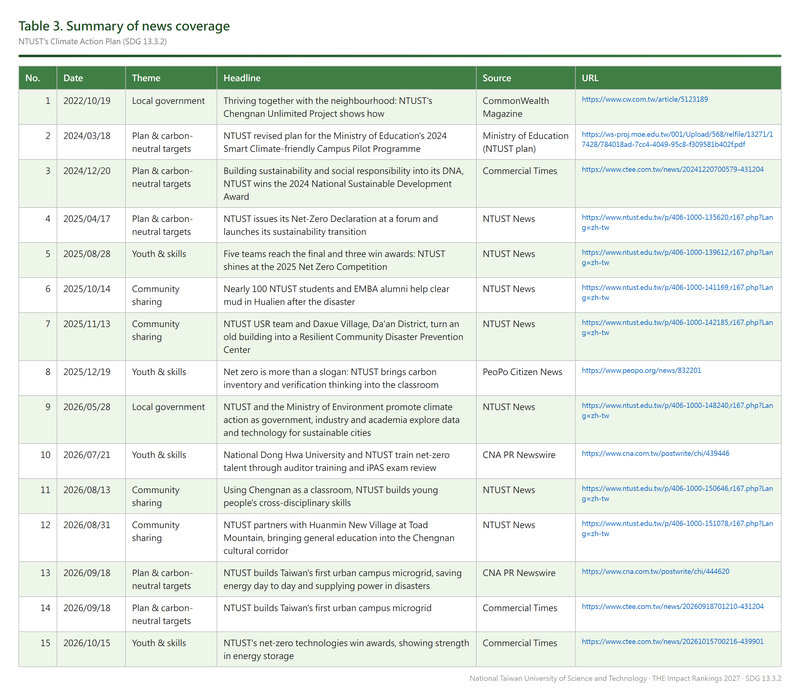
This indicator is supported by 15 news stories and public documents, listed by date:
Summary: NTUST's climate action plan aims for 50% carbon neutrality by 2030 and 100% by 2049. It is led by the Center for Sustainable Development and Institutional Research and delivered through ISO 14064-1 inventories verified by DNV, a Net-Zero Declaration and a campus microgrid. NTUST shares the plan and its results with the Ministry of Education, co-hosts youth climate action with the Ministry of Environment, and has supported Taipei City's disaster prevention programme since 2010. In the community, its USR team builds resilience with Daxue and Xuefu villages and uses the Chengnan area as a classroom for sustainability. Carbon inventory courses, verifier training and net-zero competitions give young people, government and industry the skills to act on climate.