跳到主要內容
:::
:::
計畫簡介

最新消息

成果電子報

減碳存摺海報
NTUST's Sustainable Commuting Initiative
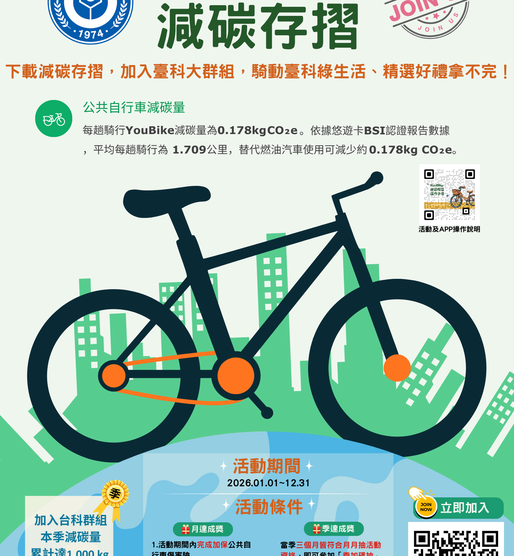
Does the university as a body promote sustainable commuting? Yes.National Taiwan University of Science and Technology (NTUST) promotes walking, cycling, public transport and zero-emission vehicles in three ways: a university-wide YouBike cycling incentive campaign in 2026, low-carbon transport facilities on and around campus, and an annual inventory of how staff commute and the emissions it causes. 1. Campaign: YouBike Carbon Reduction Passbook, NTUST group (2026)NTUST's Office of Environment and Safety has partnered with YouBike, Taipei's public bike-sharing system, to run the "YouBike Carbon Reduction Passbook" campaign for all students, faculty and staff. Participants record the carbon they save by riding YouBike in daily commuting and travel, and earn rewards as individuals and as a campus group.Campaign period: 1 January to 31 December 2026.How to join: take out public-bike accident insurance, download and log in to the Carbon Reduction Passbook app, and join the NTUST group.Qualifying riders: ride YouBike on at least 11 days a month and save at least 4 kg CO₂e a month.Individual rewards: a monthly draw of 2,000 winners across all YouBike service areas, and a quarterly bonus draw (with a smartphone as the top prize) for riders who qualify in all three months of a quarter.Group reward: when the NTUST group saves 1,000 kg CO₂e in a quarter, members receive extra free-ride vouchers, so every rider's trips count toward a shared campus goal.Impact: according to certified data cited by the campaign, each YouBike trip saves about 0.178 kg CO₂e on average.Campaign announcement: https://she.ntust.edu.tw/p/406-1068-151160,r1497.php?Lang=zh-tw2. Low-carbon transport facilitiesNTUST is on Keelung Road in Taipei, with a bus stop at the main gate and Gongguan MRT station about ten minutes away on foot. The university has worked with the Taipei City Government and private partners to add the following facilities.YouBike 2.0 public bikes: NTUST joined the Taipei Department of Transportation's YouBike 2.0 programme and secured an expanded service area. There are now 8 rental stations around campus, and docks have grown from 40 to 347.EV charging: 4 charging stations on campus with 12 charging points.Electric-scooter battery swapping: a Gogoro GoStation battery-swap station on campus, in service since July 2019 at NTUST's invitation.Bus shelters: NTUST provides setback land along the road free of charge, under the National Property Act, to the Taipei City Public Transportation Office, which has built 3 bus shelters there. Facilities announcement (Office of General Affairs): https://www.general.ntust.edu.tw/p/406-1054-130103,r9.php?Lang=zh-tw 3. Measuring how staff commuteNTUST surveys how its faculty and staff travel to campus and reports the resulting emissions as GHG Protocol Scope 3, Category 7 (employee commuting). In 2025, staff commuted 3.84 million passenger-km and produced 312.9 t CO₂e. Public transport and zero-emission vehicles already cover 54.5% of commuting distance. Petrol and hybrid cars and petrol scooters cover the remaining 45.5% but produce 60% of emissions, which is why the campaigns and facilities above focus on moving these trips to cycling, transit and electric vehicles.EvidenceYouBike Carbon Reduction Passbook campaign, Office of Environment and Safety: https://she.ntust.edu.tw/p/406-1068-151160,r1497.php?Lang=zh-twBuilding a green campus transport environment, Office of General Affairs: https://www.general.ntust.edu.tw/p/406-1054-130103,r9.php?Lang=zh-tw2025 (ROC 114) Scope 3 staff commuting emissions inventory, NTUST.
NTUST green transport network
NTUST Sustainable Commuting Targets
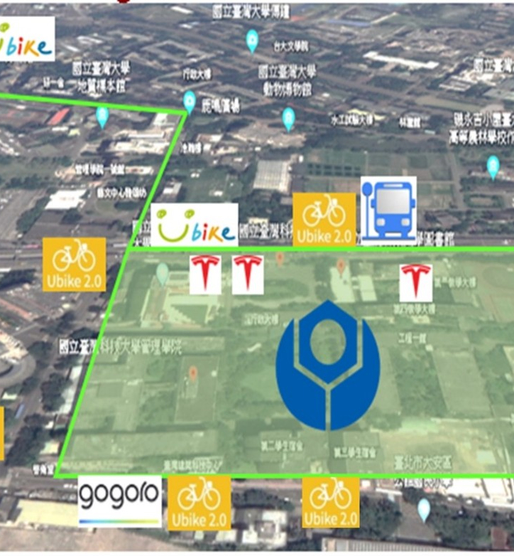
National Taiwan University of Science and Technology (NTUST) measures how its faculty and staff travel to campus each year and provides facilities that make public transport, cycling and zero-emission vehicles easy to use. This document presents the 2025 staff commuting inventory and the campus green transport measures.Inventory year: 2025 (ROC year 114) | Scope: faculty and staff commuting, GHG Scope 3 | Campus: No. 43, Sec. 4, Keelung Rd., Da'an Dist., Taipei1. How staff commute: 2025 inventoryMore than half of all staff commuting distance already runs on Taipei's public transport network, mainly the MRT and city buses. Public transport and zero-emission vehicles together account for 54.5% of commuting distance, while petrol and hybrid cars and petrol scooters account for 45.5%.Emissions are concentrated in private vehicles. Petrol and hybrid cars cover 36% of commuting distance but produce 49% of commuting emissions. All private cars and scooters together produce 190.5 t CO₂e (60.9%), and public transport produces 122.3 t CO₂e (39.1%). Per passenger-kilometre, the Taipei MRT emits about a third less than a petrol car, and walking or cycling emits nothing.Table 1. Staff commuting distance and emissions by mode, 20252. Campus measures for low-carbon commutingNTUST is located on Keelung Road in Taipei, with a bus stop at the main gate and Gongguan MRT station about ten minutes away on foot. Building on this location, the university has worked with the Taipei City Government and private partners on the following facilities.YouBike 2.0 public bikes: NTUST took part in the Taipei Department of Transportation's YouBike 2.0 programme and secured an expanded service area around campus. There are now 8 rental stations, and docks have grown from 40 to 347 for students and staff.EV charging: four electric-vehicle charging stations on campus provide a total of 12 charging points.Electric-scooter battery swapping: NTUST invited Gogoro to open a GoStation battery-swap station on campus, in service since July 2019, to support zero-emission scooter commuting.Bus shelters on university land: under the National Property Act, NTUST provides setback land along the road free of charge to the Taipei City Public Transportation Office, which has built 3 bus shelters there.Figure 1. NTUST green transport network: YouBike 2.0 stations, bus stops, MRT access, EV charging stations and the battery-swap station around campus3. How the inventory was calculatedEach faculty and staff member reported the Google Maps distance from home to campus. Round-trip distance (×2) was summed over the working year.Each person was counted under their main mode of transport.Emissions = annual commuting distance × mode emission factor (kg CO₂e per passenger-km), reported as GHG Protocol Scope 3, Category 7 (employee commuting).Walking and cycling are counted as zero-emission. Their distance was not recorded in the 2025 survey.Table 2. Emission factors and sourcesSourcesNational Taiwan University of Science and Technology, Office of General Affairs.2025 (ROC 114) Scope 3 staff commuting emissions inventory."Building a green campus transport environment", Office of General Affairs announcement: https://www.general.ntust.edu.tw/p/406-1054-130103,r9.php?Lang=zh-tw
Indigenous students opened the exhibition with a performance at the opening reception
NTUST's Record and preserve cultural heritage
National Taiwan University of Science and Technology (NTUST, Taiwan Tech) records, preserves and revitalises cultural heritage through its University Social Responsibility (USR) projects, the Center for General Education's South Side College, the Indigenous Students Resource Centre and student practice. Work covers three areas: local and regional heritage, such as the historic South Side (Chengnan) settlements around campus and Yuanli's rush-weaving craft; national heritage, including the cultures of Taiwan's Indigenous peoples and the Hakka; and the heritage of displaced communities, notably Huanmin New Village at Toad Mountain, a former military dependents' village settled by soldiers and families who came to Taiwan after 1949. Toad Mountain was designated a Taipei cultural landscape in 2016. Students and faculty document these places and traditions through fieldwork, bilingual guiding, courses, exhibitions and design, so that the public can learn and carry them on. Taiwan Tech's "Inabayan: Stories and Roots" performance celebrates Nanwang Culture through food and storytelling (21 Sep. 2026) For the 8th annual showcase of the Indigenous Youth Society, Indigenous students from different disciplines and ethnic groups spent more than six months visiting the Nanwang Puyuma community in Taitung to learn from its members. Held from 14 to 24 September 2026, the showcase featured a dining-table exhibition where community members and students shared food and life stories, cultural artefacts, a flower-garland workshop, the lecture "Puyuma, My Homeland: Exploring Memories Across Time and Space" by the former director of the National Museum of Prehistory, and a traditional Puyuma music and dance performance. It covered the Puyuma youth gathering house (palakuwan) and the ties between the community and the city. Inabayan means "hello" in the Nanwang variety of Puyuma.News linksEnglish: https://www.ntust.edu.tw/p/406-1000-152615,r1182.php?Lang=enTaiwan Tech partners with Huanmin New Village to bring general education into the community (31 Aug. 2026)The Center for General Education's South Side College signed a memorandum of understanding with the Taipei Culture Foundation's Huanmin New Village at Toad Mountain to support community-based learning, revitalise local spaces and exchange culture. Huanmin New Village brings together military-village heritage, settlement life, hillside ecology and contemporary art. Under the agreement, Taiwan Tech holds courses, workshops and exhibitions in the village. Existing courses already use the site: South Side Short Trips introduces how the settlements developed, Art and Public Environment has students propose art projects for Toad Mountain, Cultural Heritage and Sustainable Development (TCG136301, taught in English) studies reuse of Taiwan Tech's Japanese-era dormitories, and Painting South Side Culture records cultural sites in watercolour. The partners will link the village with Treasure Hill Artist Village, Gongguan Shuiyuan Market and Taipei Hakka Culture Park as a "South Side Learning Network".News linksEnglish: https://www.ntust.edu.tw/p/406-1000-151734,r1182.php?Lang=en中文(臺科大攜手蟾蜍山煥民新村 通識教育走進城南文化廊帶): https://www.ntust.edu.tw/p/406-1000-151078,r167.php?Lang=zh-twTaiwan Tech turns the south side into a living classroom to build cross-disciplinary skills (13 Aug. 2026)From 7 to 10 July 2026, the Center for General Education ran a four-day immersive summer school for 13 high-school students, supported by 15 Taiwan Tech undergraduate peer-learning partners and nearly all of the Center's full-time faculty. Participants did fieldwork, environmental observation and hands-on work in three South Side settlements: Treasure Hill Artist Village, Fanglan Mountain and Huanmin New Village, an ageing military dependents' village. They explored how art coexists with residential life, ethnic cultures and military-village heritage, and worked in teams on proposals for cultural preservation, local revitalisation and cultural sustainability.News linksEnglish: https://www.ntust.edu.tw/p/406-1000-151741,r1182.php?Lang=en中文(2026城人式:台科識視營知識與視野夏校): https://www.cna.com.tw/postwrite/chi/441512Taiwan Tech students create a new model for Yuanli's Rush Grass Heritage (6 Aug. 2026)Hsien-Tse Lai, a master's student in the Department of Design, returned to his hometown of Yuanli, Miaoli, and joined the Taiwan Rush Grass Association. Yuanli's rush weaving was once exported worldwide as hats and mats, but the craft declined as industry moved away and skilled weavers aged. Lai turned knowledge once passed on orally through apprenticeship into illustrated teaching materials and kits that people can use at home, backed by short intensive courses and trained seed teachers. He also helps restore rush fields, introduces visitors to the full cycle from planting and harvesting to weaving, and created rush-themed banquets and ceramic tableware. The average age of participants has fallen from the seventies to the forties. The project won a GOOD DESIGN AWARD 2025 BEST100 (Regional Planning, 100 chosen from 5,225 entries) and a GOOD FOCUS AWARD [New Business Design].News linksEnglish: https://www.ntust.edu.tw/p/406-1000-151749,r1182.php?Lang=en中文(從家鄉苑裡出發 臺科大學生打造藺草傳承新模式): https://www.ntust.edu.tw/p/406-1000-150464,r167.php?Lang=zh-twIndigenous village journey: Amis shaman ritual culture (29 Oct. 2025)The Indigenous Students Resource Centre invited Mahengheng Akang, a ritual priest of the Lidaw Amis community, to share first-hand the beliefs and rituals of the Amis shamans (Sikawasay), who lead prayers for blessing, healing and protection and act as a bridge between the community and ancestral spirits.News links中文(部落漫遊x阿美族巫師祭儀文化): https://indigenous-r.ntust.edu.tw/p/404-1108-143142.php?Lang=zh-twTaiwan Tech empowers Nepal's mountain communities with local revitalisation and disaster education (23 Sep. 2025)In the fourth year of its work in Nepal, the USR team continued restoring a century-old traditional house in Upper Pisang, Annapurna region, as the "Story Café", a cultural hub that shares local history and culture with travellers. The retaining wall in front of the house was completed, and the team installed new signposts and a guide map. Earlier, students learned traditional building materials, methods and customs from village elders and surveyed the house to prepare drawings and repair designs.News linksEnglish: https://www.ntust.edu.tw/p/16-1000-141506.php?Lang=enTaiwan Tech's "Hata: still on the road" brings innovation to Atayal indigenous villages (Sep. 2025)The Indigenous Students Resource Centre and the Indigenous Youth Society based their 2025 annual showcase on students' learning in Jinyue village, an Atayal community in Nan'ao, Yilan. Students turned their fieldwork on Atayal history and culture into four works, Breath, Shuttle, Intersection and Pulse, including traditional rattan weaving, a material used in daily village life. Hata means "to walk, to set out" in Atayal.News linksEnglish: https://www.secretariat.ntust.edu.tw/p/404-1063-140986.php?Lang=en中文(臺科大「hata還在路上」走進泰雅族部落): https://www.ntust.edu.tw/p/406-1000-140656,r167.php?Lang=zh-twBilingual heritage guide training at Toad Mountain settlement (3 Sep. 2025)The Department of Civil and Construction Engineering trained 20 Taiwan Tech students as bilingual (Chinese/English) guides at Huanmin New Village. Training covered guiding skills, a guide-robot app and a tour of the Toad Mountain settlement, so that students can tell the stories of the campus's neighbourhood to local and international visitors as part of the university's USR work.News links中文(114年臺科大雙語(中、英)導覽員培訓課程--蟾蜍山聚落): https://www.ct.ntust.edu.tw/ct/articles/view/15223Taiwan Tech Immersive Summer School integrates tech, humanities, and public issues to empower communities (5 Aug. 2025)The South Side College's Urban STREAM Immersive Summer School (1–5 July 2025) took high-school students on fieldwork to South Side settlements including Treasure Hill Artist Village and Huanmin New Village at Toad Mountain. Participants learned about military-village history and the old settlements of Taipei and proposed projects on local issues.News linksEnglish: https://www.ntust.edu.tw/p/406-1000-140046,r1182.php?Lang=en中文(當科技遇上人文,臺科大城南學院STREAM沉浸式夏校帶領學子進行「城人式」): https://www.cna.com.tw/postwrite/chi/408817Promoting Hakka Culture: Taiwan Tech General Education demonstrates the art of opera (Jun. 2025)With funding from the Hakka Affairs Council, the Center for General Education offers Exploring the Aesthetics of Hakka Opera Costume and Makeup (2 credits). Students study Hakka history and the development of Hakka opera, use Hakka floral fabric in costume design, and learn make-up, props and stage gestures. At the end-of-term showcase they performed the classic Hakka opera Tiao Jiu in the Hakka language, alongside two more plays, one mixing Hakka, Taiwanese and English. A Hakka opera performer and researcher assessed the performances.News linksEnglish: https://www.secretariat.ntust.edu.tw/p/404-1063-138171.php?Lang=en中文(演繹精彩客家文化 臺科大通識教育教學成果秀戲曲魅力): https://www.ntust.edu.tw/p/406-1000-137743,r167.php?Lang=zh-twRevitalising the space beside Historic Building No. 92 at Toad Mountain settlement (since 10 Feb. 2025)Since 10 February 2025, Taiwan Tech's Center for General Education has been the custodian of the open space and storeroom beside Historic Building No. 92 in the Toad Mountain settlement. The university revitalised this unused space as a base for real-time monitoring of the historic building, a venue for residents to meet and train in disaster evacuation, and a classroom for disaster-preparedness training.The revitalised space beside Historic Building No. 92 is used as a classroom for disaster-preparedness training .Taiwan Tech staff and community members inspect the space at Toad Mountain settlement.
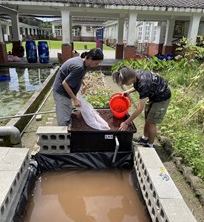
Taiwan Tech mobile engineers are currently cleaning the foam stone in the aquaponics system's planting beds.
NTUST's Off-campus water conservation support
Through the University Social Responsibility (USR) programme Engineers in Action (EIA), National Taiwan University of Science and Technology (NTUST, Taiwan Tech) students and faculty work with partner universities and local communities to support practical water conservation off campus. Their work includes repairing leaking ponds and irrigation channels, maintaining irrigation facilities, and introducing water reuse and recirculation systems in Indonesia, Vietnam, Japan and rural Taiwan.Taiwan Tech's Engineers in Action take engineering solutions to communities in Indonesia, Vietnam, and Japan (24 Sep. 2026)In summer 2026, one team worked with Widya Mandala Catholic University Surabaya in the Gubug Lazaris community, repairing leaks in ponds and irrigation channels to reduce water loss and maintaining greenhouse irrigation facilities to meet local agricultural water needs. In Pacet village, a team partnered with Institut Teknologi Sepuluh Nopember to help establish a solar-powered aquaponic greenhouse system. At Hoa-An 1 Primary School in Vietnam, the team worked with Can Tho University to install a reverse osmosis (RO) water filtration system and incorporated a hydroponic vegetable-growing rack into plans for water reuse, introducing pupils to the concept of water recycling. The team holds a DIY charcoal briquette workshop, where residents of Gubug Lazaris use agricultural waste to make charcoal briquettes. The activity promotes resource reuse while fostering interaction between Taiwanese students and local residents. The team paints and decorates the toilets at Hoa-An 1 Primary School, refreshing deteriorated walls and creating a cleaner, brighter environment.News linksEnglish: https://www.ntust.edu.tw/p/406-1000-152613,r1182.php?Lang=en中文(臺科大行動工程師前進印尼、越南、日本 以工程專業回應社區需求): https://www.ntust.edu.tw/p/406-1000-152058,r167.php?Lang=zh-twTaiwan Tech Mobile Engineers excel in Indonesia, Japan, and Vietnam, showcasing outstanding practical skills (8 Oct. 2025)In summer 2025, a team collaborated with Widya Mandala Catholic University in the Gubug Lazaris area, where students helped install water pipes and set up a programmed automatic watering system for an organic greenhouse that had been left unused during the pandemic.The team restored an organic greenhouse that had been left unused during the pandemic and installed an automatic watering system to assist with irrigation.News linksEnglish: https://www.secretariat.ntust.edu.tw/p/404-1063-142060.php?Lang=en中文(臺科大行動工程師深耕印尼、日本、越南 展現超群實踐力): https://www.ntust.edu.tw/p/406-1000-140988,r167.php?Lang=zh-twFrom Indonesia, Vietnam to Japan: Taiwan Tech Engineers in Action promotes sustainable development across rural areas (1 Oct. 2024)In Magetan regency, Indonesia, the team helped residents build greenhouses and install solar aquaponics systems, which combine fish farming with growing vegetables. In Kawakami Village, Nara Prefecture, Japan, the team and Osaka Institute of Technology held workshops teaching local elementary and middle school students to filter spring water with simple devices made from PET bottles, activated carbon, quartz sand and cotton.Students from Taiwan, Indonesia, and Japan collaborated to build a solar-powered aquaponics system, providing local farmers with a sustainable agriculture model. News linksEnglish: https://www.ntust.edu.tw/p/404-1000-131167.php?Lang=en中文(從印尼、越南到日本 臺科大行動工程師深入偏鄉推動永續發展): https://www.ntust.edu.tw/p/406-1000-129482,r167.php?Lang=zh-twTaiwan Tech mobile engineers bring passion and professionalism to Dong'ao for social welfare (22 Aug. 2024)A 50-member volunteer team spent 10 days in the Dongyue Atayal village and at Dong'ao Elementary School in Yilan County. The team built an aquaponics system that allows cultivation water to be continuously recycled, and taught pupils to make their own water filters from PET bottles and gravel.News linksEnglish: https://www.secretariat.ntust.edu.tw/p/404-1063-128503.php?Lang=en中文(臺科大行動工程師前往東澳:熱情與專業推動社會公益): https://www.ntust.edu.tw/p/406-1000-127921,r167.php?Lang=zh-tw