National Taiwan University of Science and Technology (NTUST) leverages its institutional capacity to provide local and regional governments with early warnings, monitoring data, and practical support for climate change-related disasters. Between 2025 and 2026, these efforts materialized through two main pillars: Technological Research and Disaster Prevention Applications, and Community Disaster Support and Personnel Training (USR).
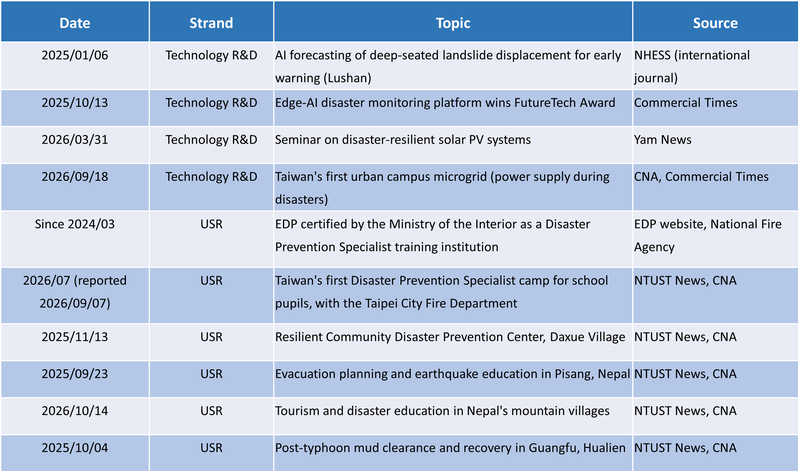
In technological research, NTUST's Engineering and Disaster Prevention Innovative Technology Research Center (EDP) focuses on disaster engineering protection, slope monitoring, and structural resilience under extreme climate conditions. The Department of Construction Engineering utilizes AI models to accurately predict deep-seated landslide displacements, providing local authorities with critical 1-day and 7-day slope disaster warnings. Meanwhile, the Department of Electronic and Computer Engineering developed an edge AI platform that enables drones and satellites to efficiently execute disaster monitoring. Furthermore, NTUST partnered with Taiwan Power Company to build Taiwan's first urban campus microgrid, which supplies emergency power during typhoon or earthquake outages and serves as a disaster resilience hub to maintain vital city operations.
Regarding community disaster prevention and social responsibility, the EDP Center operates as a disaster preparedness training institution approved by the Ministry of the Interior, actively cultivating grassroots resilience. NTUST's USR team collaborated with the Taipei City Fire Department to pioneer disaster training camps for elementary school students and partnered with Daxue Neighborhood in Taipei's Da’an District to establish a Resilient Community Disaster Prevention Center. These relief efforts have also expanded outward, contributing to post-disaster recovery in Hualien's Guangfu Township and promoting disaster prevention education in the mountain towns of Nepal, fully demonstrating NTUST's profound contributions to climate disaster warnings and local resilience building.
The EDP Center grew out of the Center for Ecology and Disaster Prevention Engineering, set up in August 2002 with Ministry of Education funding, and later merged with the Occupational Disaster Prevention Center for the Construction Industry, established in February 2007 under a Council of Labor Affairs commission. It brings together NTUST experts across departments and external partners to work on engineering protection against extreme-weather disasters, slope monitoring and structural resilience, covering urban geotechnics, earthquakes, soil liquefaction, debris flows and slope failures, and hazards in green-energy construction. Its priorities include disaster-prevention technology for buildings, earthquakes and slopes, and urban disaster-management planning (hazard-potential analysis, disaster maps, public education, review of the disaster-response system and information integration). Through an industry-academia platform, the center takes on engineering and disaster-prevention research commissioned by government and industry and transfers its results to government agencies and industry.
Related news:
l EDP Center home page: https://edp.ntust.edu.tw/index.php?Lang=zh-tw
l EDP Center history: https://edp.ntust.edu.tw/p/426-1112-1.php?Lang=zh-tw
l EDP Center mission: https://edp.ntust.edu.tw/p/426-1112-2.php?Lang=zh-tw
l EDP R&D goals and strategy: https://edp.ntust.edu.tw/p/426-1112-3.php?Lang=zh-tw
Prof. Jui-Sheng Chou's team in the Department of Civil and Construction Engineering, working with National Chi Nan University, studied the deep-seated landslide on the northern slope of Lushan, Ren'ai Township, Nantou County. Using eight years of surface displacement, groundwater-level and weather monitoring data, the team compared machine-learning, time-series deep-learning and convolutional neural network (CNN) models and tuned them with the AEIO optimisation algorithm. The best model, AEIO–MobileNet, predicted next-day displacement at monitoring station E-2 with a mean absolute percentage error (MAPE) of only 2.81%. One-day forecasts support rapid evacuation of residents and seven-day forecasts give time to move machinery and property, and both are linked to the displacement alert levels of the TGS-SLOPEM106 slope-monitoring standard. The results give local governments and slope-management agencies a basis for landslide warning and evacuation decisions. The study was published in Natural Hazards and Earth System Sciences.
Related news:
l NHESS paper: Predicting deep-seated landslide displacement on Taiwan's Lushan: https://nhess.copernicus.org/articles/25/119/2025/
l DOI: 10.5194/nhess-25-119-2025: https://doi.org/10.5194/nhess-25-119-2025
Prof. Pei-Chun Li's team in the Department of Electronic and Computer Engineering won a 2025 FutureTech Award from the National Science and Technology Council for an area-efficient, low-voltage sparse neural-network accelerator. Their edge-computing platform uses two-stage model compression to run cloud removal, farmland segmentation and disaster monitoring on the device itself, cutting bandwidth and storage needs. The team plans to package it as an AI module for drones and satellites, so that imagery can be interpreted and monitored in real time when disasters occur.
Related news:
l Commercial Times: Five NTUST technologies win FutureTech Awards (13 Oct 2025): https://www.ctee.com.tw/news/20251013700706-431204
Under Taiwan Power Company's University Energy Conservation and Power Resilience programme (NT$100 million from Taipower and over NT$50 million from NTUST), NTUST built Taiwan's first urban campus microgrid at its Huaxia campus. It comprises 229.68 kWp of solar PV, a 2 MWh battery storage system, a 400 kW backup diesel generator and an energy management system. When typhoons or earthquakes cut grid power, the system switches automatically to island mode and can supply the whole campus for about four hours, or about eight hours when power goes first to the emergency shelter. Six emergency sockets at the Juyu Building guard station let nearby residents charge their phones during outages, making the campus a disaster-resilience hub for the city.
Related news:
l CNA press platform: NTUST builds Taiwan's first urban campus microgrid (18 Sep 2026): https://www.cna.com.tw/postwrite/chi/444620
l Commercial Times (18 Sep 2026): https://www.ctee.com.tw/news/20260918701210-431204
l 1111 Job Bank News: https://www.1111.com.tw/news/jobns/167535
NTUST's Energy Management Systems Industry-Academia Technology Alliance and the Industrial Technology Research Institute (ITRI) co-hosted a seminar on disaster-resilient solar PV systems, with NTUST's Department of Electrical Engineering and Institute of Energy and Sustainability Technology as co-organisers. More than 200 experts from industry, academia and research attended. Using the Huaxia campus microgrid as a demonstration site, the seminar showed how grid-forming technology restores stable voltage and frequency within milliseconds after a grid failure, keeping communications, medical equipment and lighting running. This serves as a reference for local governments planning disaster shelters and resilient energy facilities.
Related news:
l Yam News: Inside NTUST's disaster-resilient microgrid 'energy fortress' (2 Apr 2026): https://n.yam.com/Article/20260402341566
- Community Disaster Support and Disaster Prevention Specialist Training (USR)
Since 11 March 2024, the EDP Center has been a Disaster Prevention Specialist training institution certified by the Ministry of the Interior. It trains groups from companies, public agencies and local communities (up to 40 people per regular class, or 70 for off-site classes in Greater Taipei). Structured teaching and hands-on drills build trainees' basic disaster-prevention knowledge, emergency-response skills and ability to support community disaster prevention. Trainees who complete the course and pass the test receive the Ministry's Disaster Prevention Specialist certificate, adding to the community disaster-response workforce that local governments rely on.
Related news:
l EDP Disaster Prevention Specialist training page: https://edp.ntust.edu.tw/p/426-1112-6.php?Lang=zh-tw
l National Fire Agency, Disaster Prevention Specialist Training website: https://rtp.nfa.gov.tw/dp/intro
l National Fire Agency, list of certified training institutions: https://rtp.nfa.gov.tw/dp/training-institution
NTUST's Urban Mountain Village USR project and the Taipei City Fire Department held a summer Disaster Prevention Specialist camp. It was the first in Taiwan to extend this training to pupils in the middle grades of primary school, as well as junior and senior high-school students. Nearly 100 students and teachers completed the intensive two-day course and all passed the test. Topics included the duties of a Disaster Prevention Specialist, Taiwan's disaster-management system, recent disaster patterns, opening and running community evacuation shelters, household preparedness and personal protection, and CPR, AED and Heimlich training by fire-department instructors. A pre-test found that about one in five trainees held mistaken beliefs about disaster safety, and post-tests showed clear gains across all age groups.
Related news:
l NTUST News: Taiwan's first Disaster Prevention Specialist training for young students, with the Taipei City Fire Department (7 Sep 2026): https://www.ntust.edu.tw/p/406-1000-151392,r167.php?Lang=zh-tw
l CNA press platform: https://www.cna.com.tw/postwrite/Chi/443471
l PChome News: https://news.pchome.com.tw/living/cna/20260907/index-17887477324425318009.html
l Yam News: https://n.yam.com/Article/20260907673412
Since 2024, NTUST's USR team (students and staff from Civil and Construction Engineering and Architecture) has worked with Daxue Village in Da'an District, Taipei, to turn a vacant old building beside No. 25, Lane 283, Section 3, Roosevelt Road into a Resilient Community Disaster Prevention Center, with a Disaster Education Center and a Disaster Resource Room. The team repaired structural cracks, added roof waterproofing and insulation, renovated the outer walls, improved drainage and mounted an evacuation-route map for the village on the outer wall. Inside, supplies are grouped by alert, evacuation and rescue functions, with colour-coded shelves and stock and expiry tracking, strengthening the community's readiness for heavy rain, earthquakes and other disasters.
Related news:
l NTUST News: Taiwan Tech USR Team transforms old building into Resilient Community Disaster Prevention Center: https://www.ntust.edu.tw/p/16-1000-142930.php?Lang=en
l NTUST News (Chinese): https://www.ntust.edu.tw/p/406-1000-142185,r167.php?Lang=zh-tw
l CNA press platform: https://www.cna.com.tw/Postwrite/Chi/418450
l Taiwan Shin Sheng Daily News: https://www.tssdnews.com.tw/?FID=46&CID=839093
l PChome News: https://news.pchome.com.tw/living/cna/20251113/index-17630021334777718009.html
Since 2022, the Civil and Construction Engineering USR team has worked in Upper Pisang in Nepal's Annapurna region. In 2025 it built a new retaining wall in front of a century-old house, installed new signs and guide maps, planned evacuation routes and assembly points, and produced a disaster-preparedness brochure giving residents guidance on responding to earthquakes and other hazards. The team also ran earthquake-preparedness lessons at an elementary school in Manang and exchanged disaster-reduction research with Kathmandu University's Department of Civil Engineering, taking Taiwan's community disaster-prevention experience to mountain settlements abroad.
Related news:
l NTUST News: Taiwan Tech empowers Nepal's mountain communities with local revitalization and disaster education: https://www.ntust.edu.tw/p/16-1000-141506.php?Lang=en
l NTUST News (Chinese): https://www.ntust.edu.tw/p/406-1000-140536,r167.php?Lang=zh-tw
l CNA press platform: https://www.cna.com.tw/postwrite/Chi/413100
In 2026 the USR team took 11 students back to Upper Pisang, where the restored century-old Pisang Story House officially opened. At Manang Primary School the team used interactive games and drills to teach children self-protection and evacuation. GO-IN Engineering provided the power system for the Story House, construction-industry partners and the department's alumni association donated funds, and the team continued exchanges on engineering technology and disaster-reduction research with Kathmandu University.
Related news:
l NTUST News (Chinese): NTUST continues work in Nepal's mountain villages, promoting tourism and disaster education with industry partners: https://www.ntust.edu.tw/p/406-1000-152618,r167.php?Lang=zh-tw
l CNA press platform: https://www.cna.com.tw/postwrite/chi/446917
l PChome News: https://news.pchome.com.tw/living/cna/20261014/index-17919436030606718009.html
After typhoon rains caused severe flooding in Guangfu Township, Hualien, in 2025, the NTUST Student Union and the EDBA/EMBA Alumni Association sent 60 students and 34 alumni to Guangfu during the Mid-Autumn holiday. In line with local recovery needs, they helped residents clear mud and clean their homes. Places filled within 24 hours of the call for volunteers, and the NTUST Alumni Association and campus partners provided funding and supplies.
Related news:
l NTUST News (Chinese): Nearly 100 NTUST students and EMBA alumni clear mud in Hualien (14 Oct 2025): https://www.ntust.edu.tw/p/406-1000-141169,r167.php?Lang=zh-tw
l CNA press platform: https://www.cna.com.tw/postwrite/Chi/415132
Note: This document draws on the EDP Center website, NTUST news releases, an international journal article and media coverage (retrieved 4 November 2026).