National Taiwan University of Science and Technology (NTUST, Taiwan Tech) has established a university-wide commitment to meaningful education for sustainable development through its General Education framework and SDG curriculum mapping mechanism. These initiatives integrate SDG-related knowledge, values and competencies across disciplines, making sustainability education relevant and accessible to students throughout the University.
This document presents the narrative and evidence under three themes: (1) university-wide integration of the SDGs into the General Education curriculum; (2) university-wide SDG curriculum mapping across all colleges; and (3) SDG-related courses across all colleges. Course data cover all 4,208 NTUST-offered courses in Semester 1 (1141) and Semester 2 (1142) of Academic Year 2025–26, as published in the NTUST Course Query System.
General Education is the common foundation of sustainability education at NTUST. Every undergraduate, regardless of major, completes the Common Education curriculum, which systematically exposes students to social, institutional, environmental, health and global issues. The compulsory Social Practice domain then turns this knowledge into action.
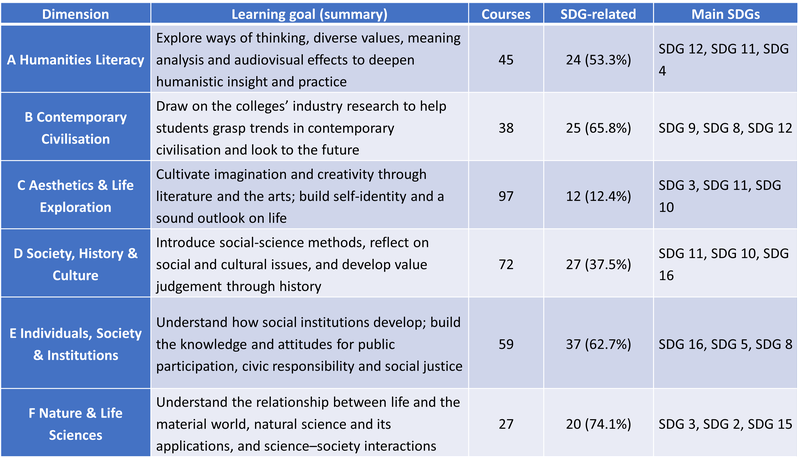
NTUST’s Common Education comprises five domains: Social Practice, Chinese, English, General Education and Physical Education. Since Academic Year 2017–18, General Education courses have been organised into six dimensions, and students must take courses across dimensions so that every student, whatever their discipline, gains literacy in the humanities, society, institutions and natural sciences. The 1141–1142 course mapping shows how each dimension connects to the SDGs:
Social Practice is a compulsory Common Education domain coordinated by the Center for General Education. Under the NTUST Guidelines for Social Practice Courses (last amended at the 224th Academic Affairs Meeting, 29 May 2026), courses centre on civic awareness and social responsibility and encourage students to apply their professional knowledge to real social issues. Courses follow five design principles: professional social intervention, civic awareness, university social responsibility, real-world problem solving, and diverse cross-boundary innovation. Each course combines knowledge workshops, hands-on participation (at least 36 hours) and reflection, and keeps records of outcomes and learning. Through the Social Practice Course System, students submit individual or group proposals and carry them out with NGOs, communities and institutions.
The Center for General Education offers the Interdisciplinary Micro-Program in Sustainable Development and Social Responsibility (approved at the 220th Academic Affairs Meeting, 27 May 2025). It is open to all undergraduates with no enrolment cap and requires at least 9 credits. Courses are co-taught by the University’s USR project teams, who take students to field sites for hands-on engagement, building their capacity for sustainable action and their sense of social responsibility. Completing the program also exempts students from the Social Practice requirement.
- Cornerstone (at least one): Sustainable Development and Society I & II; EU, Globalisation – Cross-boundary Local Thinking on the SDGs; Cultural Heritage and Sustainable Development; Western Classical Architecture and Sustainable Development
- Keystone – required: Introduction to USR and Sustainable Development
- Keystone – USR project courses (at least one): Engineering Design (Civil and Construction Engineering); Practice of Instructional Media (Teacher Education Center); Social Practice Advocacy: Self-Media Production (Center for General Education); International Volunteer Learning Practice / Overseas Practice (Engineering Undergraduate Program); Food, Agriculture and Environment Exploration (Management Undergraduate Program)
In 1141–1142, the Center for General Education offered 317 courses, 145 of which (45.7%) were SDG-related, covering 14 of the 17 SDGs, led by SDG 16, SDG 3, SDG 11, SDG 4. Examples include Sustainable Development and Society, Gender and Law, Contemporary International Relations and Politics, and Environmental and Ecological Caring. Since Academic Year 2021–22 the Language Center has published a Course Integrated SDGs Issues Comparison List every semester, encouraging instructors to build SDG issues into English teaching materials, and it runs an NTUST SDGs English Presentation Contest. Common English courses such as Integrated Academic English, Global Communication in English, and Advanced Communication in English: Global Sustainable Development Issues are designed with each unit linked to specific SDGs.
Evidence links:
▸ Center for General Education | Six General Education dimensions: learning goals and courses (Chinese) https://cla.ntust.edu.tw/p/412-1076-8608.php?Lang=zh-tw
▸ Center for General Education | General Education credit requirements and the five Common Education domains (Chinese) https://cla.ntust.edu.tw/p/412-1076-8607.php?Lang=zh-tw
▸ Center for General Education | NTUST Guidelines for Social Practice Courses (Chinese) https://cla.ntust.edu.tw/p/412-1076-8714.php?Lang=zh-tw
▸ Center for General Education | Social Practice Course System https://sp.cge.ntust.edu.tw/
▸ Office of Academic Affairs | Regulations of the Interdisciplinary Micro-Program in Sustainable Development and Social Responsibility (Chinese) https://academic.ntust.edu.tw/var/file/48/1048/img/2860/600860929.pdf
▸ Language Center | Course Integrated SDGs Issues Comparison List https://lc.ntust.edu.tw/p/412-1070-10384.php?Lang=en
NTUST’s New Course Proposal Form includes a Course Attribute Checklist. Item 4, “Alignment with the Sustainable Development Goals (SDGs)”, requires the offering unit to tick each SDG the course addresses (S01–S17, multiple selections allowed; S99 if none). Every new course must be approved by the department, college and university curriculum committees and by the Academic Affairs Meeting. SDG alignment is therefore built into the course approval process of every college and department rather than left to individual instructors.
To understand how SDG courses are distributed across colleges, NTUST mapped the full course list and syllabi (course objectives, content and core competencies) in the Course Query System against the 17 SDGs. Courses offered by National Taiwan University and National Taiwan Normal University through the University System of Taiwan were excluded. A course is mapped to an SDG when its title contains an SDG keyword, its syllabus contains at least three distinct keywords for that SDG, or its syllabus explicitly names the SDG. A course may map to several SDGs.
- Scope: 2,118 courses in 1141 and 2,090 in 1142, or 4,208 NTUST-offered course sections in total.
- SDG-related courses: 1,817 (43.2%): 906 in 1141 and 911 in 1142, representing 981 distinct course titles.
- Coverage: All 17 SDGs are addressed. All seven colleges, the Center for General Education and the other teaching units offer SDG-related courses.
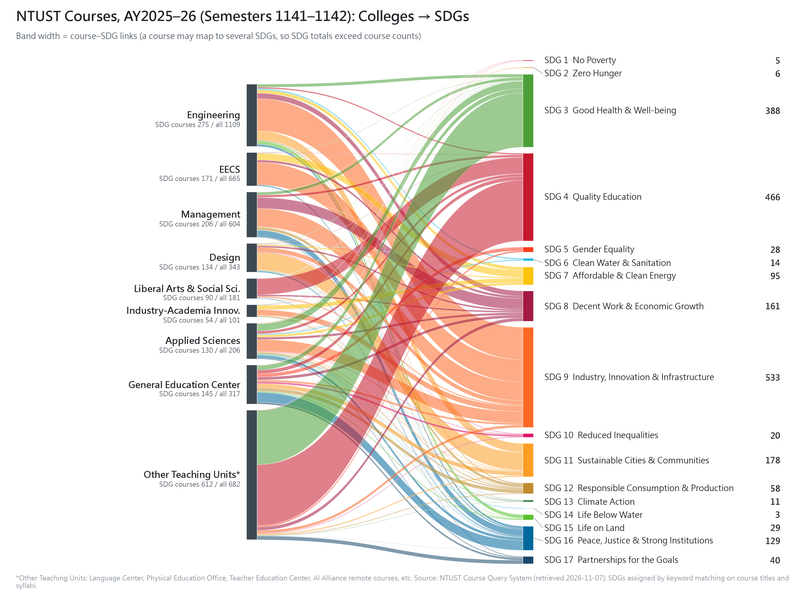
Figure 1. NTUST colleges and the SDGs, 1141–1142
The Sankey diagram shows that each college has its own SDG focus and that these strengths complement one another. Engineering and EECS concentrate on SDG 9 (Industry, Innovation and Infrastructure) and SDG 7 (Affordable and Clean Energy); Design on SDG 11 (Sustainable Cities and Communities); Management spans SDGs 8, 9 and 16; Liberal Arts and Social Sciences centres on SDG 4 (Quality Education); and Industry-Academia Innovation focuses on SDGs 7 and 9. The Center for General Education extends the curriculum to social and institutional goals such as SDGs 5, 10, 12 and 16, which professional courses address less often.
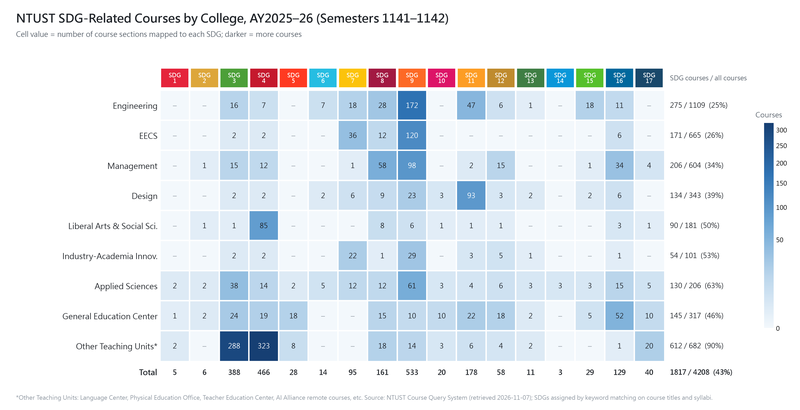
Figure 2. Number of SDG-related courses by college and SDG, 1141–1142
The spectrum chart shades each college’s course count for SDGs 1–17. The College of Applied Sciences covers all 17 SDGs, the Center for General Education 14, the College of Design 12, and the College of Engineering and the School of Management 11 each. Looking across SDGs, SDG 7 courses are offered by EECS (36), Industry-Academia Innovation (22) and Engineering (18); SDG 16 mainly by the Center for General Education (52) and Management (34); and SDGs 5 and 10 mainly by the Center for General Education. SDG education at NTUST is thus delivered jointly by the professional colleges and General Education, so students in every college can take sustainability-related courses.
Evidence links:
▸ Office of Academic Affairs | NTUST New Course Proposal Form, including the Course Attribute Checklist with SDG alignment (Chinese) https://academic.ntust.edu.tw/var/file/48/1048/img/2561/389468995.odt
▸ NTUST Course Query System (course lists and syllabi) https://querycourse.ntust.edu.tw/querycourse/
In 1141–1142, NTUST’s seven colleges, the Center for General Education and other teaching units offered 1,817 SDG-related courses. The table below shows each college’s SDG course count and main SDGs.
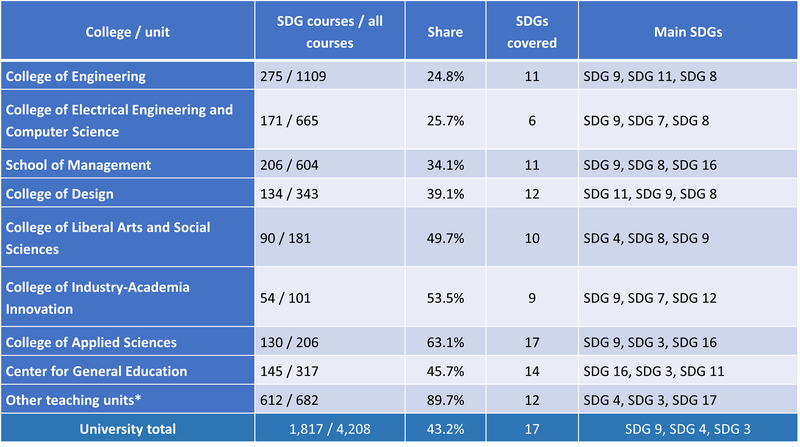
Representative SDG-related courses in each college (official English titles from the Course Query System):
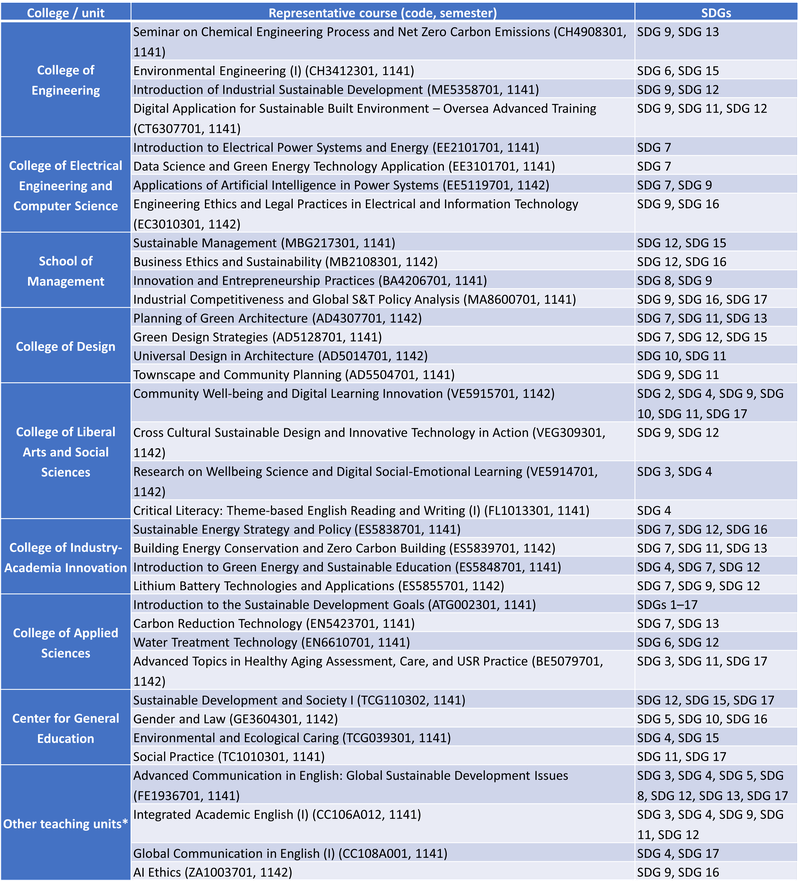
*Other teaching units include the Language Center, Physical Education Office, Teacher Education Center and AI Alliance remote courses. Physical education courses map to SDG 3 and language courses to SDG 4, which explains the high SDG share.
Evidence links:
▸ NTUST Course Query System (syllabi searchable by course code) https://querycourse.ntust.edu.tw/querycourse/
▸ Secretariat News | Taiwan Tech wins the 113th National Sustainable Development Award (about 1,500 SDG- and USR-related courses offered each year) https://www.secretariat.ntust.edu.tw/p/16-1063-132572.php?Lang=en