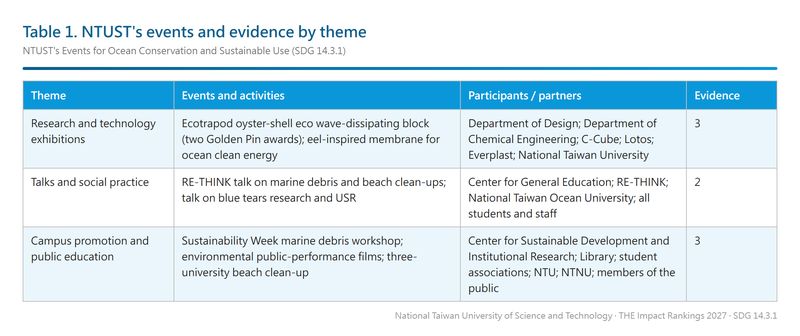
Guided by SDG 14 (Life Below Water), NTUST uses cross-disciplinary research, design exhibitions, social practice talks and its campus Sustainability Week to help students, staff and neighbours understand and care for the ocean. This report draws on 8 news stories and university notices from 2020 to 2026, grouped into three themes:
- Research and technology exhibitions: Design students 3D-printed Ecotrapod, an eco-friendly wave-dissipating block made from waste oyster shells and recycled slurry, which won Best Design of the Year and the Circular Design Special Award at the Golden Pin Young Talent awards. Chemical engineers, with National Taiwan University, developed an eel-inspired membrane that improves ocean salinity-gradient (blue) energy.
- Talks and social practice: The Center for General Education invited RE-THINK to share its beach clean-up and marine debris campaigns, and Distinguished Professor Chiang Kuo-ping of National Taiwan Ocean University to explain how research on Matsu's blue tears supports local communities and ocean conservation.
- Campus promotion and public education: Sustainability Week ran the workshop Drifting Plastic Dreams: From Marine Debris to a Sustainable New Life. The Library offers public-performance environmental films such as Minamata. Students from NTUST, NTU and NTNU hold a joint beach clean-up that is open to the public.
The table below summarises NTUST's events under each theme and the supporting evidence:
Ecotrapod, the graduation project of Design students Chiang Chia-ying and Lin Shao-yu, won two prizes at the 2024 Golden Pin Young Talent awards: Best Design of the Year in the industry-academia category and the Circular Design Special Award (CNA PR Newswire, 17 June 2024). Developed with C-Cube, Lotos and Everplast, the block uses C-Slurry, a recycled slurry, and waste oyster shells to replace or reduce cement.
Its porous, spiral bionic form lets algae attach and gives fish, shrimp and shellfish a place to live, and lets visitors watch marine life in the intertidal zone. The team says the material has about 50% less carbon footprint than cement blocks, 3D printing saves more than 40% of material, and the blocks can be crushed and reused at end of life. Shown through a national design award, the work demonstrates to designers and the public a way to protect coasts while creating marine habitat.
Professor Yeh Li-Hsien of Chemical Engineering and a National Taiwan University team, funded by the Ministry of Science and Technology's Shackleton Project, developed a membrane inspired by electric eel cells. It turns the energy released when seawater and fresh water mix into electricity, setting records for osmotic power density and anion selectivity. The work was published in Science Advances and may also help desalination (April 2021). The research develops blue energy that does not deplete ocean resources and was widely reported in the media.
📎 News evidence for this section
- CNA PR Newswire (2024/06/17) Using recycled materials and oyster shells, NTUST students' eco-friendly wave-dissipating blocks win two Golden Pin Young Talent awards: https://www.cna.com.tw/postwrite/chi/374039
- NTUST News (2024/06/17) NTUST students' oyster-shell wave-dissipating blocks win two Golden Pin awards (media coverage): https://www.ntust.edu.tw/p/406-1000-126189,r167.php?Lang=zh-tw
- NTUST News (2021/04/22) NTUST and NTU develop an eel-inspired membrane that greatly improves ocean clean-energy efficiency, published in a top journal: https://www.ntust.edu.tw/p/16-1000-90043.php?Lang=zh-tw
On 4 December 2020, the Center for General Education held a social practice talk by Liu Hsin-wei, an NTUST polymer engineering graduate and project manager at RE-THINK. She noted that nowhere in Taiwan is more than about 50 km from the sea. Since 2013, RE-THINK has run island-wide beach clean-ups with more than 30,000 volunteers, and turned the rubbish collected into a 'menu' to make people think about their part in ocean pollution. The talk proposed five daily actions: use fewer single-use utensils, avoid bottled water, recycle properly, think before buying and join beach clean-ups.
On 24 March 2022, with support from the Ministry of Education's Higher Education Sprout Project, the Center for General Education invited Distinguished Professor Chiang Kuo-ping of National Taiwan Ocean University to give the talk Decoding the Mermaid's Tears. He explained that Matsu's blue tears come from bioluminescent dinoflagellates, and that his team cultivates them so visitors can see the glow all year. This supports Matsu's tourism and local businesses and shows how ocean science can serve communities and the sustainable use of marine resources.
📎 News evidence for this section
- NTUST Center for General Education (2020/12/04) Talk: A rubbish lesson every islander needs – solving social problems through enterprise (speaker: Liu Hsin-wei, RE-THINK): https://cla.ntust.edu.tw/p/406-1076-84824,r1747.php?Lang=zh-tw
- NTUST Center for General Education (2022/03/24) Talk: Decoding the mermaid's tears – blue tears research and university social responsibility (speaker: Distinguished Professor Chiang Kuo-ping, NTOU): https://cla.ntust.edu.tw/p/405-1076-97935,c9406.php?Lang=zh-tw
The Center for Sustainable Development and Institutional Research holds NTUST Sustainability Week every year. The 2025 week (17–21 November) was co-organised with the Environmental Protection and Safety Office and USR project teams. On 19 November, teacher Lin Chia-wei led the workshop Drifting Plastic Dreams: From Marine Debris to a Sustainable New Life at the College of Management E-house, where students and staff learned about ocean plastic waste and turned marine debris into upcycled works. During the same week, NTUST ran sustainable living and disaster prevention classes at nearby Fanghe Experimental High School and Gongguan Elementary School.
The Library provides public-performance films for screenings and teaching on campus. Its list includes Minamata, about mercury pollution in Japan's Minamata Bay, and other environmental films that help students and staff understand how water pollution harms marine life and human health.
On 14 November 2026, NTUST students will join students from National Taiwan University and National Taiwan Normal University in the beach clean-up Three Universities, One Coast, a joint event initiated by the NTNU Student Association and announced on 21 October 2026. The event is tagged SDG 11 and SDG 14 and is open to friends and family from outside the universities, taking direct action to reduce coastal litter.
📎 News evidence for this section
- NTUST Center for Sustainable Development and Institutional Research (2025/11/12) NTUST Sustainability Week 2025 (including the workshop Drifting Plastic Dreams: From Marine Debris to a Sustainable New Life): https://po.ntust.edu.tw/p/406-1059-141845,r763.php?Lang=zh-tw
- NTUST Library (2021/12 onwards) NTUST Library public-performance film list (includes Minamata and other environmental films): https://libself.lib.ntust.edu.tw/public-movie/zh
- NTNU Sustainability News (2026/10/21) Three Universities, One Coast: NTU, NTUST and NTNU students hold a joint beach clean-up on 14 November: https://www.sdgs.ntnu.edu.tw/%E3%80%90%E4%B8%89%E6%A0%A1%E8%BF%8E%E9%A2%A8-%E9%87%8E%E6%B5%B7%E5%90%8C%E8%A1%8C%E3%80%91%E5%B8%AB%E5%A4%A7%E5%AD%B8%E7%94%9F%E6%9C%83%E9%82%80%E8%AB%8B11-14%E4%B8%80%E8%B5%B7%E6%B7%A8%E7%81%98/
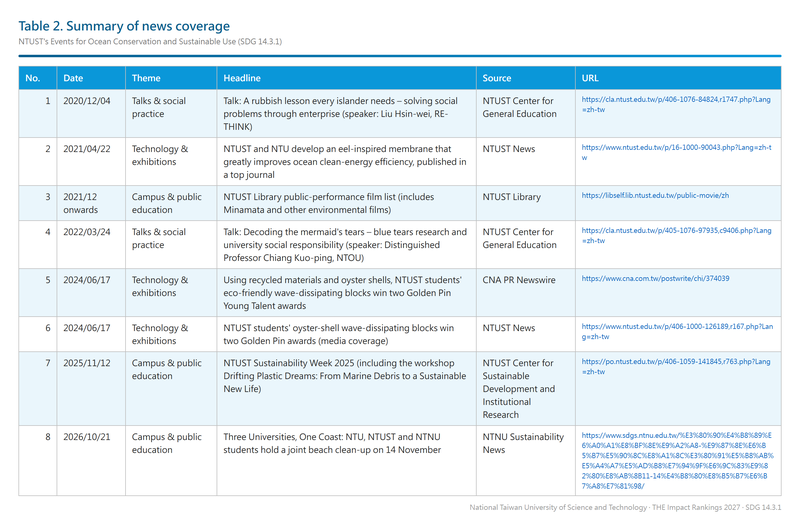
This indicator is supported by 8 news stories and university notices, listed by date:
Summary: NTUST promotes ocean conservation and sustainable use through cross-disciplinary research, design exhibitions, social practice talks and its campus Sustainability Week. The Design Department's oyster-shell habitat blocks won national design awards, and the Chemical Engineering Department's eel-inspired membrane advances ocean clean energy. The Center for General Education brings marine debris campaigners and ocean scientists to campus. Sustainability Week's marine debris workshop, the Library's environmental films and the three-university beach clean-up help students, staff and the community move from learning about the ocean to protecting it.