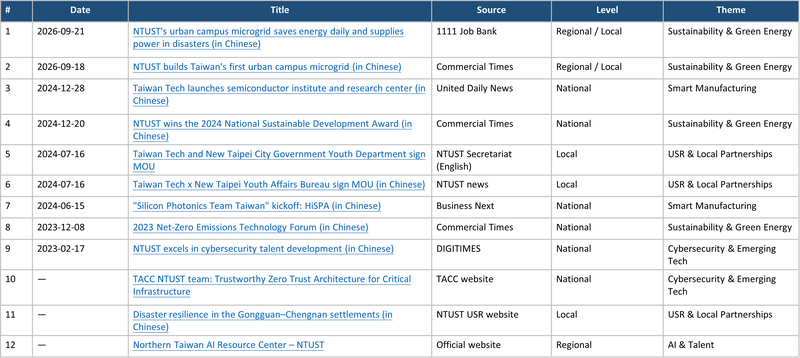
National Taiwan University of Science and Technology (NTUST, Taiwan Tech) has long served as a bridge between industry and government decision-making. Its faculty experts and research teams provide professional advice, commissioned research and real-world testbeds to local, regional and national governments in engineering, information technology, smart manufacturing, green energy and sustainable development.
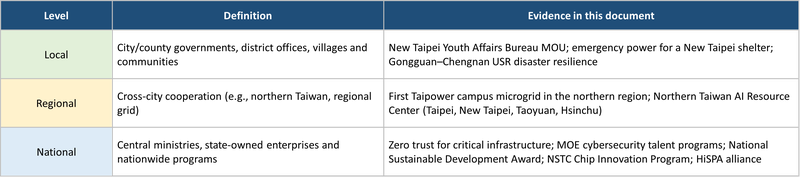
- Cybersecurity and Emerging Technologies

NTUST runs a university-level Information Security Research and Teaching Center that brings together the Departments of Information Management and Computer Science and Information Engineering; it was among the first such centers at a Taiwanese university. Its director, Prof. Shi-Cho Cha (查士朝), leads a cross-university team in the Taiwan Information Security Center (TACC) on "Trustworthy Zero Trust Architecture for Critical Infrastructure", turning research into standards and tools that government and critical infrastructure operators can adopt.
- Zero-trust policy: supports the government in promoting zero-trust architecture and gives strategy recommendations to organizations adopting cybersecurity measures (national level).
- Financial regulation: helps financial institutions adopt zero trust and meet regulators' requirements for dynamic access control.
- Healthcare security: helps hospitals keep information secure while moving to hybrid cloud.
- Testing standards: builds a certification test platform for zero-trust products (also able to evaluate AI-based security products) to help competent authorities set inspection standards.
- Smart transport and unmanned vehicles: uses NTUST's ISO 17025-aligned laboratory to draft security test standards for smart-vehicle components, an evidence base for regulating smart transport and autonomous vehicles.
- National cyber talent: the Department of Computer Science and Information Engineering runs two sub-projects of the MOE Advanced Cybersecurity Practical Talent Program and co-organizes the MOE AIS3 summer school with the Department of Information Management.
News reports:
- [2023-02-17] DIGITIMES | NTUST excels in cybersecurity talent development and keeps linking Taiwan's security industry (in Chinese)
Websites:

NTUST uses its campus as a Living Lab: results from its microgrid, energy storage and energy management systems become concrete recommendations on urban energy resilience, low-carbon circularity and net-zero pathways. The Sustainable Electrochemical Energy Development (SEED) Center and Prof. Tsai-Chi Kuo (郭財吉) of the Department of Industrial Management contribute expertise on electrochemical storage, circular economy and sustainability governance.
- Taiwan's first urban campus microgrid (regional/local): NTUST was the first northern-region school in Taipower's University Energy Saving and Power Resilience project. The Huaxia Campus microgrid, completed in early 2026, combines 229.68 kWp of solar PV, 2 MWh of storage, two 100 kW DC fast chargers and a 400 kW diesel backup generator, funded by a NT$100 million Taipower subsidy and over NT$50 million from NTUST.
- Urban energy resilience: in a grid outage it switches to island mode, powering the whole campus for 4 hours, or 8 hours for priority loads. One campus building is also a New Taipei City emergency shelter where residents can charge devices, a model for disaster-ready urban power.
- Net-zero pathway: estimated savings of about NT$540,000 a year, rising to about NT$1.26 million with green-certificate sales. NTUST targets 50% carbon neutrality by 2030 and 100% by 2049.
- National recognition: NTUST received the Executive Yuan's 2024 National Sustainable Development Award (education category), presented by the Minister of Environment, for smart energy management, greenhouse gas inventory and sustainability education.
- SEED Center: battery, thin-film and hydrogen research teams carry out an NSTC academic summit research program and host the 2026 Lithium Battery & Electrochemical Energy Storage Industry–Academia Summit.
- Prof. Tsai-Chi Kuo: researches sustainable development, circular economy and smart manufacturing. As Secretary-General of the Taiwan Institute for Sustainable Energy, he spoke on university sustainability in the net-zero transition at the 2023 Net-Zero Emissions Technology Forum, held under the guidance of the MOE and NSTC.
News reports:
- [2026-09-18] Commercial Times | NTUST builds Taiwan's first urban campus microgrid (in Chinese)
- [2026-09-21] 1111 Job Bank campus news | NTUST's urban campus microgrid saves energy daily and supplies power in disasters (in Chinese)
- [2024-12-20] Commercial Times | NTUST wins the 2024 National Sustainable Development Award (in Chinese)
- [2023-12-08] Commercial Times | Supporting the carbon economy: 2023 Net-Zero Emissions Technology Forum (in Chinese)
Websites:
SEED: 2026 Lithium Battery & Electrochemical Energy Storage Industry–Academia Summit

NTUST combines mechanical engineering, automation, AI and semiconductor technology through its Intelligent Manufacturing Innovation Center (IMIC) and its Heterogeneous Integration Silicon Photonic IC Center (HiSiPIC). Both inform smart factories, industrial transformation and the strategic chip supply chain, and open state-funded equipment to users across Taiwan.
- IMIC: led by Chair Professor Shun-Feng Su (蘇順豐), it focuses on data centers, 5G networks, smart manufacturing (robotics, digital twins, AI, cyber-physical systems), sustainable energy and information security, and shares a site with the Industry 4.0 Implementation Center, a demonstration and training ground for SME upgrading.
- HiSPA alliance: on 9 April 2024 HiSiPIC and the Photonics Industry & Technology Development Association (PIDA) launched the International Silicon Photonics Heterogeneous Integration Alliance (HiSPA), linking industry, government, academia and research to build a silicon-photonics "Team Taiwan".
- National chip policy: NTUST set up the Graduate Institute of Advanced Semiconductor Technology and a Semiconductor Innovation and Application Research Center. Silicon-photonics measurement and packaging equipment funded by the NSTC Chip Innovation Program is open to researchers and companies nationwide through the TSRI sharing platform.
News reports:
- [2024-12-28] United Daily News | Taiwan Tech launches semiconductor institute and research center for silicon photonics and advanced packaging (in Chinese)
- [2024-06-15] Business Next | "Silicon Photonics Team Taiwan" kickoff: the HiSPA alliance (in Chinese)
Websites:
- Intelligent Manufacturing Innovation Center (IMIC)
- Heterogeneous Integration Silicon Photonic IC Center (HiSiPIC)
- HiSiPIC news archive

NTUST hosts the Northern Taiwan AI Resource Center, linking 15 technical and vocational colleges in Taipei, New Taipei, Taoyuan and Hsinchu. Course design follows the MOE Future Talent AI Competency framework, so schools with fewer resources can share AI tools, instructors and teaching materials.
- Regional AI capacity building: runs on three principles (shared resources, open cross-school enrolment and co-created, openly licensed materials). Courses map to the MOE's four competencies: learning with AI, using AI responsibly, solving problems with AI, and abilities AI cannot replace.
- Scale: 408 cross-school AI courses at 15 schools in the first semester of academic year 2026–27 (ROC year 115), plus 6 capacity-building courses run by the center this term.
Websites:

Through University Social Responsibility (USR) projects and MOUs with local governments, NTUST brings engineering and management expertise to communities and young entrepreneurs, helping local governments solve local problems.
- New Taipei Youth Affairs Bureau MOU (16 July 2024): NTUST Dean of Industry–Academia Collaboration Cheng-Fa Yang (楊成發) and Bureau Director Chao-Mei Chiu (邱兆梅) signed an entrepreneurship resource-sharing MOU covering venues, equipment and expert talent. NTUST's incubation center has been named an Outstanding Incubator by the MOEA SME and Startup Administration ten times. The Bureau helps match startups to the B2G market, and NTUST-incubated Andgreen joined the city's startup procurement list.
- Gongguan–Chengnan disaster-resilience USR: led by Prof. Chien-Kuo Chiu (邱建國), the team works with the chiefs and residents of Fushui, Shuiyuan and Xuefu villages on town meetings, disaster-preparedness courses and evacuation-map workshops, is building an AI disaster-information chatbot, and is planning smart slope monitoring at Treasure Hill.
- Advice to a central agency on heritage repair: the team assessed the "Anzhai No. 3" building in Xueren Village for the Ministry of National Defense and recommended emergency repairs, then drafted reuse plans with residents. Its showcase drew MND units and Zhongzheng District village chiefs.
News reports:
- [2024-07-16] NTUST Secretariat news (English) | Taiwan Tech and New Taipei City Government Youth Department sign MOU to promote interdisciplinary cooperation
- [2024-07-16] NTUST news (Chinese) | Taiwan Tech x New Taipei Youth Affairs Bureau sign MOU to advance youth entrepreneurship (in Chinese)
- [undated] NTUST USR website | Improving disaster resilience in the Gongguan–Chengnan settlements through community renewal (in Chinese)
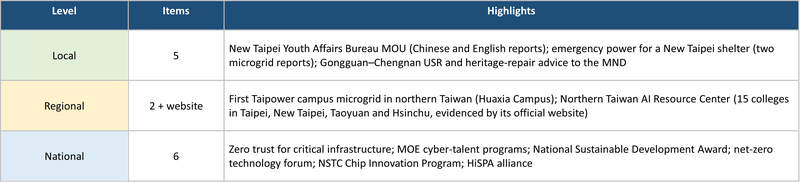
Note: the microgrid reports count under both Regional (Taipower northern region) and Local (New Taipei shelter).