NTUST practises inclusive recruitment for both students and staff. This report draws on 16 news stories and public documents from 2019 to 2026, grouped into three themes:
- Students from disadvantaged backgrounds: Students with disabilities enter through the national entrance examination for students with disabilities. Under the People with Disabilities Rights Protection Act, NTUST hires its full quota of assistants and student workers with disabilities. The Indigenous Student Resource Center supports identity and culture, and company scholarships and international programmes help students with financial need and from New Southbound countries to study and find work.
- Staff: four-tier faculty recruitment: In June 2026, NTUST launched a 10-year, NT$286 million faculty plan. Its four tiers (S, A, B and C) recruit international scholars, researchers from public research institutes and industry R&D talent, widening the range of faculty backgrounds.
- A diverse, gender-inclusive campus: In 2025, NTUST offered 21 gender equality courses, including Gender, Sexual Orientation and Culture and Workplace Equality and Employment Discrimination. Its rules state that courses and admissions place no restrictions on gender or sexual orientation.
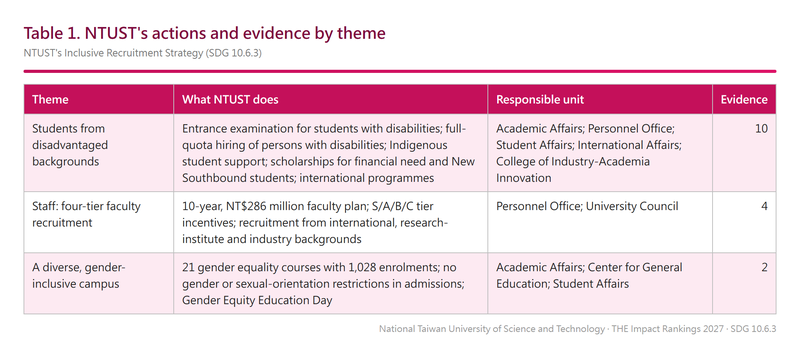
The table below summarises what NTUST does under each theme and the supporting evidence:
NTUST admits students with disabilities through the Ministry of Education's University Entrance Examination for Students with Disabilities. At the new student orientation on 29 August 2025, 2 of the 1,477 first-year students had entered through this examination. One of them, mechanical engineering student Lin Guan-you, has a severe hearing impairment. He uses hearing aids, lip-reads and asks his teachers questions to master machine operation. The university said it builds a diverse and welcoming learning environment so every student can reach their potential. The Liberty Times covered his story the same day.
For employment, under Article 38 of the People with Disabilities Rights Protection Act, NTUST adopted its Plan for Hiring the Full Quota of Persons with Disabilities in Line with Teaching Assistant Insurance (amended 11 April 2019). Each unit must hire persons with disabilities equal to 3% of the teaching assistants it insures on the first day of each month. Units provide the posts, the Office of Student Affairs helps match candidates, and the Personnel Office handles insurance. Units must reach their quota by the start of each semester (1 March and 1 October). Until they do, they cannot fill other contract posts, and they must adapt jobs and workplaces to suit staff with disabilities.
On 16 May 2025, the Indigenous Student Resource Center held an issue-reflection workshop. A Bunun lecturer led new Indigenous students through a discussion of their own identities, and students said the open format let them share freely. In September 2025, the center and an Indigenous youth club staged the annual exhibition hata: Still on the Road, showing what students learned about Atayal history and culture in Jinyue village, Nan'ao, Yilan.
In January 2025, the NTUST Alumni Association founded an Indigenous Alumni Association to promote Indigenous culture and support Indigenous students' studies and careers, so support continues after graduation.
In July 2025, Taiwan Fertilizer Co. gave NT$600,000 in scholarships to 20 NTUST students in chemical engineering, materials science and applied science. The scholarships go to high-achieving students from families with financial difficulties, with particular encouragement for international students from New Southbound countries.
For international recruitment, in September 2025 the College of Industry-Academia Innovation and Delta Electronics (Thailand) launched a master's programme for Thai students. The first cohort of 18 receives full scholarships, internships and a guaranteed job after graduation. NTUST also leads the Ministry of Education's Taiwan-Vietnam International Talent Circulation Base. PTS reported in December 2025 that students in these new programmes receive a living allowance of at least NT$10,000 a month from partner companies, while the university covers tuition. CommonWealth Magazine (republished by UDN, June 2026) reported that NTUST now has more than 1,000 international students from 54 countries, that about 60% of graduates in the past five years stayed to work in Taiwan, and that the academic, student affairs and housing offices all have dedicated staff for international students.
📎 News evidence for this section
- NTUST News (2025/08/29) NTUST welcomes new students with its motto of diligence and sincerity; a student with a hearing impairment pursues his dream: https://www.ntust.edu.tw/p/406-1000-139648,r167.php?Lang=zh-tw
- Liberty Times (2025/08/29) Learning to operate machines by lip-reading: student with a severe hearing impairment admitted to NTUST: https://news.ltn.com.tw/news/life/breakingnews/5160483
- NTUST Personnel Office (2019/04/11) NTUST Plan for Hiring the Full Quota of Persons with Disabilities in Line with Teaching Assistant Insurance (amended 11 April 2019): https://www.personnel.ntust.edu.tw/var/file/66/1066/img/202/165137169.pdf
- NTUST News (2025/07/16) Open and diverse identities: NTUST Indigenous Student Resource Center holds an issue-reflection workshop: https://www.ntust.edu.tw/p/406-1000-138479,r167.php?Lang=zh-tw
- NTUST News (2025/09/25) NTUST's 'hata: Still on the Road' takes students into an Atayal community: https://www.ntust.edu.tw/p/406-1000-140656,r167.php?Lang=zh-tw
- NTUST News (2025/01/30) NTUST Alumni Association installs new president and launches an Indigenous Alumni Association: https://www.ntust.edu.tw/p/406-1000-133038,r167.php?Lang=zh-tw
- NTUST News (2025/07/21) Taiwan Fertilizer scholarships support NTUST students with financial need and from New Southbound countries: https://www.ntust.edu.tw/p/406-1000-138593,r167.php?Lang=zh-tw
- NTUST News (2025/09/22) NTUST and Delta Electronics (Thailand) launch a fully funded master's programme for Thai students: https://www.ntust.edu.tw/p/406-1000-140442,r167.php?Lang=zh-tw
- PTS News Network (2025/12/16) NTUST's new international industry-academia programmes recruit international students to study and work in Taiwan: https://news.pts.org.tw/article/786170
- UDN (from CommonWealth Magazine) (2026/06/15) 60% of NTUST's international graduates stay in Taiwan: why tech companies from Acer to Delta want them: https://udn.com/news/story/6841/9567504
On 30 June 2026, NTUST announced a 10-year faculty plan under the Ministry of Education's programme for the sustainable development of higher education talent, approved by the University Council on 12 June 2026. The plan's budget is about NT$286 million: NT$216 million requested from the Ministry and an extra NT$50 million from NTUST. In the first five-year phase, NTUST plans to recruit 75 faculty in priority fields, about 48 of them in semiconductors, smart manufacturing and ICT. About 101 faculty members are due to retire within five years.
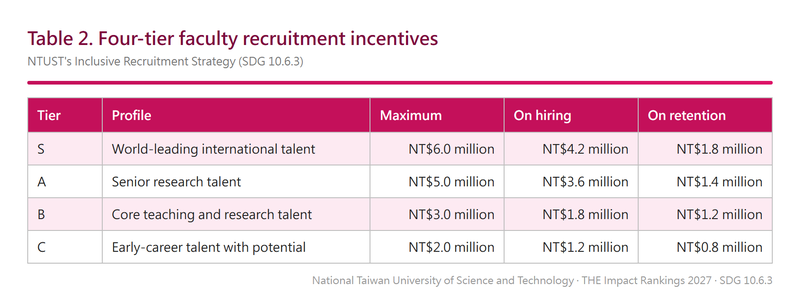
The plan offers hiring and retention incentives in four tiers (S, A, B and C), on top of statutory and internal flexible pay, as shown in the table below. It looks beyond the usual academic pool: international scholars not currently teaching full-time in Taiwan, researchers at public research institutes, and people with industry R&D experience, especially mid-career scholars who combine research ability, industry impact and team leadership.
President Yen Chia-yu said NTUST aims to be the institutional home for international applied researchers and industry translation talent, attracting the cross-sector and mid-career people that research universities find harder to recruit. Full-time faculty must also spend at least 180 days in industry every six years, keeping teaching connected to practice. Taiwan News, the Liberty Times and UDN all reported the plan the same day.
Table 2. Four-tier recruitment incentives (maximum additional pay):
📎 News evidence for this section
- NTUST News (2026/06/30) Facing the competition for talent, NTUST launches a 10-year faculty plan: https://www.ntust.edu.tw/p/406-1000-149388,r167.php?Lang=zh-tw
- Taiwan News (2026/06/30) Taiwan's NTUST unveils NT$286 million recruitment plan: https://www.taiwannews.com.tw/news/6392184
- Liberty Times (2026/06/30) NTUST launches a 10-year faculty plan to recruit senior international talent: https://news.ltn.com.tw/news/life/breakingnews/5488445
- United Daily News (UDN) (2026/06/30) NTUST competes for semiconductor and smart manufacturing faculty; S-tier hires can receive up to NT$6 million extra over five years: https://udn.com/news/story/6928/9597263
According to the Office of Academic Affairs' 2025 Gender Equity Education Work Report (6 January 2026), NTUST offered 21 gender equality courses in 2025, with 1,028 enrolments. They include Gender, Sexual Orientation and Culture; Cross-cultural Literacy: Love, Sexual Orientation and Romance (taught in English); and Gender, Technology and Globalisation, as well as workplace-related courses such as Workplace Equality and Employment Discrimination and Handling Workplace Sexual Harassment. The courses build students' gender awareness and help reduce discrimination. The report also states that courses and all admissions place no restrictions on students' gender or sexual orientation.
In April 2026, the Center for General Education held Gender Equity Education Day under the theme of equality through personal style, in line with the Ministry of Education's annual theme of understanding and respecting gender diversity. Education, hands-on and interactive zones promoted respect for gender diversity and personal choice. The event was supported by the Ministry's programme for developing gender equity education courses.
📎 News evidence for this section
- NTUST Office of Academic Affairs (2026/01/06) NTUST 2025 Gender Equity Education Work Report (Office of Academic Affairs): https://www.secretariat.ntust.edu.tw/var/file/63/1063/img/1433/350051312.pdf
- NTUST News (2026/04/20) NTUST promotes gender equity education through hands-on learning and respect for diversity: https://www.ntust.edu.tw/p/406-1000-146800,r167.php?Lang=zh-tw
This indicator is supported by 16 news stories and public documents, listed by date:

Summary: NTUST's inclusive recruitment covers both students and staff. For students, the entrance examination for students with disabilities, full-quota hiring of persons with disabilities, the Indigenous Student Resource Center and Indigenous Alumni Association, and company scholarships and international programmes help students with disabilities, Indigenous students, students with financial need and students from New Southbound countries to enrol and graduate. For staff, a 10-year, NT$286 million four-tier faculty plan opens NTUST to international scholars, research-institute researchers and industry R&D talent, widening the range of faculty backgrounds. Across campus, 21 gender equality courses and admissions rules with no gender or sexual-orientation restrictions support a diverse and welcoming place to study and work.