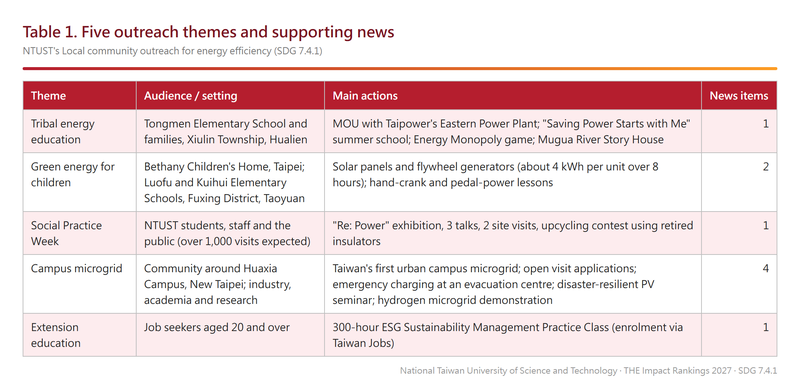
Through University Social Responsibility (USR) projects, the Center for General Education and industry partnerships, NTUST takes its energy expertise to Indigenous villages in Hualien and Taoyuan, communities in Taipei and the neighbourhood of its Huaxia Campus in New Taipei, and has turned the campus itself into an open energy demonstration site. News coverage from the past two years shows five themes:
- Tribal energy education: Gong-Hao Spark+ and Taipower's Eastern Power Plant: An MOU with Taipower's Eastern Power Plant; the "Saving Power Starts with Me" summer school at Tongmen Elementary School in Hualien; the "Energy Monopoly" teaching game; and a renewed Mugua River Story House.
- Green energy for disadvantaged and Indigenous children: The USR "Sustainable Green Energy and Carbon Reduction" project installed solar panels and flywheel generators at Bethany Children's Home; with the Dandelion Hope Foundation, NTUST ran hands-on green-energy lessons for Indigenous pupils in Fuxing District, Taoyuan.
- Empathy Social Lab - CGE Social Practice Week "Re: Power": The Center for General Education and Taipower held 9 exhibitions, talks and visits over 5 days to help students and the public think about the energy transition in daily life.
- Taiwan's first urban campus microgrid: open demonstration and community resilience: The Huaxia Campus microgrid combines solar power, storage, backup generation and an energy management system (EMS) to save energy every day and supply power in disasters. It is open for visits and provides emergency charging to nearby residents during blackouts.
- Extension education: ESG sustainability management training: The Center for Continuing Education runs a 300-hour pre-employment ESG Sustainability Management Practice Class that builds green-job skills for job seekers.
The table below summarises the audience, main actions and supporting news for each theme:
Since 2023, NTUST's Gong-Hao Spark+ USR team has run a science summer school at Tongmen Elementary School in Hualien, first focused on language and robotics. Seeing how closely village life is linked to Taipower's hydropower facilities, the team was introduced by the school to Taipower's Eastern Power Plant. Taipower engineers taught NTUST students on site at the Chuying and Rongshu units, giving them a solid understanding of hydropower and grid operation for developing teaching materials.
In 2025 the two partners ran the "Tongmen Summer School: Saving Power Starts with Me", with a hydropower science class and a "Where Does Green Energy Go?" activity that explained, in terms children understand, where electricity comes from and why saving it matters.
Project leader Ying Wang and Plant Manager Chung-Yi Lee of the Eastern Power Plant signed a memorandum of understanding for long-term cooperation on green-energy education, translating power knowledge for the public, revitalising local sites and video documentation, built around "local connection x citizen science x sustainable action". Wang said the aim is to build "a bridge from the power plant to the village classroom".
NTUST students used their design and engineering skills to create the "Energy Monopoly" game. It grew from a small station-based activity into a sustainability game map several metres long covering wind, hydro and grid logic, using blown balls to simulate wind power and plastic bottles to show hydropower. Plant Manager Lee took part in person two years running and suggested adding advanced topics such as carbon credits and green-energy labels.
The partners also renewed Taipower's Mugua River Story House with interactive exhibits such as a retired turbine guide vane and working models, and launched a local power and culture video project in which Tongmen pupils, parents and Taipower engineers film local stories together to build a community energy archive.
📰 News and evidence links for this section
- NTUST Official Website (2025/08/21) From tribal classroom to power plant: NTUST's Gong-Hao Spark+ project builds a bridge for energy education: https://www.ntust.edu.tw/p/406-1000-139425,r167.php?Lang=zh-tw
Also reported by: CNA PR Newswire https://www.cna.com.tw/postwrite/Chi/410239; PChome News https://news.pchome.com.tw/living/cna/20250821/index-17557621156752918009.html; yam News https://n.yam.com/Article/20250821873657
Associate Professor Cheng-Jhe Lin (Industrial Management) and Assistant Professor Hung-Lung Chou (Applied Science and Technology) led a USR team on the "Sustainable Green Energy and Carbon Reduction" project, installing a rooftop solar system and flywheel generators with storage at Bethany Children's Home in Taipei. The Rotary Club of Taipei Chung An and Ho An Insurance Agency donated the flywheel generators.
Each flywheel generator produces about 500 W and about 4 kWh over 8 hours of use, directly lowering the home's electricity bills. The team also ran flywheel contests and quizzes so the children could turn their own effort into electricity and learn to save energy in daily life.
On Earth Day 2026, the Dandelion Hope Foundation and NTUST's Graduate Institute of Applied Science and Technology ran a "Sustainable Green Energy Education" event for pupils from Luofu and Kuihui Elementary Schools in Fuxing District, Taoyuan, at the Dandelion Sustainable Ecological Park. Professor Hung-Lung Chou brought interactive solar models, hand-crank generators and a pedal-powered dance machine so the children could experience energy conversion first-hand, alongside sensory nature activities and an organic-soil classroom.
📰 News and evidence links for this section
- NTUST Official Website (2024/09/23) Learning green energy through play: NTUST brings flywheel power generation to disadvantaged children: https://www.ntust.edu.tw/p/406-1000-129038,r167.php?Lang=zh-tw
Also reported by: CNA PR Newswire https://www.cna.com.tw/Postwrite/Chi/382109; Taiwan Shin Sheng Daily News https://www.tssdnews.com.tw/?FID=46&CID=764815
- Commercial Times (2026/04/22) Earth Day lesson with the Dandelion Foundation: Indigenous pupils generate power with their own feet and experience green energy: https://www.ctee.com.tw/news/20260422702078-431208
From 18 to 22 May 2026, the Center for General Education held the "Empathy Social Lab - CGE Social Practice Week" on the theme "Re: Power - Design Innovation, Sustainable Practice, and Social Dialogue". With Taiwan Power Company, it ran 9 exhibitions, talks, site visits and a creative call over 5 days, expecting more than 1,000 visits. The bilingual (Chinese and English) exhibition was open to visitors from outside the university.
The exhibition at the NTUST Gallery covered energy science, reuse of retired materials, public art, Taipower's Kilowatt Design Award, NTUST's microgrid research, and the Gong-Hao Spark project with the Tongmen power plant in Hualien. Visitors who completed interactive tasks received Taipower design souvenirs.
Three talks covered design for social communication, a project to remake retired electricity meters, and "the second life of materials". Students and staff visited Taipower's Energym, an interactive green-energy exhibition hall, where an "energy poker" game let them simulate energy mix decisions and learn the environmental impact of different power sources; they also toured the public art at the Taipower Building. Before the week, a creative contest invited students to redesign Taipower's retired porcelain insulators.
President Jia-Yush Yen said a university campus should be not only a place of learning but also a demonstration base for the energy transition. Center Director Szu-Ying Lee described the week as a full learning cycle: "exhibitions build awareness, talks deepen the issues, visits connect to real sites and making shows the results".
📰 News and evidence links for this section
- NTUST Official Website (2026/05/19) NTUST launches the "Empathy Social Lab - CGE Social Practice Week", opening a new cross-disciplinary learning experience: https://www.ntust.edu.tw/p/406-1000-147817,r167.php?Lang=zh-tw
Also reported by: Center for General Education event page https://cla.ntust.edu.tw/p/406-1076-146474,r1476.php?Lang=zh-tw; CNA PR Newswire https://www.cna.com.tw/postwrite/Chi/433855; yam News https://n.yam.com/Article/20260519882668
NTUST was the first university in northern Taiwan selected for Taipower's University Energy Saving and Power Resilience programme, and in early 2026 completed Taiwan's first urban campus microgrid at its Huaxia Campus in New Taipei. It includes a 229.68 kWp solar system, 2 MWh of battery storage, two 100 kW DC fast chargers, a 400 kW diesel backup generator and an EMS showroom. NTUST invested over NT$50 million in site infrastructure, and Taipower contributed NT$100 million.
In normal operation the microgrid runs in parallel with the grid; the EMS shifts load between peak and off-peak hours and manages storage, and the rooftop solar power is 100% self-consumed. Estimated savings are about NT$540,000 a year, rising to about NT$1.26 million with optimised storage and sales of renewable energy certificates. If grid power fails, it switches to island mode and powers the whole campus for 4 hours, or 8 hours with air-conditioning shed.
The Juyu Building on Huaxia Campus is one of New Taipei City's emergency evacuation centres. The guardhouse has 6 emergency charging points, each with two 110 V sockets and three USB ports, so nearby residents can charge phones and laptops during a large blackout and stay in contact. Dean of General Affairs Jui-Sheng Chou said the microgrid makes the campus "not just an energy user, but a hub that connects with the community and puts sustainability into practice".
The Office of General Affairs runs a Huaxia Campus Microgrid page with a tour video and media coverage; anyone can apply to visit or take part in research by submitting a facility-use form and visitor declaration. On 31 March 2026, ITRI and NTUST's Energy Management System Industry-Academia Alliance held a Disaster-Resilient Solar PV Technology Seminar on Huaxia Campus. More than 200 people from industry, academia, research and community groups (such as the ROC Urban Renewal and Dangerous Building Reconstruction Association) attended and toured the site. Speakers shared measured results: the EMS cut annual grid purchases by 9.8% and electricity costs by 25%.
In October 2025, Atemitech, the Yu-Hsiu Education Foundation and the Lien Hwa MiTAC Group also donated a smart hydrogen microgrid and storage system that uses a hydrogen fuel cell, mobile storage and an EMS to demonstrate disaster-resilient microgrids and energy efficiency in green buildings. The mobile storage unit can be deployed quickly to emergency sites.
📰 News and evidence links for this section
- NTUST Official Website (2026/09/18) NTUST builds Taiwan's first urban campus microgrid: saving energy every day and supplying power in disasters: https://www.ntust.edu.tw/p/406-1000-151678,r167.php?Lang=zh-tw
Also reported by: Central News Agency https://www.cna.com.tw/news/ahel/202609180238.aspx; Liberty Times https://news.ltn.com.tw/news/life/breakingnews/5578334; United Daily News https://udn.com/news/story/6929/9763336; Radio Taiwan International https://www.rti.org.tw/news?uid=3&pid=232630; National Education Radio https://www.ner.gov.tw/CultureNews/Content/26091816180693688/; Mandarin Daily News https://www.mdnkids.com/content.asp?Link_String_=249J00000LJEOJE
- NTUST Office of General Affairs (2026/09) Huaxia Campus Microgrid: visit and facility-use applications: https://www.general.ntust.edu.tw/p/406-1054-152457,r5.php?Lang=zh-tw
- yam News (2026/04/02) No fear of blackouts: inside NTUST's "energy fortress" - how a disaster-resilient microgrid cuts electricity bills by 25% and protects energy security: https://n.yam.com/Article/20260402341566
- Liberty Times (2025/10/07) Getac's Atemitech and the Lien Hwa MiTAC Group install a hydrogen microgrid and storage system at NTUST: https://ec.ltn.com.tw/article/breakingnews/5203119
The Center for Continuing Education runs cohort 3 of the pre-employment ESG Sustainability Management Practice Class, taught by NTUST experts in environmental engineering, green energy and management together with industry ESG practitioners, to train "green-collar" talent. The 300-hour course runs on campus from 14 October to 22 December 2026 and is open to job seekers aged 20 and over with at least a senior high school education who want to work in ESG. Enrolment is through the government's Taiwan Jobs portal.
The course brings energy management and sustainability knowledge to members of the public, giving them practical skills to drive energy saving and carbon reduction in companies.
📰 News and evidence links for this section
- NTUST Center for Continuing Education (2026/09) Pre-employment training: ESG Sustainability Management Practice Class, cohort 3 (300 hours, 14 Oct - 22 Dec 2026): https://sce.ntust.edu.tw/p/404-1074-150702.php?Lang=zh-tw
Also reported by: Taiwan Jobs course page (class code 166065) https://its.taiwanjobs.gov.tw/Course/Detail?ID=166065
This indicator is supported by 9 news reports and announcements, listed by date (media that also carried each story are listed in each section):
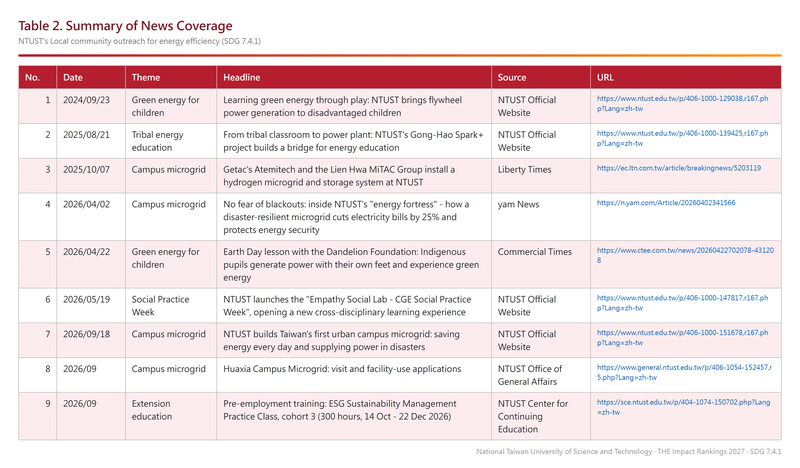
Summary: The news coverage shows NTUST's energy-efficiency and clean-energy outreach reaching from campus into the community. In Tongmen, Hualien, a long-term partnership with Taipower's Eastern Power Plant turns power science into games for Indigenous children. In Taipei and Taoyuan, flywheel, hand-crank and pedal generators let disadvantaged and Indigenous children experience green energy first-hand, and lower a children's home's electricity bills. On campus, the Social Practice Week invites students and the public to think about the energy transition in daily life. At Huaxia Campus, Taiwan's first urban campus microgrid demonstrates energy saving and resilience, is open for visits and supports nearby residents. Extension education builds ESG and energy-management skills for job seekers. The microgrid story alone was carried by more than 30 media outlets, including CNA, the Liberty Times and United Daily News.