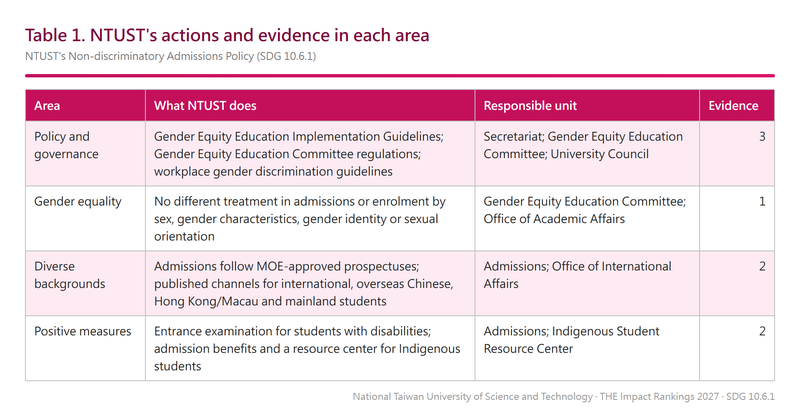
NTUST admits students under Taiwan's education and gender equality laws, on the principles of fairness, impartiality and openness, and follows the admission prospectuses approved by the Ministry of Education (MOE). NTUST puts non-discriminatory admissions into practice in four ways:
- Policy and governance: Under the Gender Equity Education Act, NTUST has adopted the Gender Equity Education Implementation Guidelines, approved by the Gender Equity Education Committee and the University Council and most recently amended at the 86th University Council on 7 June 2024. The Gender Equity Education Committee leads and oversees their implementation.
- Gender equality: Article 5 of the Guidelines states that NTUST's admissions and enrolment decisions must not treat anyone differently because of sex, gender characteristics, gender identity or sexual orientation. Article 6 extends this to teaching, assessment and services after enrolment.
- Diverse backgrounds: Entrance examinations and eligibility reviews do not exclude or discriminate against anyone because of race, social class or religion. Separate, published admission channels and criteria exist for domestic, international, overseas Chinese, Hong Kong/Macau and mainland Chinese students.
- Positive measures: Under MOE rules, NTUST offers a dedicated entrance examination for students with disabilities, admission benefits for Indigenous students and support services, aiming for real equality rather than equal treatment on paper alone.
The table below summarises NTUST's actions and evidence in each area:
Under Article 12(2) of the Gender Equity Education Act, NTUST adopted the NTUST Gender Equity Education Implementation Guidelines. They were first approved by the Gender Equity Education Committee on 27 July 2005, amended in 2012 and 2014, and most recently approved at the 86th University Council on 7 June 2024. They are published on the Secretariat's gender equity page.
The Guidelines aim to provide a gender-equal learning environment that respects students' and staff members' sex, gender characteristics, gender identity and sexual orientation, and to use education to eliminate gender discrimination and achieve real gender equality.
Under its establishment regulations, NTUST's Gender Equity Education Committee leads and oversees gender equity education, including fairness in admissions and enrolment. For staff, the Guidelines on Preventing and Handling Workplace Sexual Harassment and Gender Discrimination provide a complaints and handling process, so the non-discrimination principle covers both students and staff.
📎 Evidence links for this section
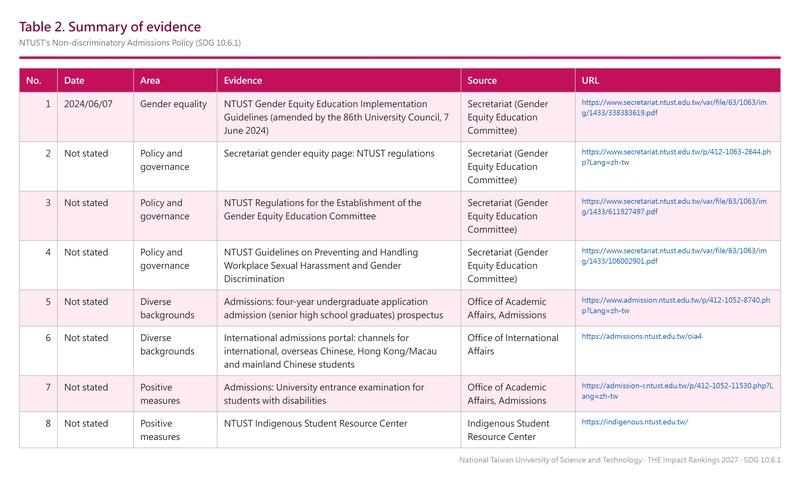
- Secretariat (Gender Equity Education Committee) (Not stated) Secretariat gender equity page: NTUST regulations: https://www.secretariat.ntust.edu.tw/p/412-1063-2644.php?Lang=zh-tw
- Secretariat (Gender Equity Education Committee) (2024/06/07) NTUST Gender Equity Education Implementation Guidelines (amended by the 86th University Council, 7 June 2024): https://www.secretariat.ntust.edu.tw/var/file/63/1063/img/1433/338383619.pdf
- Secretariat (Gender Equity Education Committee) (Not stated) NTUST Regulations for the Establishment of the Gender Equity Education Committee: https://www.secretariat.ntust.edu.tw/var/file/63/1063/img/1433/611927497.pdf
- Secretariat (Gender Equity Education Committee) (Not stated) NTUST Guidelines on Preventing and Handling Workplace Sexual Harassment and Gender Discrimination: https://www.secretariat.ntust.edu.tw/var/file/63/1063/img/1433/106002901.pdf
Article 5 of the Gender Equity Education Implementation Guidelines states that NTUST's admissions and enrolment decisions must not treat anyone differently because of sex, gender characteristics, gender identity or sexual orientation. The only exception is a class or course set up for a legitimate reason unrelated to gender, such as historical tradition or a specific educational goal, and approved by the competent authority. The university cannot make this exception on its own.
Non-discrimination does not stop at the admission decision. Article 6 states that NTUST must not treat students differently in teaching, activities, assessment, rewards and discipline, welfare or services because of sex, gender characteristics, gender identity or sexual orientation, and must actively help students who are disadvantaged for these reasons. Article 7 protects pregnant students' right to education and requires flexible measures to help them complete their studies.
Article 10 asks teachers, when advising students on programmes and careers, to encourage them to follow their own strengths, including in fields not traditionally associated with their gender, and to avoid treating any subject as belonging to one gender. For a university focused on science and engineering, this helps attract more women into STEM programmes.
📎 Evidence links for this section
- Secretariat (Gender Equity Education Committee) (2024/06/07) NTUST Gender Equity Education Implementation Guidelines (amended by the 86th University Council, 7 June 2024): https://www.secretariat.ntust.edu.tw/var/file/63/1063/img/1433/338383619.pdf
All NTUST admissions follow MOE-approved prospectuses, which are published on the Admissions website. Entrance examinations and eligibility reviews are based on academic record and ability, and do not exclude or discriminate against anyone because of race, social class or religion.
NTUST publishes a clear admission channel and criteria for each group. Domestic students can enter through channels such as application admission and recommendation-selection admission. International students apply directly to NTUST under the Regulations Regarding International Students Undertaking Studies in Taiwan. Overseas Chinese and Hong Kong/Macau students who do not qualify as international students apply through the University Entrance Committee for Overseas Chinese Students, and mainland Chinese students apply through the joint admissions committee for mainland students. Eligibility and procedures for every channel are online, so students of every nationality and background have a clear and equal route into NTUST.
📎 Evidence links for this section
- Office of Academic Affairs, Admissions (Not stated) Admissions: four-year undergraduate application admission (senior high school graduates) prospectus: https://www.admission.ntust.edu.tw/p/412-1052-8740.php?Lang=zh-tw
- Office of International Affairs (Not stated) International admissions portal: channels for international, overseas Chinese, Hong Kong/Macau and mainland Chinese students: https://admissions.ntust.edu.tw/oia4
Under MOE rules, NTUST offers reserved places, bonus points or financial support for students who are culturally disadvantaged, economically disadvantaged or from specific groups. These measures aim for real equality rather than equal treatment on paper alone, in line with Article 6 of the Guidelines, which requires NTUST to actively help disadvantaged students.
Students with disabilities can enter NTUST's four-year and two-year undergraduate programmes through the MOE University Entrance Examination for Students with Disabilities, which is run centrally by its committee; NTUST's Admissions website explains the route and links to it. Indigenous students receive admission benefits under MOE rules, and NTUST's Indigenous Student Resource Center offers scholarships, academic support and help with daily life so they can complete their degrees.
📎 Evidence links for this section
- Office of Academic Affairs, Admissions (Not stated) Admissions: University entrance examination for students with disabilities: https://admission-r.ntust.edu.tw/p/412-1052-11530.php?Lang=zh-tw
- Indigenous Student Resource Center (Not stated) NTUST Indigenous Student Resource Center: https://indigenous.ntust.edu.tw/
This indicator is supported by 8 published NTUST rules and web pages, grouped by area:
Summary: NTUST's Gender Equity Education Implementation Guidelines state that admissions and enrolment must not treat anyone differently because of sex, gender characteristics, gender identity or sexual orientation, and the Gender Equity Education Committee oversees this. Admissions follow published MOE-approved prospectuses, do not discriminate by race, social class or religion, and offer clear channels for domestic, international, overseas Chinese, Hong Kong/Macau and mainland students. Positive measures, including the entrance examination for students with disabilities and admission benefits and support for Indigenous students, aim for real equality, so every capable and motivated student has a fair chance to study at NTUST.