In line with UN Sustainable Development Goal 1 "No Poverty", NTUST treats poverty reduction as long-term work to protect the right to education, narrow urban-rural and digital divides, and build the capacity of disadvantaged groups. NTUST acts through campus support systems, general education, University Social Responsibility (USR) projects and international service, from the local to the global level:
- Financial support for disadvantaged students: NTUST provides a full aid system for students with financial need, including need-based scholarships and grants, emergency relief funds and on-campus work-study jobs, supplemented by corporate scholarships. These ease financial pressure and safeguard students' right to education and basic living.
- General education and sustainability courses: The Center for General Education and the Language Center offer courses such as "Introduction to Sustainable Development" and "Sustainable Development and Society", which bring SDG 1 and social-justice issues into teaching and build students' social responsibility.
- USR and local practice: NTUST runs USR projects such as healthcare outreach for elderly people in rural areas, community science and environmental education, mentor-led tutoring in students' home towns, and camps for new-immigrant families. These reach under-resourced communities and narrow gaps in information, learning and professional skills.
- International and transnational service: Through teacher education and transnational student teams, NTUST brings digital education, life education and international social responsibility to Kenya and the Philippines (Manila and Cebu), extending poverty relief and educational equity to the region and the world.
The table below summarises NTUST's main actions at each level and the supporting news:
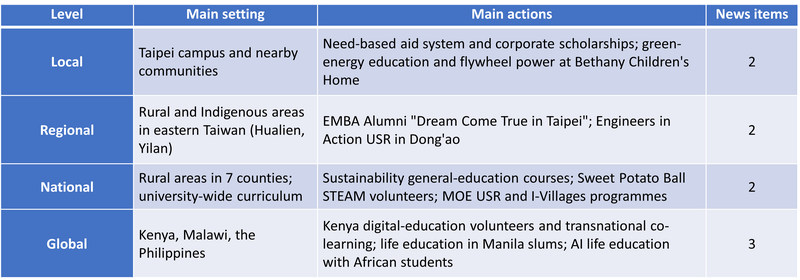
NTUST maintains a complete aid system for students with financial need, covering need-based scholarships and grants, emergency relief funds and on-campus work-study. It helps students from low-income families, or whose families face a sudden crisis, to stay in school, which helps break the cycle of poverty across generations.
NTUST also brings in corporate support for disadvantaged students. In July 2025, Taiwan Fertilizer Co. donated nearly NT$2 million in scholarships, of which NT$600,000 went to NTUST for 20 students in Chemical Engineering, Materials Science and Engineering, and the Graduate Institute of Applied Science and Technology. The awards go to high-achieving students from families in financial difficulty, and international students from New Southbound Policy countries are especially encouraged to apply.
Under NTUST's USR "Sustainable Green Energy and Carbon Reduction" project, Associate Professor Cheng-Jhe Lin (Industrial Management) and Assistant Professor Hung-Lung Chou (Applied Science and Technology) led students to install a rooftop solar system and flywheel generators with storage at Bethany Children's Home. They also ran game-based lessons, such as flywheel contests and quizzes, to teach the children how flywheel and solar power work.
The Rotary Club of Taipei Chung An and Ho An Insurance Agency donated two flywheel generators. Each has an output of about 500 W and generates about 4 kWh over 8 hours of use, directly lowering the home's electricity bills while providing environmental education.
📰 News and evidence links for this section
- NTUST Official Website (2025/07/21) Industry-academia partnership: Taiwan Fertilizer scholarships support sustainable chemical-engineering talent at NTUST: https://www.ntust.edu.tw/p/406-1000-138593,r167.php?Lang=zh-tw
- NTUST Official Website (2024/09/23) Learning green energy through play: NTUST brings flywheel power generation to disadvantaged children: https://www.ntust.edu.tw/p/406-1000-129038,r167.php?Lang=zh-tw
On 4-5 July 2024, the NTUST EDBA/EMBA Alumni Association brought 68 pupils from three rural primary schools in Hualien County (Guanyin, Changliang and Mingli) to Taipei, supported by nearly 300 alumni volunteers. The children saw NTUST's Formula Student electric race car and robots, tried VR/MR at the Department of Design, joined career tours, and visited Taipei 101 and the zoo. A thank-you dinner encouraged gratitude and social responsibility.
The trip followed the previous year's "Gift of Love for Hualien", in which 104 alumni donated and 41 travelled at their own expense to deliver 253 gifts to pupils at six rural schools. This long-term support responds to the way the urban-rural gap limits children's sense of what their future can be.
The Ministry of Education (MOE) USR project "Engineers in Action" has worked in Dongyue (Dong'ao) village, Nan'ao Township, Yilan County, for six years since 2020. From 7 to 16 June 2025, about 60 students and teachers from NTUST, Osaka Institute of Technology (Japan), Widya Mandala Catholic University (Indonesia) and Songshan Agricultural and Industrial High School rebuilt the Snake Mountain Trail with eco-friendly methods. They also installed a solar-powered guide wall at Dong'ao Station with audio in five languages (Mandarin, English, Japanese, Korean and Atayal), set up an Indigenous-language information board at Dong'ao Elementary School, and designed eight STEAM lessons.
By combining infrastructure, tourism guidance and education, the project strengthens the community's ability to develop local tourism and improves both economic and educational conditions in a remote Indigenous village.
📰 News and evidence links for this section
- NTUST Official Website (2024/07/08) NTUST EMBA Alumni help rural Hualien children "Make a Dream Come True in Taipei", opening up future choices: https://www.ntust.edu.tw/p/406-1000-126794,r167.php?Lang=zh-tw
- NTUST Official Website (2025/06/30) NTUST Engineers in Action partner with Japan and Indonesia to revitalise rural Dong'ao: https://www.ntust.edu.tw/p/406-1000-138039,r167.php?Lang=zh-tw
The Center for General Education and the Language Center offer courses such as "Introduction to Sustainable Development" and "Sustainable Development and Society". These cover poverty, inequality and social justice so that students across the university understand the structural causes of poverty and go on to service learning and USR work.
In line with the MOE University Social Responsibility policy and the "I-Villages: Mobility for Change" programme, NTUST runs projects including healthcare outreach for rural elderly people, community science and environmental education, mentor-led tutoring in students' home towns, and camps for new-immigrant families. These bring university knowledge and people to under-resourced communities across Taiwan.
The Sweet Potato Ball volunteer team was founded by skills-competition students in the Bachelor Program of Applied Science and Technology and is advised by Chia-Wen Hu. Guided by the idea "from rural areas, giving back to rural areas", the team has since 2023 brought hands-on STEAM lessons such as 3D printing and laser engraving, combined with local culture, to New Taipei, Miaoli, Hsinchu, Changhua, Nantou, Yilan and Hualien. Participants range from 8 to 88 years old. By April 2026 the team had run 22 tailored sessions with 96 volunteer shifts, serving more than 510 people.
The team received the MOE Youth Development Administration's 2nd Youth Volunteer Award (Rising Star) in 2025 and met the President, then received the Youth Volunteer Excellence Award in 2026. One team leader founded a science-education company after graduating to continue this work in rural areas, showing the long-term value of technical education in building capacity in disadvantaged regions.
📰 News and evidence links for this section
- NTUST Official Website (2025/05/20) NTUST "Sweet Potato Ball" volunteers bring hands-on STEAM to rural Taiwan and win national Youth Volunteer Award: https://www.ntust.edu.tw/p/406-1000-136716,r167.php?Lang=zh-tw
- NTUST Official Website (2026/04/08) Turning technical skills into impact: NTUST Sweet Potato Ball volunteer team showcases results: https://www.ntust.edu.tw/p/406-1000-146363,r167.php?Lang=zh-tw
In summer 2023, with MOE support, Professor Shelley Shwu-Ching Young of the Graduate Institute of Digital Learning and Education ran the "Equation of Love" Kenya service project, leading 17 student volunteers (mainly from NTUST, with others from National Tsing Hua University and National Taipei University of Nursing and Health Sciences) on a 20-day trip to Nyeri, Kenya. At Christ the King Girls' Secondary School and St. Mary's Boys' Secondary School they taught SDG-themed drawing, social-emotional learning, information literacy and AI picture-book creation, and they visited Gititu Secondary School. The aim was to "internationalise rural Taiwan and digitalise education in Kenya".
The team then launched the Innovative Transnational Service Co-learning Course, which brings together 75 Taiwanese secondary students, 75 Taiwanese university students and 75 Kenyan secondary students for online learning. Rural Taiwanese children gain international experience and Kenyan students gain access to digital learning, narrowing digital and resource gaps on both sides.
Under NTUST's USR project led by Professor Young, teacher-education students from a partner university, NTUST students and students from Sanchong Commercial and Industrial Vocational High School formed a joint team for the first time. They spent a week in Manila and Cebu on life-experience lessons, community service and cultural exchange. Working with the global humanitarian organisation Metro World Child, the team visited a Manila slum beside a garbage mountain, where more than half of the families live in less than about 6.6 m² (two ping). They joined children's Sunday school activities, handed out supplies and played games with the children.
Facing extreme poverty first-hand helps future teachers and young people build empathy and a will to act on poverty, extending NTUST's concern for poverty relief and educational equity to Southeast Asia.
In February 2025, Assistant Professor Tsai-Ju Lee and Professor Young ran an online "Life Review" workshop for 71 participants from Malawi and Kenya studying medicine, education and law. Participants used AI to write scripts, generate images and edit videos, producing more than 60 life-review videos while building AI literacy and cross-cultural understanding.
📰 News and evidence links for this section
- NTUST Official Website (2023/09/17) Volunteers fly 9,000 km to promote digital education; NTUST to launch transnational digital co-learning with Kenyan students: https://www.ntust.edu.tw/p/404-1000-117070.php?Lang=zh-tw (also published on the NTUST USR website: https://usr.ntust.edu.tw/news/23)
- NTUST Official Website (2024/10/24) NTUST teacher-education students join vocational high-school students for the first time to bring life education to slums in the Philippines: https://www.ntust.edu.tw/p/406-1000-130371,r167.php?Lang=zh-tw
- NTUST Official Website (2025/02/18) AI meets humanistic care: NTUST and African students create AI videos for cross-cultural life education: https://www.ntust.edu.tw/p/406-1000-133525,r167.php?Lang=zh-tw
This indicator is supported by 9 news reports covering the local, regional and national levels (2 each) and the global level (3):
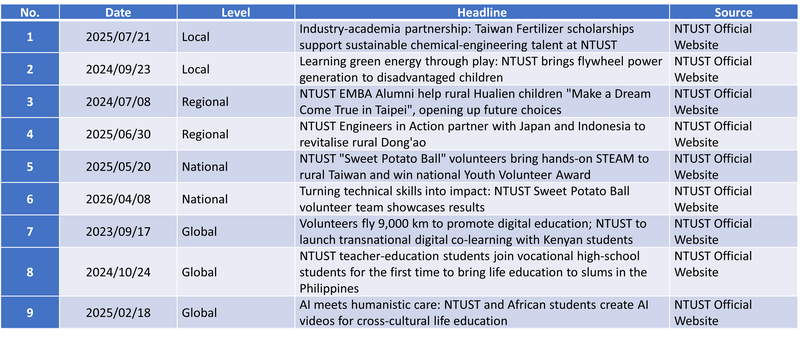
Summary: The news coverage shows NTUST's poverty-reduction work reaching from campus to the world. Locally, the aid system and corporate scholarships protect disadvantaged students' right to education, and a children's home has lower electricity bills. Regionally, NTUST gives long-term support to rural and Indigenous communities in Hualien and Yilan. Nationally, general-education courses and volunteer service across seven counties narrow technology and learning gaps. Globally, digital education, life education in slums and AI life education connect NTUST with Kenya, the Philippines and Malawi. Together these show NTUST's strategy of using education and technology to address SDG 1.