NTUST sees basic services as things everyone should be able to obtain: water, electricity, safe roads and living conditions, and education, job training and the chance to start a business. Building on its engineering and technical-education strengths, NTUST meets this responsibility through four types of programmes and courses:
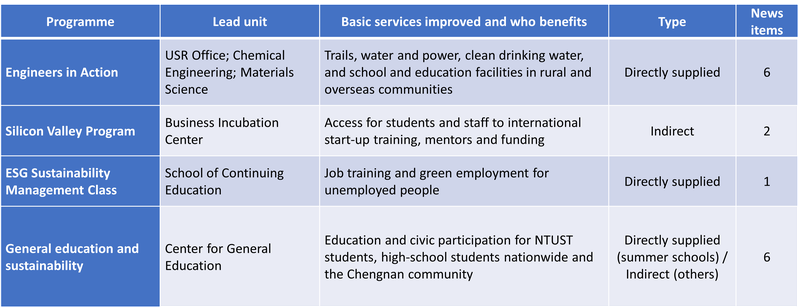
- Engineers in Action (USR): This programme combines basic engineering with project-based learning (PBL). Students go to rural communities in Taiwan, such as Dong'ao in Yilan, and to communities in Indonesia, Vietnam and Japan, where they build trails, water and power systems, drinking-water facilities and school facilities. This improves local access to infrastructure and education.
- NTUST Silicon Valley Program: The Business Incubation Center selects campus start-up teams for training in Silicon Valley, with up to NT$250,000 per team, giving students and staff access to international start-up resources and markets.
- Pre-employment Training: ESG Sustainability Management Practice Class: The School of Continuing Education runs this 300-hour, government-commissioned course for unemployed people who want to work in ESG, helping them gain green skills and return to work.
- General education and sustainability courses: The Center for General Education offers cross-disciplinary courses and social-practice events that deepen students' understanding of social structures, media access, sustainable development and care for disadvantaged groups. It also opens its learning to high-school students and local residents.
The table below summarises the basic services each programme improves and the supporting news:
Engineers in Action is a Ministry of Education (MOE) University Social Responsibility (USR) project led by Professor Meng-Jiy Wang (Chemical Engineering), with Associate Professor Chiu-Yen Wang (Materials Science and Engineering) as co-PI. It starts from basic engineering skills and uses project-based learning (PBL) to train engineers who communicate well, care about people and think green. The programme has trained nearly 1,000 students. Its sites include rural Taiwan (such as Dong'ao and Siji elementary schools in Yilan) and communities in Indonesia and Vietnam, and its work covers bridge repair, power systems and better living conditions.
The programme has worked in Dongyue village, Nan'ao Township, Yilan County, since 2020. From 7 to 16 June 2025, about 60 students and teachers from NTUST, Songshan Agricultural and Industrial High School, Osaka Institute of Technology (Japan) and Widya Mandala Catholic University (Indonesia) worked together as an international team for the first time. Using eco-friendly methods, they reopened the Snake Mountain Trail (Babaw Kulu), which had been closed for years, repairing steps, handrails, a pavilion and drainage. They installed a solar-powered guide wall at Dong'ao Station with audio in five languages (Mandarin, English, Japanese, Korean and Atayal), set up an Indigenous-language information board at Dong'ao Elementary School, and designed eight STEAM sustainability lessons.
In summer 2025, the team repaired a greenhouse and built a crop dryer and composting system in Pacet village, Indonesia; repaired roofs, laid water pipes and wiring, and installed automatic irrigation in Gubug Lazaris; installed a post-earthquake rapid building-safety assessment system and multilingual evacuation signs at a shelter in Kawakami, Nara, Japan; and built a reading corner, play equipment and a football pitch at Long Tuyen 2 Primary School in Can Tho, Vietnam.
In summer 2026, the team installed a reverse-osmosis drinking-water filter and renovated toilets and lighting at Hoa-An 1 Primary School in Vietnam; built a solar-powered aquaponics greenhouse, a reading room and road-safety signs in Pacet, and repaired leaking ponds and channels in Gubug Lazaris, Indonesia; and repaired sports facilities and ran a structures workshop in Otari, Nagano, Japan. This work directly improves local access to clean water, sanitation, power and a safe environment.
From 25 to 27 September 2025, the programme was invited to exhibit with Osaka Institute of Technology in the Future Life Village at Expo 2025 Osaka. It was the only Taiwanese USR project shown at the Expo and drew more than 600 visitors in three days. In April 2026 it received a Merit Award (Sustainability Curriculum category) at the 7th Global Views USR Awards.
📰 News and evidence links for this section
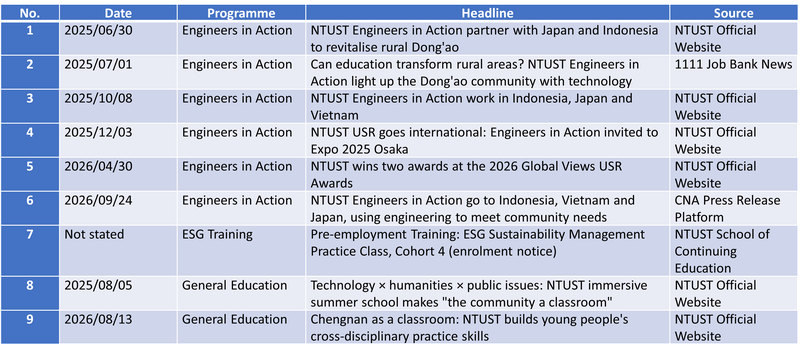
- [Direct] NTUST Official Website (2025/06/30) NTUST Engineers in Action partner with Japan and Indonesia to revitalise rural Dong'ao: https://www.ntust.edu.tw/p/406-1000-138039,r167.php?Lang=zh-tw
- [Direct] 1111 Job Bank News (2025/07/01) Can education transform rural areas? NTUST Engineers in Action light up the Dong'ao community with technology: https://www.1111.com.tw/news/jobns/161380
- [Direct] NTUST Official Website (2025/10/08) NTUST Engineers in Action work in Indonesia, Japan and Vietnam: https://www.ntust.edu.tw/p/406-1000-140988,r167.php?Lang=zh-tw
- [Direct] NTUST Official Website (2025/12/03) NTUST USR goes international: Engineers in Action invited to Expo 2025 Osaka: https://www.ntust.edu.tw/p/406-1000-142778,r167.php?Lang=zh-tw
- [Direct] NTUST Official Website (2026/04/30) NTUST wins two awards at the 2026 Global Views USR Awards: https://www.ntust.edu.tw/p/406-1000-147199,r167.php?Lang=zh-tw
- [Direct] CNA Press Release Platform (2026/09/24) NTUST Engineers in Action go to Indonesia, Vietnam and Japan, using engineering to meet community needs: https://www.cna.com.tw/Postwrite/Chi/445125
The Business Incubation Center runs the NTUST Silicon Valley Program for campus spin-off teams. Teams need at least two members drawn mainly from NTUST staff and students, and at least one NTUST teacher or industry mentor as advisor. Each team receives up to NT$250,000. Selected teams pitch on an international stage in Silicon Valley, get face-to-face advice from venture capitalists, visit Google and international accelerators, and are supported by the Northern California alumni network.
According to the Center's results page, 22 teams travelled to Silicon Valley between 2017 and 2025 (no teams are listed for 2020-2022 due to the pandemic), including Anx.IO Bio, Ergonome and Boring AI in 2025 and MIT Studio, COTWO and B-ECO in 2024. The programme gives students from all backgrounds access to international markets, investors and mentors that would otherwise be hard to reach.
📰 News and evidence links for this section
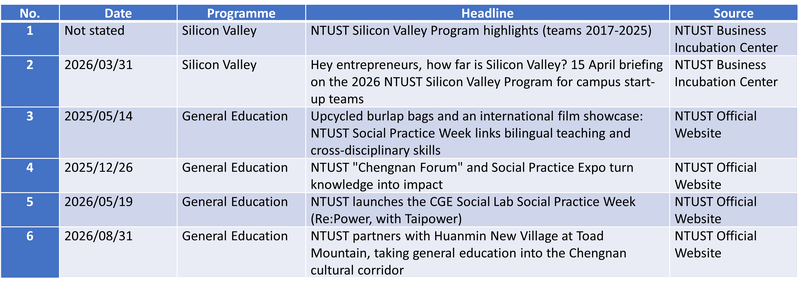
- [Indirect] NTUST Business Incubation Center (Not stated) NTUST Silicon Valley Program highlights (teams 2017-2025): https://www.bic.ntust.edu.tw/%e8%87%ba%e7%a7%91%e8%b5%b4%e7%9f%bd%e8%b0%b7%e8%a8%88%e7%95%ab%e6%88%90%e6%9e%9c%e8%8a%b1%e7%b5%ae
- [Indirect] NTUST Business Incubation Center (2026/03/31) Hey entrepreneurs, how far is Silicon Valley? 15 April briefing on the 2026 NTUST Silicon Valley Program for campus start-up teams: https://www.bic.ntust.edu.tw/11347/
The School of Continuing Education runs the government-commissioned ESG Sustainability Management Practice Class, now in its fourth cohort. It is open to unemployed people aged 20 or over with at least a high-school education who want to work in ESG-related jobs. Applicants register through Taiwan Jobs, the national employment portal, and are selected by written test and interview. Cohort 4 runs for 300 hours from 30 November 2026 to 17 February 2027.
The course brings together NTUST experts in environmental engineering, green energy and management with ESG practitioners from industry, following a full training map to prepare "green-collar" workers. It gives unemployed people the skills they need to enter green industries and improves their job prospects.
📰 News and evidence links for this section
- [Direct] NTUST School of Continuing Education (Not stated) Pre-employment Training: ESG Sustainability Management Practice Class, Cohort 4 (enrolment notice): https://sce.ntust.edu.tw/p/404-1074-152093.php?Lang=zh-tw
The Center for General Education offers cross-disciplinary courses that deepen students' understanding of social structures, media access, sustainable development and care for disadvantaged groups. The first CGE Social Lab Social Practice Week in May 2025 worked with the Spring Bud social-innovation association to promote the circular economy and women's empowerment by upcycling coffee burlap bags, and with the Mekong Cultural Hub to explore climate and social challenges in Southeast Asia. The second edition in May 2026, "Re:Power", partnered with Taiwan Power Company on nine exhibitions, talks and visits about energy literacy and a USR project with the Tongmen Power Plant in Hualien, with more than 1,000 visits expected.
The Chengnan Forum on 5 December 2025 brought in scholars and local practitioners from National Penghu University of Science and Technology, the Taitung Sustainable Development Association and others to discuss how general education can create social impact. The 2025 Social Practice Expo held the same day showed student projects such as "Dong'ao Culture and Sustainable Action" and "Technology Empowering Rural Areas for Urban-Rural Prosperity". In August 2026, the Center's Chengnan College signed an MOU with the Taipei Culture Foundation's Huanmin New Village at Toad Mountain, making the settlement a field site for general-education courses and USR.
The Center runs the annual Chengren STREAM Immersive Summer School. The second edition, on 2-5 July 2025, invited high-school students from across Taiwan to try mBot programming, 3D printing and green energy, and to do fieldwork in the Treasure Hill, Jiahe New Village and Toad Mountain communities, where they proposed "social prescriptions". On 7-10 July 2026, 13 high-school students from across Taiwan learned alongside 15 NTUST students, giving young people outside the university access to its teaching resources.
📰 News and evidence links for this section
- [Indirect] NTUST Official Website (2025/05/14) Upcycled burlap bags and an international film showcase: NTUST Social Practice Week links bilingual teaching and cross-disciplinary skills: https://www.ntust.edu.tw/p/406-1000-136525,r167.php?Lang=zh-tw
- [Direct] NTUST Official Website (2025/08/05) Technology × humanities × public issues: NTUST immersive summer school makes "the community a classroom": https://www.ntust.edu.tw/p/406-1000-138994,r167.php?Lang=zh-tw
- [Indirect] NTUST Official Website (2025/12/26) NTUST "Chengnan Forum" and Social Practice Expo turn knowledge into impact: https://www.ntust.edu.tw/p/406-1000-143391,r167.php?Lang=zh-tw
- [Indirect] NTUST Official Website (2026/05/19) NTUST launches the CGE Social Lab Social Practice Week (Re:Power, with Taipower): https://www.ntust.edu.tw/p/406-1000-147817,r167.php?Lang=zh-tw
- [Direct] NTUST Official Website (2026/08/13) Chengnan as a classroom: NTUST builds young people's cross-disciplinary practice skills: https://www.ntust.edu.tw/p/406-1000-150646,r167.php?Lang=zh-tw
- [Indirect] NTUST Official Website (2026/08/31) NTUST partners with Huanmin New Village at Toad Mountain, taking general education into the Chengnan cultural corridor: https://www.ntust.edu.tw/p/406-1000-151078,r167.php?Lang=zh-tw
This indicator is supported by 15 news reports and evidence pages covering four programmes: Engineers in Action (6), the Silicon Valley Program (2), ESG pre-employment training (1) and general education and sustainability courses (6). Following the THE scoring criterion "Existence of programmes: maximum one point for directly supplied, only 0.25 points for indirect programmes", they are grouped by the impact of the action each item reports:
- Directly supplied: NTUST staff and students carry out the work themselves and supply basic services or training directly to communities or the public. Examples: Engineers in Action building trails, solar power, drinking-water and sanitation facilities and teaching in rural and overseas communities (including reports of its Expo exhibit and award), the School of Continuing Education's ESG pre-employment training for unemployed people, and the Center for General Education's summer schools for high-school students across Taiwan. 9 items.
- Indirect: NTUST does not supply a basic service to a community directly, but promotes access indirectly by training campus teams, raising student awareness, hosting forums or forming partnerships. Examples: the Silicon Valley start-up training, Social Practice Week, the Chengnan Forum and the Toad Mountain MOU. 6 items.
Summary: The coverage shows NTUST using its engineering and technical-education strengths to promote access to basic services for all. Engineers in Action builds trails, solar power, drinking-water and school facilities in rural Taiwan and in communities in Indonesia, Vietnam and Japan. The Silicon Valley Program gives campus teams access to international start-up resources. ESG pre-employment training helps unemployed people gain green skills and jobs. General education and sustainability courses deepen students' understanding of social structures and disadvantaged groups and open NTUST's teaching to high-school students and local communities.