NTUST is in Da'an District, Taipei, one of the most expensive rental areas in Taiwan. So that housing costs do not stand in the way of study, NTUST runs three on-campus dormitories and makes sure students can afford them in three ways:
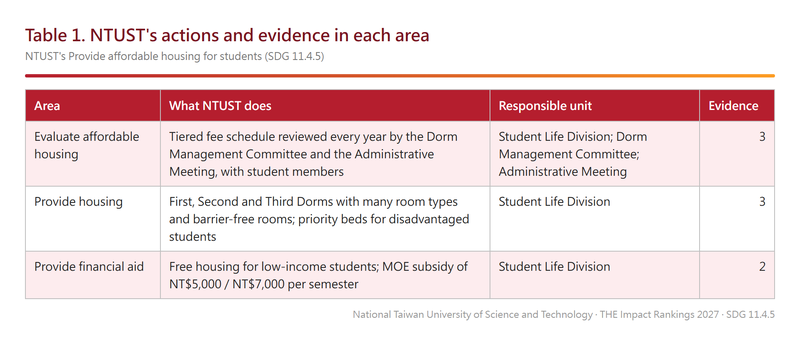
- Evaluate affordable housing: Dorm fees are reviewed by the Student Dormitory Management Committee, which includes the Student Association president and each dorm's head and deputy heads, and then approved by the Administrative Meeting. Fees have been reviewed every year since 2020. Rooms are priced in tiers, starting at NT$6,500 per semester (winter break included).
- Provide housing: Three on-campus dorms offer rooms and suites for two to six people, plus barrier-free rooms. Beds are allocated by published eligibility and priority rules, with students with disabilities and students from low-income and lower-middle-income households placed first.
- Provide financial aid: Low-income students live rent-free in exchange for service-learning hours. Under the Ministry of Education (MOE) on-campus housing subsidy, every domestic resident gets NT$5,000 off each semester, rising to NT$7,000 for students from low-income households.
The table below summarises NTUST's actions and evidence in each area:
NTUST's Student Dormitory Fees set prices by dorm, floor and room type. Fees per semester (winter break included) range from NT$6,500 to NT$27,500, with summer charged separately. The cheapest option, a six-person room in the Second Dorm, costs NT$6,500 per semester, or about NT$1,300 a month over a five-month semester. This is far below private rents near the campus. Fees for each room type are shown below:
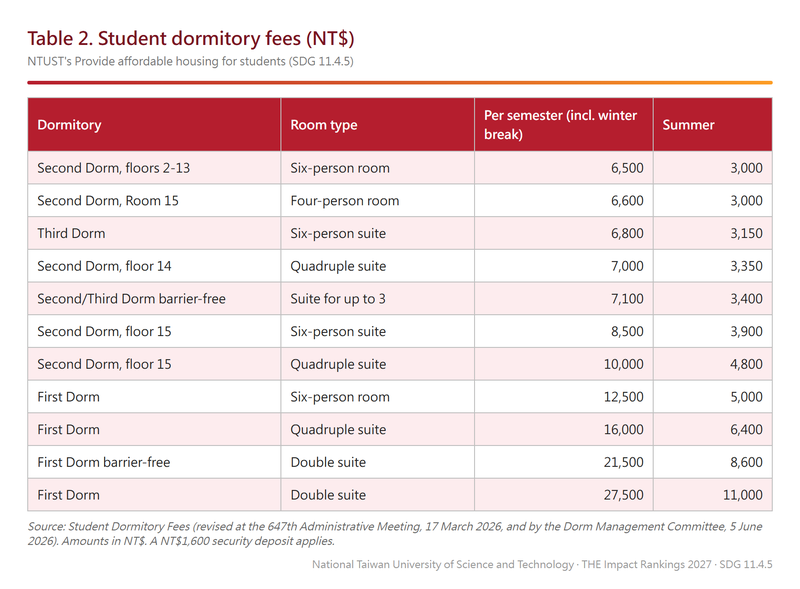
Source: Student Dormitory Fees (revised at the 647th Administrative Meeting, 17 March 2026, and by the Dorm Management Committee, 5 June 2026). Amounts in NT$. A NT$1,600 security deposit applies.
Fees are first reviewed by the Student Dormitory Management Committee. Under its Organization Rules, the Dean of Student Affairs chairs the committee. Members include the heads of the Construction and Maintenance Section and the Student Life Division, an Office of International Affairs representative, dorm advisors, a teacher from each college, the Student Association president, and each dorm's head and deputy heads. Its duties include reviewing and revising the rules on dorm allocation and fees. It meets at least once a semester.
After the committee's review, the fee schedule goes to the Administrative Meeting for approval. Since December 2020 it has been reviewed and revised every year, in 2021, 2022, 2023, 2024, 2025 and on 17 March 2026 (647th Administrative Meeting). It was most recently revised again by the Dorm Management Committee on 5 June 2026.
Other housing charges follow the same process. For example, the dorm deposit was set at NT$1,600 from academic year 2026 only after it was discussed by the dorm self-governance officers in October 2025 and approved by the Dorm Management Committee in spring 2026. This makes sure student views are part of the evaluation.
📎 Evidence links for this section
- Office of Student Affairs, Student Life Division (2026/03/17) Student Dormitory Fees (revised at the 647th Administrative Meeting, 17 March 2026): https://student.ntust.edu.tw/p/406-1053-82135,r1676.php?Lang=zh-tw
- Office of Student Affairs, Student Life Division (2024/03/08) Dormitory Management Committee Organization Rules (revised by the Student Affairs Meeting, 8 March 2024): https://student.ntust.edu.tw/p/406-1053-115285,r1676.php?Lang=zh-tw
- Office of Student Affairs, Student Life Division (2026/08/19) Announcement of the dorm deposit adjustment from academic year 2026 (approved by the dorm self-governance and management committees): https://student.ntust.edu.tw/p/406-1053-150812,r1436.php?Lang=zh-tw
NTUST runs the First, Second and Third Dormitories, offering six-person rooms, four-person rooms, six-person suites, quadruple suites, double suites, and barrier-free rooms in all three dorms. Students can check beds, housing information and photos on the Dormitory Applications page, and each dorm has its own information page. The dorms have kitchens, quiet rooms and living rules, and are managed under the Student Dormitory Regulations.
Under the 2026 eligibility and bed-allocation rules, students whose household registration has been outside Taipei City and nearby New Taipei districts for at least a year, international students, and students with disabilities or from low-income and lower-middle-income households can apply. First priority goes to students holding disability certificates in categories 2, 3 and 7, students from low-income and lower-middle-income households certified by local government, dorm self-governance officers and special cases approved by the Dorm Management Committee. Next come new undergraduates (first year of the four-year programme and third year, the entry year, of the two-year programme), followed by other groups by year and status. Remaining beds are filled by lottery.
This puts students with financial need or disabilities first in line for low-cost campus beds, reducing the cost of renting off campus.
📎 Evidence links for this section
- Office of Student Affairs, Student Life Division (Not stated) Dormitory applications (dorm pages, announcements, fees and regulations): https://student.ntust.edu.tw/p/412-1053-8395.php?Lang=zh-tw
- Office of Student Affairs, Student Life Division (2026/03/17) Dormitory eligibility and bed-allocation priority, academic year 2026 (647th Administrative Meeting): https://student.ntust.edu.tw/p/406-1053-87678,r1676.php?Lang=zh-tw
- Office of Student Affairs, Student Life Division (2025/06/01) Student Dormitory Regulations: https://student.ntust.edu.tw/p/406-1053-141728,r1436.php?Lang=zh-tw
Under the Guidelines on Free Accommodation with Service Learning for Low-income Students (approved 13 May 2021), any enrolled student who holds a government low-income certificate and lives in campus housing can apply for free accommodation (in-service and extended-study students excluded). Students submit the certificate when applying for a dorm, and the housing fee on their tuition bill is then NT$0. They complete the service-learning hours set for their room type and hand in a service-learning record card at the end of the semester. Internet fees and the deposit are not waived.
From spring 2025, NTUST has applied the MOE on-campus housing subsidy for college students. Domestic residents do not need to apply: NT$5,000 is deducted from each semester's bill automatically. Students admitted as international students who hold Taiwanese nationality qualify once they submit proof of nationality. Residents from low-income or lower-middle-income households receive NT$7,000 per semester.
In the cheapest room (Second Dorm six-person room, NT$6,500 per semester), a domestic student pays only NT$1,500 per semester after the subsidy, and a student from a low-income household pays nothing because the subsidy exceeds the fee. Where the subsidy is less than the fee, low-income students can cover the rest with service-learning hours, and lower-middle-income students pay only the difference.
📎 Evidence links for this section
- Office of Student Affairs, Student Life Division (2021/05/13) Guidelines on Free Accommodation with Service Learning for Low-income Students (approved 13 May 2021): https://student.ntust.edu.tw/p/404-1053-109915.php?Lang=zh-tw
- Office of Student Affairs, Student Life Division (2025/01) Spring 2025: MOE on-campus housing subsidy for domestic students - eligibility and FAQ: https://student.ntust.edu.tw/p/404-1053-121161.php?Lang=zh-tw
This indicator is supported by 8 published NTUST rules and announcements, grouped by area:
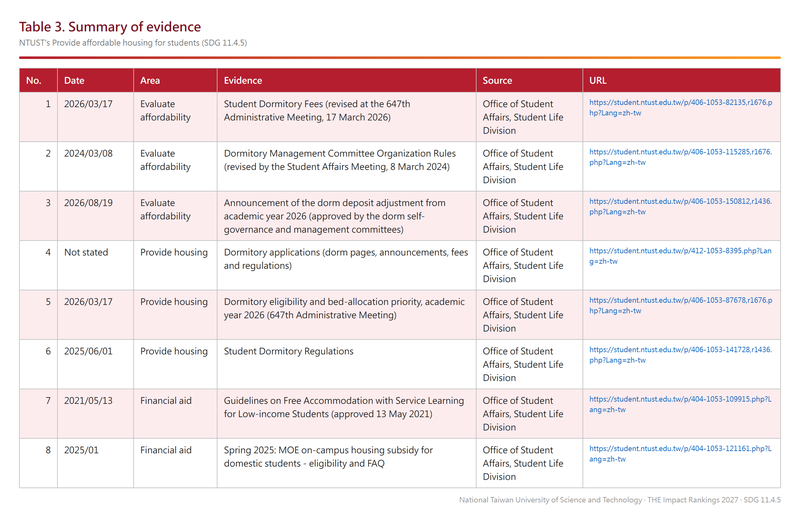
Summary: NTUST evaluates affordability through tiered pricing that keeps low-cost rooms available and an annual fee review by a Dorm Management Committee with student members and by the Administrative Meeting. It provides housing through three on-campus dorms, many room types and priority beds for disadvantaged students. It provides financial aid through free housing for low-income students and the MOE on-campus housing subsidy. After the subsidy, the cheapest room costs NT$1,500 per semester and students from low-income households pay nothing, so housing costs do not keep students from finishing their degrees.