NTUST works with government at national, regional and local levels on climate-change planning and disaster resilience. Two research projects funded by the National Science and Technology Council (NSTC) in 2024–2025 address climate action directly: one examines how collaborative multiplayer digital games build citizens' knowledge, attitudes and willingness to act on climate problems; the other analyses the transformation potential of Taiwan's Climate Change Response Act for companies and policy. At national level, NTUST co-hosted the "Youth Participation in Climate Action" series with the Ministry of Environment (May 2026), with speakers from the Ministry's Climate Change Administration. At local and regional level, NTUST's University Social Responsibility (USR) teams worked with Daxue Village (Da'an District, Taipei City) to turn a vacant building into a Resilient Community Disaster Prevention Center; built infrastructure and disaster-prevention systems with an Indigenous community in Nan'ao Township, Yilan County; protected the Feitsui Reservoir watershed in Pinglin through low-carbon tea farming; signed an MOU with the Guanshan Township Office in Taitung County; and sent volunteers to support flood recovery in Guangfu Township, Hualien County. The campus disaster-resilient microgrid also serves as a public demonstration site for energy security during disasters.
The two research projects below were approved and funded by the National Science and Technology Council (NSTC), a central government agency. Research outputs belong to NTUST. The projects support government climate policy from two angles: climate action education for citizens, and climate legislation and corporate transition.
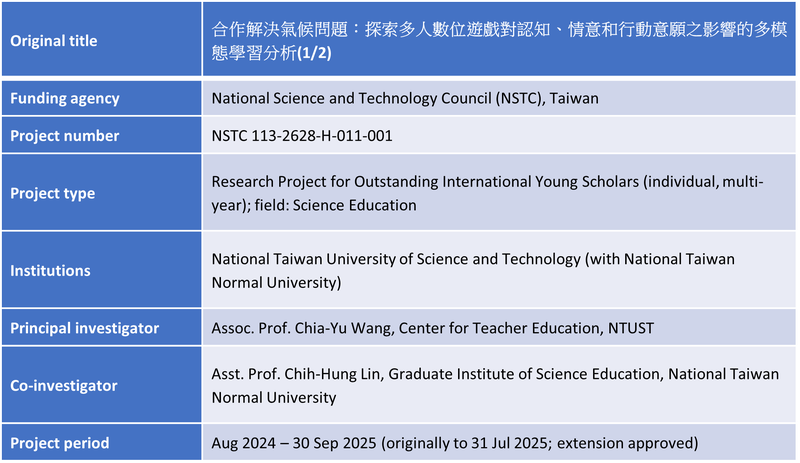
The project focuses on solving climate problems collaboratively. It uses multiplayer digital games as a setting for climate education, in which learners face climate change scenarios and make decisions as a team. Using multimodal learning analytics, it examines how the gameplay process affects learners' climate knowledge, attitudes and willingness to take climate action. The findings can give government and schools an evidence base for climate change education and public participation, helping turn mitigation and adaptation knowledge into actions people can take, in line with national climate policy goals for climate literacy.
Relevance to 13.3.3: Government-funded research that supports climate change education and citizen action planning, improving public awareness of and preparedness for climate-related disasters (mitigation and adaptation).
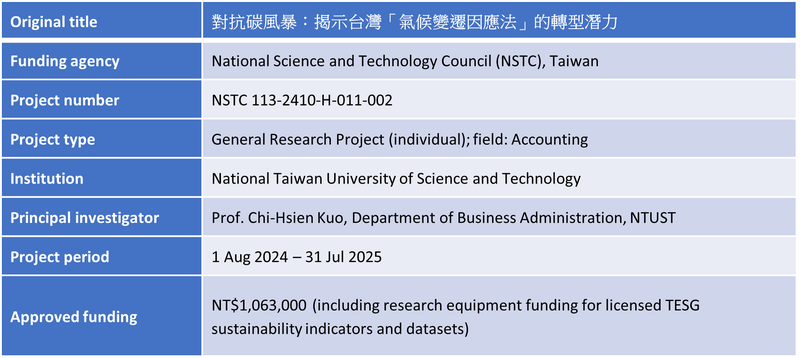
In 2023 Taiwan amended its Greenhouse Gas Reduction and Management Act into the Climate Change Response Act, which sets a 2050 net-zero target and introduces economic instruments such as a carbon fee. This project studies the Act, using TESG sustainability indicators and datasets to analyse how the law affects corporate emission reduction, disclosure and sustainability transition. The results can help government assess the effectiveness of climate legislation and refine mitigation and adaptation policy tools, and help companies respond to carbon pricing and climate risk. It is a concrete example of academic support for national climate governance.
Relevance to 13.3.3: Evidence-based evaluation of national climate legislation that informs government mitigation policy planning.
NTUST and the Ministry of Environment co-hosted a campus lecture in the "Youth Participation in Climate Action" series for universities, titled "Data, Technology and Civic Action: Co-creating Sustainable Cities Across Disciplines". Speakers came from the Ministry's Climate Change Administration, a weather risk management company, the Taiwan Green Energy Public Welfare Development Association and the Executive Yuan Youth Advisory Committee. NTUST faculty moderated the event and joined the panel discussion. Nearly 130 students and members of the public took part. The forum shared experience in climate governance and sustainability transition from policy, industry, civic advocacy and youth perspectives, and discussed how weather and climate data can be used to take part in climate action and strengthen urban climate resilience, building green-job skills among young people.
Source: NTUST news, https://www.ntust.edu.tw/p/406-1000-148240,r167.php?Lang=zh-tw ; CNA press release platform (28 May 2026)
In line with Taiwan's 2050 net-zero target, the Ministry of Education funded NTUST with NT$123 million through its Regional Industry Talent and Technology Training Base programme. NTUST leads a four-university alliance with National Yunlin University of Science and Technology, Ming Chi University of Technology and Kun Shan University to train talent in electric-vehicle powertrains and related technologies. The Minister of Economic Affairs attended the launch. The base is a partnership between central government and regional universities to cut emissions in the transport sector.
Source: Liberty Times, https://news.ltn.com.tw/news/life/breakingnews/5285907 (22 Dec 2025); https://news.ltn.com.tw/news/life/paper/1736945 (23 Dec 2025)
- Disaster Resilience with Local Government and Communities (Local)
Since 2024, NTUST's USR team (faculty and students from the Departments of Civil and Construction Engineering and Architecture) has worked with Daxue Village in Da'an District, Taipei. After consulting the village office and local stakeholders, the team turned a vacant old building on Section 3, Roosevelt Road into a Resilient Community Disaster Prevention Center for disaster education and emergency supplies. The team inspected and reinforced the structure, added a waterproof and insulating roof layer, repaired the exterior walls and installed drainage to stop flooding. Inside, emergency supplies are organised by function (alert, evacuation and first aid) with expiry-date tracking, and an evacuation route map is posted outside. The center strengthens the community's response to heavy rain, earthquakes and other disasters, and offers a new model of university–community cooperation on resilience.
Source: NTUST news, https://www.ntust.edu.tw/p/406-1000-142185,r167.php?Lang=zh-tw
NTUST runs the Ministry of Education USR programme "Engineers in Action" (EIA). Since 2020 it has worked for six consecutive years with the Atayal Indigenous community of Dongyue Village in Nan'ao Township, Yilan County, applying engineering skills to rural infrastructure, water resource improvements and disaster-prevention systems. In 2025, about 60 students and teachers from NTUST, Songshan Agricultural and Industrial Vocational High School, Osaka Institute of Technology (Japan) and Widya Mandala Catholic University (Indonesia) worked in the village together. The programme was exhibited at Expo 2025 Osaka and received a Merit Award (Sustainability Curriculum category) in the 2026 Global Views USR Awards.
Source: https://www.ntust.edu.tw/p/406-1000-138039,r167.php?Lang=zh-tw ; https://www.ntust.edu.tw/p/406-1000-140988,r167.php?Lang=zh-tw ; https://www.ntust.edu.tw/p/406-1000-142778,r167.php?Lang=zh-tw
NTUST's USR-Hub project "From Fields to Stage: An Experiment in Local Revitalisation" signed an MOU in 2025 with the Guanshan Township Office, the Guanshan Farmers' Association, the Department of Architecture at Waseda University and the University of Shiga Prefecture. The partners are jointly planning and designing the public spaces of the Farmers' Association's "Rice School", responding to rural ageing and out-migration and bringing sustainability and resilience into local public-space planning.
Source: NTUST news, https://www.ntust.edu.tw/p/406-1000-144924,r167.php?Lang=zh-tw
After typhoon rains caused severe damage in Guangfu Township, Hualien, in 2025, the NTUST Student Association and the EDBA/EMBA Alumni Association organised 60 students and 34 alumni over the Mid-Autumn Festival holiday to help residents clear mud and clean their homes, in line with local recovery needs. The NTUST Alumni Association and campus partner companies provided funding and supplies. The effort shows the university acting in support of local recovery after an extreme weather disaster.
Source: NTUST news, https://www.ntust.edu.tw/p/406-1000-141169,r167.php?Lang=zh-tw
- Regional Climate Adaptation and Emission Reduction (Regional)
The Smart Resilient Water Environment Lab led by Assoc. Prof. Chia-Chun Ho (Department of Civil and Construction Engineering) runs the project "Clean Water, Fragrant Tea, Thriving People: A Cross-sector Blueprint for Protecting the Feitsui Reservoir". It works in Pinglin, New Taipei City, in the watershed of the Feitsui Reservoir, the main water source for Greater Taipei. The team developed a slow-release low-phosphorus fertiliser and built bioretention cells to cut phosphorus pollution in tea-farm runoff, reducing carbon emissions by about 500 kg per hectare per year. It also connected nine companies and Rotary clubs with farmers to buy low-carbon tea, balancing regional water protection, climate mitigation and farmers' livelihoods. The project won a Model Award (Industry Co-creation category) in the 2026 Global Views USR Awards.
Source: NTUST news, https://www.ntust.edu.tw/p/406-1000-147199,r167.php?Lang=zh-tw
NTUST received a Smart Hydrogen Microgrid and Energy Storage System donated by Atemitech, the Yu-Hsiu Education Foundation and the Mitac-Synnex Group, and completed acceptance of a disaster-resilient microgrid with Smart Electric Systems. In April 2026 it hosted a seminar on disaster-resilient solar power, using the campus as a demonstration site to show industry, government and academia how critical loads can stay powered during disaster outages. The site offers a reference for local governments planning emergency shelters and resilient energy facilities.
Source: Liberty Times Finance, https://ec.ltn.com.tw/article/breakingnews/5203119 (7 Oct 2025); Economic Daily News (29 Jan 2026, 2 Apr 2026); Wealth Magazine (31 Mar 2026)
NTUST and National Dong Hwa University jointly ran greenhouse gas inventory auditor training and a review course for the Ministry of Economic Affairs iPAS Net-Zero Carbon Planning Manager certification in Hualien, helping eastern Taiwan build carbon management and net-zero skills that support local emission reduction policy.
Source: CNA (21 Jul 2026)
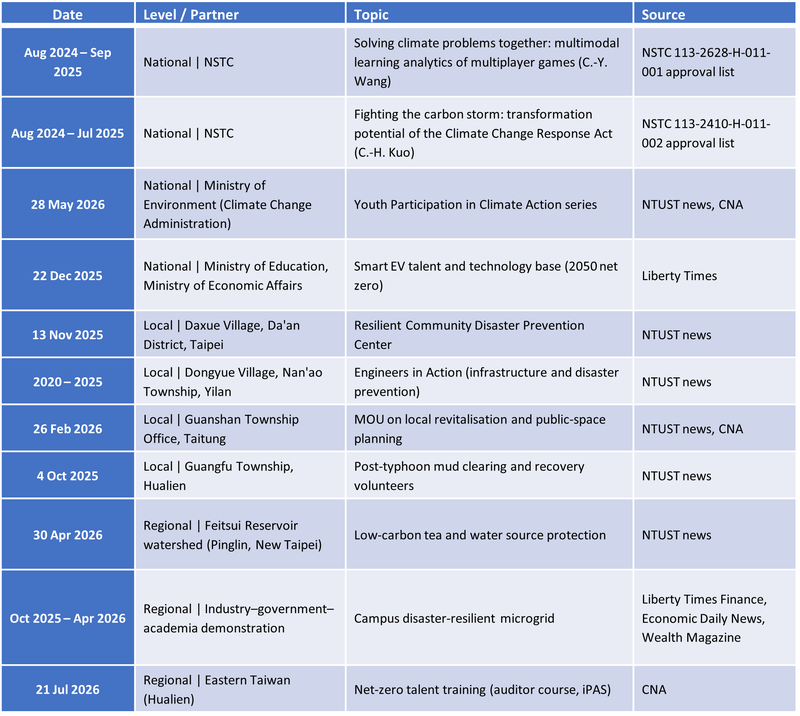
Note: This document is compiled from NTUST news releases, media reports and NSTC project funding approval lists. The research project descriptions are based on the project titles and approval details; for detailed findings, please refer to the interim or final reports provided by the principal investigators. Personal names are romanised for reference.