National Taiwan University of Science and Technology (NTUST) measures how its faculty and staff travel to campus each year and provides facilities that make public transport, cycling and zero-emission vehicles easy to use. This document presents the 2025 staff commuting inventory and the campus green transport measures.
Inventory year: 2025 (ROC year 114) | Scope: faculty and staff commuting, GHG Scope 3 | Campus: No. 43, Sec. 4, Keelung Rd., Da'an Dist., Taipei

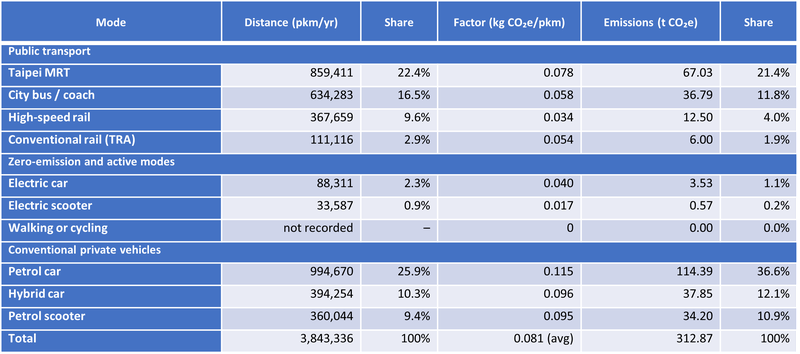
More than half of all staff commuting distance already runs on Taipei's public transport network, mainly the MRT and city buses. Public transport and zero-emission vehicles together account for 54.5% of commuting distance, while petrol and hybrid cars and petrol scooters account for 45.5%.
Emissions are concentrated in private vehicles. Petrol and hybrid cars cover 36% of commuting distance but produce 49% of commuting emissions. All private cars and scooters together produce 190.5 t CO₂e (60.9%), and public transport produces 122.3 t CO₂e (39.1%). Per passenger-kilometre, the Taipei MRT emits about a third less than a petrol car, and walking or cycling emits nothing.
NTUST is located on Keelung Road in Taipei, with a bus stop at the main gate and Gongguan MRT station about ten minutes away on foot. Building on this location, the university has worked with the Taipei City Government and private partners on the following facilities.
- YouBike 2.0 public bikes: NTUST took part in the Taipei Department of Transportation's YouBike 2.0 programme and secured an expanded service area around campus. There are now 8 rental stations, and docks have grown from 40 to 347 for students and staff.
- EV charging: four electric-vehicle charging stations on campus provide a total of 12 charging points.
- Electric-scooter battery swapping: NTUST invited Gogoro to open a GoStation battery-swap station on campus, in service since July 2019, to support zero-emission scooter commuting.
- Bus shelters on university land: under the National Property Act, NTUST provides setback land along the road free of charge to the Taipei City Public Transportation Office, which has built 3 bus shelters there.
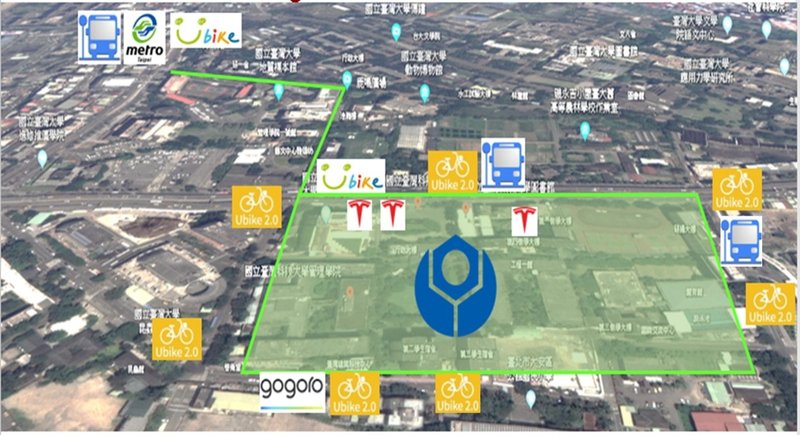
Figure 1. NTUST green transport network: YouBike 2.0 stations, bus stops, MRT access, EV charging stations and the battery-swap station around campus
- Each faculty and staff member reported the Google Maps distance from home to campus. Round-trip distance (×2) was summed over the working year.
- Each person was counted under their main mode of transport.
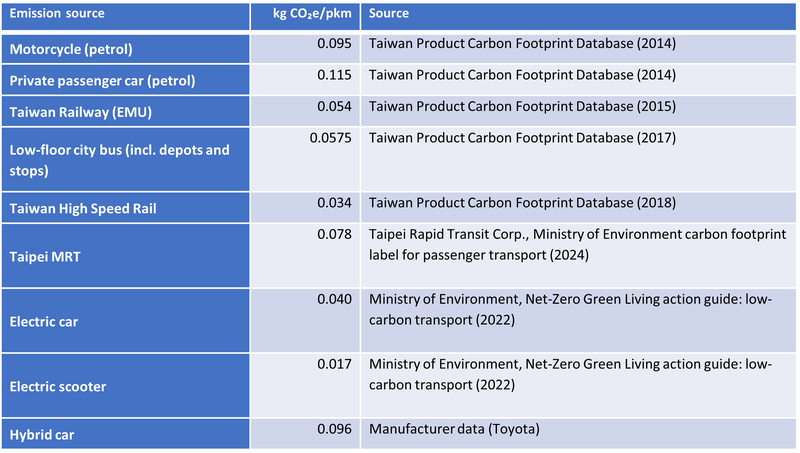
- Emissions = annual commuting distance × mode emission factor (kg CO₂e per passenger-km), reported as GHG Protocol Scope 3, Category 7 (employee commuting).
- Walking and cycling are counted as zero-emission. Their distance was not recorded in the 2025 survey.
National Taiwan University of Science and Technology, Office of General Affairs.
2025 (ROC 114) Scope 3 staff commuting emissions inventory.
"Building a green campus transport environment", Office of General Affairs announcement: https://www.general.ntust.edu.tw/p/406-1054-130103,r9.php?Lang=zh-tw