跳到主要內容
:::
:::
11.4.5_臺科大學生可負擔住宿_縮圖_514x556
NTUST's Provide affordable housing for students
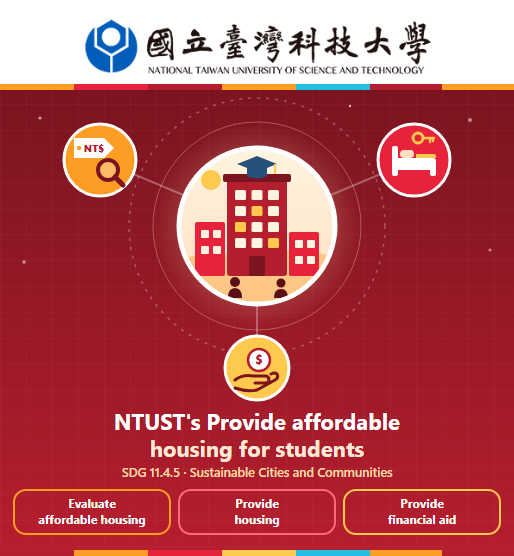
NTUST is in Da'an District, Taipei, one of the most expensive rental areas in Taiwan. So that housing costs do not stand in the way of study, NTUST runs three on-campus dormitories and makes sure students can afford them in three ways: Evaluate affordable housing: Dorm fees are reviewed by the Student Dormitory Management Committee, which includes the Student Association president and each dorm's head and deputy heads, and then approved by the Administrative Meeting. Fees have been reviewed every year since 2020. Rooms are priced in tiers, starting at NT$6,500 per semester (winter break included). Provide housing: Three on-campus dorms offer rooms and suites for two to six people, plus barrier-free rooms. Beds are allocated by published eligibility and priority rules, with students with disabilities and students from low-income and lower-middle-income households placed first. Provide financial aid: Low-income students live rent-free in exchange for service-learning hours. Under the Ministry of Education (MOE) on-campus housing subsidy, every domestic resident gets NT$5,000 off each semester, rising to NT$7,000 for students from low-income households.The table below summarises NTUST's actions and evidence in each area:1. Evaluate Affordable Housing1.1 Tiered prices that keep low-cost rooms availableNTUST's Student Dormitory Fees set prices by dorm, floor and room type. Fees per semester (winter break included) range from NT$6,500 to NT$27,500, with summer charged separately. The cheapest option, a six-person room in the Second Dorm, costs NT$6,500 per semester, or about NT$1,300 a month over a five-month semester. This is far below private rents near the campus. Fees for each room type are shown below: Source: Student Dormitory Fees (revised at the 647th Administrative Meeting, 17 March 2026, and by the Dorm Management Committee, 5 June 2026). Amounts in NT$. A NT$1,600 security deposit applies. 1.2 Regular review with student participationFees are first reviewed by the Student Dormitory Management Committee. Under its Organization Rules, the Dean of Student Affairs chairs the committee. Members include the heads of the Construction and Maintenance Section and the Student Life Division, an Office of International Affairs representative, dorm advisors, a teacher from each college, the Student Association president, and each dorm's head and deputy heads. Its duties include reviewing and revising the rules on dorm allocation and fees. It meets at least once a semester.After the committee's review, the fee schedule goes to the Administrative Meeting for approval. Since December 2020 it has been reviewed and revised every year, in 2021, 2022, 2023, 2024, 2025 and on 17 March 2026 (647th Administrative Meeting). It was most recently revised again by the Dorm Management Committee on 5 June 2026.Other housing charges follow the same process. For example, the dorm deposit was set at NT$1,600 from academic year 2026 only after it was discussed by the dorm self-governance officers in October 2025 and approved by the Dorm Management Committee in spring 2026. This makes sure student views are part of the evaluation.📎 Evidence links for this section Office of Student Affairs, Student Life Division (2026/03/17) Student Dormitory Fees (revised at the 647th Administrative Meeting, 17 March 2026): https://student.ntust.edu.tw/p/406-1053-82135,r1676.php?Lang=zh-tw Office of Student Affairs, Student Life Division (2024/03/08) Dormitory Management Committee Organization Rules (revised by the Student Affairs Meeting, 8 March 2024): https://student.ntust.edu.tw/p/406-1053-115285,r1676.php?Lang=zh-tw Office of Student Affairs, Student Life Division (2026/08/19) Announcement of the dorm deposit adjustment from academic year 2026 (approved by the dorm self-governance and management committees): https://student.ntust.edu.tw/p/406-1053-150812,r1436.php?Lang=zh-tw2. Provide Housing2.1 Three on-campus dorms with many room typesNTUST runs the First, Second and Third Dormitories, offering six-person rooms, four-person rooms, six-person suites, quadruple suites, double suites, and barrier-free rooms in all three dorms. Students can check beds, housing information and photos on the Dormitory Applications page, and each dorm has its own information page. The dorms have kitchens, quiet rooms and living rules, and are managed under the Student Dormitory Regulations.2.2 Published eligibility with priority for disadvantaged studentsUnder the 2026 eligibility and bed-allocation rules, students whose household registration has been outside Taipei City and nearby New Taipei districts for at least a year, international students, and students with disabilities or from low-income and lower-middle-income households can apply. First priority goes to students holding disability certificates in categories 2, 3 and 7, students from low-income and lower-middle-income households certified by local government, dorm self-governance officers and special cases approved by the Dorm Management Committee. Next come new undergraduates (first year of the four-year programme and third year, the entry year, of the two-year programme), followed by other groups by year and status. Remaining beds are filled by lottery.This puts students with financial need or disabilities first in line for low-cost campus beds, reducing the cost of renting off campus.📎 Evidence links for this section Office of Student Affairs, Student Life Division (Not stated) Dormitory applications (dorm pages, announcements, fees and regulations): https://student.ntust.edu.tw/p/412-1053-8395.php?Lang=zh-tw Office of Student Affairs, Student Life Division (2026/03/17) Dormitory eligibility and bed-allocation priority, academic year 2026 (647th Administrative Meeting): https://student.ntust.edu.tw/p/406-1053-87678,r1676.php?Lang=zh-tw Office of Student Affairs, Student Life Division (2025/06/01) Student Dormitory Regulations: https://student.ntust.edu.tw/p/406-1053-141728,r1436.php?Lang=zh-tw3. Provide Financial Aid3.1 Free housing for low-income studentsUnder the Guidelines on Free Accommodation with Service Learning for Low-income Students (approved 13 May 2021), any enrolled student who holds a government low-income certificate and lives in campus housing can apply for free accommodation (in-service and extended-study students excluded). Students submit the certificate when applying for a dorm, and the housing fee on their tuition bill is then NT$0. They complete the service-learning hours set for their room type and hand in a service-learning record card at the end of the semester. Internet fees and the deposit are not waived.3.2 MOE on-campus housing subsidyFrom spring 2025, NTUST has applied the MOE on-campus housing subsidy for college students. Domestic residents do not need to apply: NT$5,000 is deducted from each semester's bill automatically. Students admitted as international students who hold Taiwanese nationality qualify once they submit proof of nationality. Residents from low-income or lower-middle-income households receive NT$7,000 per semester.In the cheapest room (Second Dorm six-person room, NT$6,500 per semester), a domestic student pays only NT$1,500 per semester after the subsidy, and a student from a low-income household pays nothing because the subsidy exceeds the fee. Where the subsidy is less than the fee, low-income students can cover the rest with service-learning hours, and lower-middle-income students pay only the difference.📎 Evidence links for this section Office of Student Affairs, Student Life Division (2021/05/13) Guidelines on Free Accommodation with Service Learning for Low-income Students (approved 13 May 2021): https://student.ntust.edu.tw/p/404-1053-109915.php?Lang=zh-tw Office of Student Affairs, Student Life Division (2025/01) Spring 2025: MOE on-campus housing subsidy for domestic students - eligibility and FAQ: https://student.ntust.edu.tw/p/404-1053-121161.php?Lang=zh-twSummary of EvidenceThis indicator is supported by 8 published NTUST rules and announcements, grouped by area:Summary: NTUST evaluates affordability through tiered pricing that keeps low-cost rooms available and an annual fee review by a Dorm Management Committee with student members and by the Administrative Meeting. It provides housing through three on-campus dorms, many room types and priority beds for disadvantaged students. It provides financial aid through free housing for low-income students and the MOE on-campus housing subsidy. After the subsidy, the cheapest room costs NT$1,500 per semester and students from low-income households pay nothing, so housing costs do not keep students from finishing their degrees.
16.3.1
NTUST's Expert Advice to Government
National Taiwan University of Science and Technology (NTUST, Taiwan Tech) has long served as a bridge between industry and government decision-making. Its faculty experts and research teams provide professional advice, commissioned research and real-world testbeds to local, regional and national governments in engineering, information technology, smart manufacturing, green energy and sustainable development.Levels of governmentCybersecurity and Emerging TechnologiesNTUST runs a university-level Information Security Research and Teaching Center that brings together the Departments of Information Management and Computer Science and Information Engineering; it was among the first such centers at a Taiwanese university. Its director, Prof. Shi-Cho Cha (查士朝), leads a cross-university team in the Taiwan Information Security Center (TACC) on "Trustworthy Zero Trust Architecture for Critical Infrastructure", turning research into standards and tools that government and critical infrastructure operators can adopt.NTUST expert advice and contributionsZero-trust policy: supports the government in promoting zero-trust architecture and gives strategy recommendations to organizations adopting cybersecurity measures (national level).Financial regulation: helps financial institutions adopt zero trust and meet regulators' requirements for dynamic access control.Healthcare security: helps hospitals keep information secure while moving to hybrid cloud.Testing standards: builds a certification test platform for zero-trust products (also able to evaluate AI-based security products) to help competent authorities set inspection standards.Smart transport and unmanned vehicles: uses NTUST's ISO 17025-aligned laboratory to draft security test standards for smart-vehicle components, an evidence base for regulating smart transport and autonomous vehicles.National cyber talent: the Department of Computer Science and Information Engineering runs two sub-projects of the MOE Advanced Cybersecurity Practical Talent Program and co-organizes the MOE AIS3 summer school with the Department of Information Management.Related news reports and website linksNews reports:[2023-02-17] DIGITIMES | NTUST excels in cybersecurity talent development and keeps linking Taiwan's security industry (in Chinese)Websites:TACC – NTUST team: Trustworthy Zero Trust Architecture for Critical Infrastructure 2. Sustainable Development and Green Energy NTUST uses its campus as a Living Lab: results from its microgrid, energy storage and energy management systems become concrete recommendations on urban energy resilience, low-carbon circularity and net-zero pathways. The Sustainable Electrochemical Energy Development (SEED) Center and Prof. Tsai-Chi Kuo (郭財吉) of the Department of Industrial Management contribute expertise on electrochemical storage, circular economy and sustainability governance.NTUST expert advice and contributionsTaiwan's first urban campus microgrid (regional/local): NTUST was the first northern-region school in Taipower's University Energy Saving and Power Resilience project. The Huaxia Campus microgrid, completed in early 2026, combines 229.68 kWp of solar PV, 2 MWh of storage, two 100 kW DC fast chargers and a 400 kW diesel backup generator, funded by a NT$100 million Taipower subsidy and over NT$50 million from NTUST.Urban energy resilience: in a grid outage it switches to island mode, powering the whole campus for 4 hours, or 8 hours for priority loads. One campus building is also a New Taipei City emergency shelter where residents can charge devices, a model for disaster-ready urban power.Net-zero pathway: estimated savings of about NT$540,000 a year, rising to about NT$1.26 million with green-certificate sales. NTUST targets 50% carbon neutrality by 2030 and 100% by 2049.National recognition: NTUST received the Executive Yuan's 2024 National Sustainable Development Award (education category), presented by the Minister of Environment, for smart energy management, greenhouse gas inventory and sustainability education.SEED Center: battery, thin-film and hydrogen research teams carry out an NSTC academic summit research program and host the 2026 Lithium Battery & Electrochemical Energy Storage Industry–Academia Summit.Prof. Tsai-Chi Kuo: researches sustainable development, circular economy and smart manufacturing. As Secretary-General of the Taiwan Institute for Sustainable Energy, he spoke on university sustainability in the net-zero transition at the 2023 Net-Zero Emissions Technology Forum, held under the guidance of the MOE and NSTC.Related news reports and website linksNews reports:[2026-09-18] Commercial Times | NTUST builds Taiwan's first urban campus microgrid (in Chinese)[2026-09-21] 1111 Job Bank campus news | NTUST's urban campus microgrid saves energy daily and supplies power in disasters (in Chinese)[2024-12-20] Commercial Times | NTUST wins the 2024 National Sustainable Development Award (in Chinese)[2023-12-08] Commercial Times | Supporting the carbon economy: 2023 Net-Zero Emissions Technology Forum (in Chinese)Websites:Sustainable Electrochemical Energy Development Center (SEED)SEED: 2026 Lithium Battery & Electrochemical Energy Storage Industry–Academia SummitProf. Tsai-Chi Kuo, Department of Industrial Management3. Smart Manufacturing and Industrial UpgradingNTUST combines mechanical engineering, automation, AI and semiconductor technology through its Intelligent Manufacturing Innovation Center (IMIC) and its Heterogeneous Integration Silicon Photonic IC Center (HiSiPIC). Both inform smart factories, industrial transformation and the strategic chip supply chain, and open state-funded equipment to users across Taiwan.NTUST expert advice and contributionsIMIC: led by Chair Professor Shun-Feng Su (蘇順豐), it focuses on data centers, 5G networks, smart manufacturing (robotics, digital twins, AI, cyber-physical systems), sustainable energy and information security, and shares a site with the Industry 4.0 Implementation Center, a demonstration and training ground for SME upgrading.HiSPA alliance: on 9 April 2024 HiSiPIC and the Photonics Industry & Technology Development Association (PIDA) launched the International Silicon Photonics Heterogeneous Integration Alliance (HiSPA), linking industry, government, academia and research to build a silicon-photonics "Team Taiwan".National chip policy: NTUST set up the Graduate Institute of Advanced Semiconductor Technology and a Semiconductor Innovation and Application Research Center. Silicon-photonics measurement and packaging equipment funded by the NSTC Chip Innovation Program is open to researchers and companies nationwide through the TSRI sharing platform.Related news reports and website linksNews reports:[2024-12-28] United Daily News | Taiwan Tech launches semiconductor institute and research center for silicon photonics and advanced packaging (in Chinese)[2024-06-15] Business Next | "Silicon Photonics Team Taiwan" kickoff: the HiSPA alliance (in Chinese)Websites:Intelligent Manufacturing Innovation Center (IMIC)Heterogeneous Integration Silicon Photonic IC Center (HiSiPIC)HiSiPIC news archive 4.AI Applications and Talent DevelopmentNTUST hosts the Northern Taiwan AI Resource Center, linking 15 technical and vocational colleges in Taipei, New Taipei, Taoyuan and Hsinchu. Course design follows the MOE Future Talent AI Competency framework, so schools with fewer resources can share AI tools, instructors and teaching materials.NTUST expert advice and contributionsRegional AI capacity building: runs on three principles (shared resources, open cross-school enrolment and co-created, openly licensed materials). Courses map to the MOE's four competencies: learning with AI, using AI responsibly, solving problems with AI, and abilities AI cannot replace.Scale: 408 cross-school AI courses at 15 schools in the first semester of academic year 2026–27 (ROC year 115), plus 6 capacity-building courses run by the center this term.Related news reports and website linksWebsites:Northern Taiwan AI Resource Center – NTUST5.USR Projects and Local Government PartnershipsThrough University Social Responsibility (USR) projects and MOUs with local governments, NTUST brings engineering and management expertise to communities and young entrepreneurs, helping local governments solve local problems.NTUST expert advice and contributionsNew Taipei Youth Affairs Bureau MOU (16 July 2024): NTUST Dean of Industry–Academia Collaboration Cheng-Fa Yang (楊成發) and Bureau Director Chao-Mei Chiu (邱兆梅) signed an entrepreneurship resource-sharing MOU covering venues, equipment and expert talent. NTUST's incubation center has been named an Outstanding Incubator by the MOEA SME and Startup Administration ten times. The Bureau helps match startups to the B2G market, and NTUST-incubated Andgreen joined the city's startup procurement list.Gongguan–Chengnan disaster-resilience USR: led by Prof. Chien-Kuo Chiu (邱建國), the team works with the chiefs and residents of Fushui, Shuiyuan and Xuefu villages on town meetings, disaster-preparedness courses and evacuation-map workshops, is building an AI disaster-information chatbot, and is planning smart slope monitoring at Treasure Hill.Advice to a central agency on heritage repair: the team assessed the "Anzhai No. 3" building in Xueren Village for the Ministry of National Defense and recommended emergency repairs, then drafted reuse plans with residents. Its showcase drew MND units and Zhongzheng District village chiefs.Related news reports and website linksNews reports:[2024-07-16] NTUST Secretariat news (English) | Taiwan Tech and New Taipei City Government Youth Department sign MOU to promote interdisciplinary cooperation[2024-07-16] NTUST news (Chinese) | Taiwan Tech x New Taipei Youth Affairs Bureau sign MOU to advance youth entrepreneurship (in Chinese)[undated] NTUST USR website | Improving disaster resilience in the Gongguan–Chengnan settlements through community renewal (in Chinese)6. Summary of News CoverageCoverage by levelNote: the microgrid reports count under both Regional (Taipower northern region) and Local (New Taipei shelter). News and evidence list
減碳存摺海報
NTUST's Sustainable Commuting Initiative
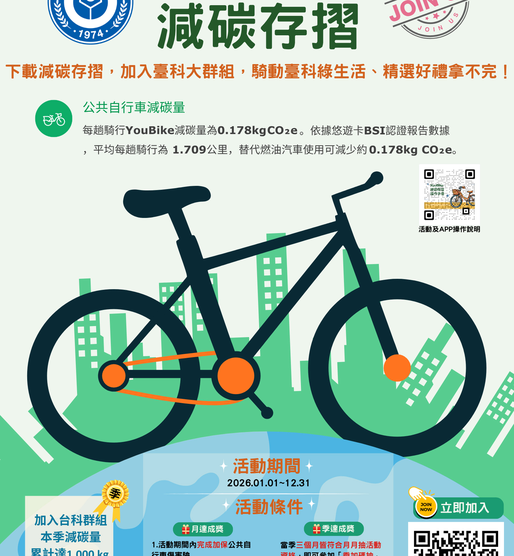
Does the university as a body promote sustainable commuting? Yes.National Taiwan University of Science and Technology (NTUST) promotes walking, cycling, public transport and zero-emission vehicles in three ways: a university-wide YouBike cycling incentive campaign in 2026, low-carbon transport facilities on and around campus, and an annual inventory of how staff commute and the emissions it causes. 1. Campaign: YouBike Carbon Reduction Passbook, NTUST group (2026)NTUST's Office of Environment and Safety has partnered with YouBike, Taipei's public bike-sharing system, to run the "YouBike Carbon Reduction Passbook" campaign for all students, faculty and staff. Participants record the carbon they save by riding YouBike in daily commuting and travel, and earn rewards as individuals and as a campus group.Campaign period: 1 January to 31 December 2026.How to join: take out public-bike accident insurance, download and log in to the Carbon Reduction Passbook app, and join the NTUST group.Qualifying riders: ride YouBike on at least 11 days a month and save at least 4 kg CO₂e a month.Individual rewards: a monthly draw of 2,000 winners across all YouBike service areas, and a quarterly bonus draw (with a smartphone as the top prize) for riders who qualify in all three months of a quarter.Group reward: when the NTUST group saves 1,000 kg CO₂e in a quarter, members receive extra free-ride vouchers, so every rider's trips count toward a shared campus goal.Impact: according to certified data cited by the campaign, each YouBike trip saves about 0.178 kg CO₂e on average.Campaign announcement: https://she.ntust.edu.tw/p/406-1068-151160,r1497.php?Lang=zh-tw2. Low-carbon transport facilitiesNTUST is on Keelung Road in Taipei, with a bus stop at the main gate and Gongguan MRT station about ten minutes away on foot. The university has worked with the Taipei City Government and private partners to add the following facilities.YouBike 2.0 public bikes: NTUST joined the Taipei Department of Transportation's YouBike 2.0 programme and secured an expanded service area. There are now 8 rental stations around campus, and docks have grown from 40 to 347.EV charging: 4 charging stations on campus with 12 charging points.Electric-scooter battery swapping: a Gogoro GoStation battery-swap station on campus, in service since July 2019 at NTUST's invitation.Bus shelters: NTUST provides setback land along the road free of charge, under the National Property Act, to the Taipei City Public Transportation Office, which has built 3 bus shelters there. Facilities announcement (Office of General Affairs): https://www.general.ntust.edu.tw/p/406-1054-130103,r9.php?Lang=zh-tw 3. Measuring how staff commuteNTUST surveys how its faculty and staff travel to campus and reports the resulting emissions as GHG Protocol Scope 3, Category 7 (employee commuting). In 2025, staff commuted 3.84 million passenger-km and produced 312.9 t CO₂e. Public transport and zero-emission vehicles already cover 54.5% of commuting distance. Petrol and hybrid cars and petrol scooters cover the remaining 45.5% but produce 60% of emissions, which is why the campaigns and facilities above focus on moving these trips to cycling, transit and electric vehicles.EvidenceYouBike Carbon Reduction Passbook campaign, Office of Environment and Safety: https://she.ntust.edu.tw/p/406-1068-151160,r1497.php?Lang=zh-twBuilding a green campus transport environment, Office of General Affairs: https://www.general.ntust.edu.tw/p/406-1054-130103,r9.php?Lang=zh-tw2025 (ROC 114) Scope 3 staff commuting emissions inventory, NTUST.
NTUST green transport network
NTUST Sustainable Commuting Targets
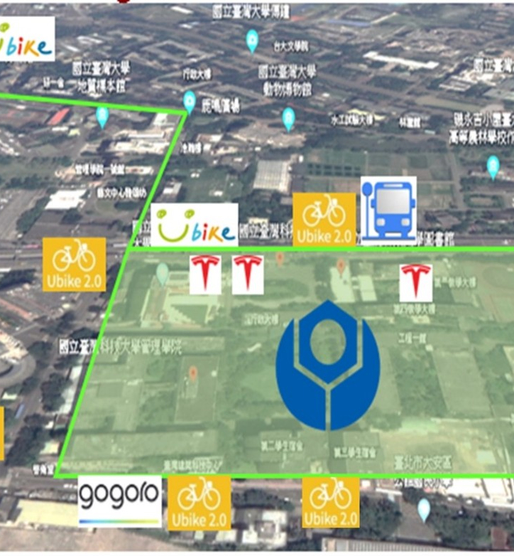
National Taiwan University of Science and Technology (NTUST) measures how its faculty and staff travel to campus each year and provides facilities that make public transport, cycling and zero-emission vehicles easy to use. This document presents the 2025 staff commuting inventory and the campus green transport measures.Inventory year: 2025 (ROC year 114) | Scope: faculty and staff commuting, GHG Scope 3 | Campus: No. 43, Sec. 4, Keelung Rd., Da'an Dist., Taipei1. How staff commute: 2025 inventoryMore than half of all staff commuting distance already runs on Taipei's public transport network, mainly the MRT and city buses. Public transport and zero-emission vehicles together account for 54.5% of commuting distance, while petrol and hybrid cars and petrol scooters account for 45.5%.Emissions are concentrated in private vehicles. Petrol and hybrid cars cover 36% of commuting distance but produce 49% of commuting emissions. All private cars and scooters together produce 190.5 t CO₂e (60.9%), and public transport produces 122.3 t CO₂e (39.1%). Per passenger-kilometre, the Taipei MRT emits about a third less than a petrol car, and walking or cycling emits nothing.Table 1. Staff commuting distance and emissions by mode, 20252. Campus measures for low-carbon commutingNTUST is located on Keelung Road in Taipei, with a bus stop at the main gate and Gongguan MRT station about ten minutes away on foot. Building on this location, the university has worked with the Taipei City Government and private partners on the following facilities.YouBike 2.0 public bikes: NTUST took part in the Taipei Department of Transportation's YouBike 2.0 programme and secured an expanded service area around campus. There are now 8 rental stations, and docks have grown from 40 to 347 for students and staff.EV charging: four electric-vehicle charging stations on campus provide a total of 12 charging points.Electric-scooter battery swapping: NTUST invited Gogoro to open a GoStation battery-swap station on campus, in service since July 2019, to support zero-emission scooter commuting.Bus shelters on university land: under the National Property Act, NTUST provides setback land along the road free of charge to the Taipei City Public Transportation Office, which has built 3 bus shelters there.Figure 1. NTUST green transport network: YouBike 2.0 stations, bus stops, MRT access, EV charging stations and the battery-swap station around campus3. How the inventory was calculatedEach faculty and staff member reported the Google Maps distance from home to campus. Round-trip distance (×2) was summed over the working year.Each person was counted under their main mode of transport.Emissions = annual commuting distance × mode emission factor (kg CO₂e per passenger-km), reported as GHG Protocol Scope 3, Category 7 (employee commuting).Walking and cycling are counted as zero-emission. Their distance was not recorded in the 2025 survey.Table 2. Emission factors and sourcesSourcesNational Taiwan University of Science and Technology, Office of General Affairs.2025 (ROC 114) Scope 3 staff commuting emissions inventory."Building a green campus transport environment", Office of General Affairs announcement: https://www.general.ntust.edu.tw/p/406-1054-130103,r9.php?Lang=zh-tw
Indigenous students opened the exhibition with a performance at the opening reception
NTUST's Record and preserve cultural heritage
National Taiwan University of Science and Technology (NTUST, Taiwan Tech) records, preserves and revitalises cultural heritage through its University Social Responsibility (USR) projects, the Center for General Education's South Side College, the Indigenous Students Resource Centre and student practice. Work covers three areas: local and regional heritage, such as the historic South Side (Chengnan) settlements around campus and Yuanli's rush-weaving craft; national heritage, including the cultures of Taiwan's Indigenous peoples and the Hakka; and the heritage of displaced communities, notably Huanmin New Village at Toad Mountain, a former military dependents' village settled by soldiers and families who came to Taiwan after 1949. Toad Mountain was designated a Taipei cultural landscape in 2016. Students and faculty document these places and traditions through fieldwork, bilingual guiding, courses, exhibitions and design, so that the public can learn and carry them on. Taiwan Tech's "Inabayan: Stories and Roots" performance celebrates Nanwang Culture through food and storytelling (21 Sep. 2026) For the 8th annual showcase of the Indigenous Youth Society, Indigenous students from different disciplines and ethnic groups spent more than six months visiting the Nanwang Puyuma community in Taitung to learn from its members. Held from 14 to 24 September 2026, the showcase featured a dining-table exhibition where community members and students shared food and life stories, cultural artefacts, a flower-garland workshop, the lecture "Puyuma, My Homeland: Exploring Memories Across Time and Space" by the former director of the National Museum of Prehistory, and a traditional Puyuma music and dance performance. It covered the Puyuma youth gathering house (palakuwan) and the ties between the community and the city. Inabayan means "hello" in the Nanwang variety of Puyuma.News linksEnglish: https://www.ntust.edu.tw/p/406-1000-152615,r1182.php?Lang=enTaiwan Tech partners with Huanmin New Village to bring general education into the community (31 Aug. 2026)The Center for General Education's South Side College signed a memorandum of understanding with the Taipei Culture Foundation's Huanmin New Village at Toad Mountain to support community-based learning, revitalise local spaces and exchange culture. Huanmin New Village brings together military-village heritage, settlement life, hillside ecology and contemporary art. Under the agreement, Taiwan Tech holds courses, workshops and exhibitions in the village. Existing courses already use the site: South Side Short Trips introduces how the settlements developed, Art and Public Environment has students propose art projects for Toad Mountain, Cultural Heritage and Sustainable Development (TCG136301, taught in English) studies reuse of Taiwan Tech's Japanese-era dormitories, and Painting South Side Culture records cultural sites in watercolour. The partners will link the village with Treasure Hill Artist Village, Gongguan Shuiyuan Market and Taipei Hakka Culture Park as a "South Side Learning Network".News linksEnglish: https://www.ntust.edu.tw/p/406-1000-151734,r1182.php?Lang=en中文(臺科大攜手蟾蜍山煥民新村 通識教育走進城南文化廊帶): https://www.ntust.edu.tw/p/406-1000-151078,r167.php?Lang=zh-twTaiwan Tech turns the south side into a living classroom to build cross-disciplinary skills (13 Aug. 2026)From 7 to 10 July 2026, the Center for General Education ran a four-day immersive summer school for 13 high-school students, supported by 15 Taiwan Tech undergraduate peer-learning partners and nearly all of the Center's full-time faculty. Participants did fieldwork, environmental observation and hands-on work in three South Side settlements: Treasure Hill Artist Village, Fanglan Mountain and Huanmin New Village, an ageing military dependents' village. They explored how art coexists with residential life, ethnic cultures and military-village heritage, and worked in teams on proposals for cultural preservation, local revitalisation and cultural sustainability.News linksEnglish: https://www.ntust.edu.tw/p/406-1000-151741,r1182.php?Lang=en中文(2026城人式:台科識視營知識與視野夏校): https://www.cna.com.tw/postwrite/chi/441512Taiwan Tech students create a new model for Yuanli's Rush Grass Heritage (6 Aug. 2026)Hsien-Tse Lai, a master's student in the Department of Design, returned to his hometown of Yuanli, Miaoli, and joined the Taiwan Rush Grass Association. Yuanli's rush weaving was once exported worldwide as hats and mats, but the craft declined as industry moved away and skilled weavers aged. Lai turned knowledge once passed on orally through apprenticeship into illustrated teaching materials and kits that people can use at home, backed by short intensive courses and trained seed teachers. He also helps restore rush fields, introduces visitors to the full cycle from planting and harvesting to weaving, and created rush-themed banquets and ceramic tableware. The average age of participants has fallen from the seventies to the forties. The project won a GOOD DESIGN AWARD 2025 BEST100 (Regional Planning, 100 chosen from 5,225 entries) and a GOOD FOCUS AWARD [New Business Design].News linksEnglish: https://www.ntust.edu.tw/p/406-1000-151749,r1182.php?Lang=en中文(從家鄉苑裡出發 臺科大學生打造藺草傳承新模式): https://www.ntust.edu.tw/p/406-1000-150464,r167.php?Lang=zh-twIndigenous village journey: Amis shaman ritual culture (29 Oct. 2025)The Indigenous Students Resource Centre invited Mahengheng Akang, a ritual priest of the Lidaw Amis community, to share first-hand the beliefs and rituals of the Amis shamans (Sikawasay), who lead prayers for blessing, healing and protection and act as a bridge between the community and ancestral spirits.News links中文(部落漫遊x阿美族巫師祭儀文化): https://indigenous-r.ntust.edu.tw/p/404-1108-143142.php?Lang=zh-twTaiwan Tech empowers Nepal's mountain communities with local revitalisation and disaster education (23 Sep. 2025)In the fourth year of its work in Nepal, the USR team continued restoring a century-old traditional house in Upper Pisang, Annapurna region, as the "Story Café", a cultural hub that shares local history and culture with travellers. The retaining wall in front of the house was completed, and the team installed new signposts and a guide map. Earlier, students learned traditional building materials, methods and customs from village elders and surveyed the house to prepare drawings and repair designs.News linksEnglish: https://www.ntust.edu.tw/p/16-1000-141506.php?Lang=enTaiwan Tech's "Hata: still on the road" brings innovation to Atayal indigenous villages (Sep. 2025)The Indigenous Students Resource Centre and the Indigenous Youth Society based their 2025 annual showcase on students' learning in Jinyue village, an Atayal community in Nan'ao, Yilan. Students turned their fieldwork on Atayal history and culture into four works, Breath, Shuttle, Intersection and Pulse, including traditional rattan weaving, a material used in daily village life. Hata means "to walk, to set out" in Atayal.News linksEnglish: https://www.secretariat.ntust.edu.tw/p/404-1063-140986.php?Lang=en中文(臺科大「hata還在路上」走進泰雅族部落): https://www.ntust.edu.tw/p/406-1000-140656,r167.php?Lang=zh-twBilingual heritage guide training at Toad Mountain settlement (3 Sep. 2025)The Department of Civil and Construction Engineering trained 20 Taiwan Tech students as bilingual (Chinese/English) guides at Huanmin New Village. Training covered guiding skills, a guide-robot app and a tour of the Toad Mountain settlement, so that students can tell the stories of the campus's neighbourhood to local and international visitors as part of the university's USR work.News links中文(114年臺科大雙語(中、英)導覽員培訓課程--蟾蜍山聚落): https://www.ct.ntust.edu.tw/ct/articles/view/15223Taiwan Tech Immersive Summer School integrates tech, humanities, and public issues to empower communities (5 Aug. 2025)The South Side College's Urban STREAM Immersive Summer School (1–5 July 2025) took high-school students on fieldwork to South Side settlements including Treasure Hill Artist Village and Huanmin New Village at Toad Mountain. Participants learned about military-village history and the old settlements of Taipei and proposed projects on local issues.News linksEnglish: https://www.ntust.edu.tw/p/406-1000-140046,r1182.php?Lang=en中文(當科技遇上人文,臺科大城南學院STREAM沉浸式夏校帶領學子進行「城人式」): https://www.cna.com.tw/postwrite/chi/408817Promoting Hakka Culture: Taiwan Tech General Education demonstrates the art of opera (Jun. 2025)With funding from the Hakka Affairs Council, the Center for General Education offers Exploring the Aesthetics of Hakka Opera Costume and Makeup (2 credits). Students study Hakka history and the development of Hakka opera, use Hakka floral fabric in costume design, and learn make-up, props and stage gestures. At the end-of-term showcase they performed the classic Hakka opera Tiao Jiu in the Hakka language, alongside two more plays, one mixing Hakka, Taiwanese and English. A Hakka opera performer and researcher assessed the performances.News linksEnglish: https://www.secretariat.ntust.edu.tw/p/404-1063-138171.php?Lang=en中文(演繹精彩客家文化 臺科大通識教育教學成果秀戲曲魅力): https://www.ntust.edu.tw/p/406-1000-137743,r167.php?Lang=zh-twRevitalising the space beside Historic Building No. 92 at Toad Mountain settlement (since 10 Feb. 2025)Since 10 February 2025, Taiwan Tech's Center for General Education has been the custodian of the open space and storeroom beside Historic Building No. 92 in the Toad Mountain settlement. The university revitalised this unused space as a base for real-time monitoring of the historic building, a venue for residents to meet and train in disaster evacuation, and a classroom for disaster-preparedness training.The revitalised space beside Historic Building No. 92 is used as a classroom for disaster-preparedness training .Taiwan Tech staff and community members inspect the space at Toad Mountain settlement.
電池材料產學「Master Talk」
推展跨領域(跨國)學術研究
校級研究中心本校校級研究中心致力於前瞻性與實務性研究,結合多年專業實力與產業資源,與政府及民間組織合作,推動國家政策和永續發展目標(SDGs),強化校內研發與產業界的可持續關係,培養並引進高階產研人才。透過技術整合,開發多元領域的前瞻技術,與國內外專家合作,如辦理多項交流活動(如知名學人來訪、SEED 系列演講),與國內外學校/機構簽訂MOU或實際展開交流工作,或選送學生和年輕學者赴國外進修等,聚焦本校優勢領域,提升專業水準與技術研發能力,最大化產業效能。本校最新成立「技職賦能研究中心」及「製程淨零研究中心」,這兩所校級研究中心符合聯合國永續發展目標中的「4.優質教育」及「11.永續城市與社區」,並將繼續推動永續環境、永續社會和永續能源的發展。跨領域(跨國)學術研究第10屆國際先進科技論壇國際先進技術論壇由國立臺灣科技大學、日本德島大學輪流舉辦,第10屆國際先進技術論壇(International Forum Advanced Technology 2024)於3月8日在日本德島大學舉行,研究的相關議題包含奈米技術與先進材料、先進測量與等離子技術、光學工程與成像感測技術、工業管理與設計等,並邀請台日傑出青年學者到場展示和討論工程領域的研究趨勢,持續促進學術合作和科技應用。波蘭華沙理工大學來訪波蘭華沙理工大學(Warsaw University of Technology)由副校長Prof. Malinowski Mariusz帶隊於6月21日至本校拜訪,共同討論兩校未來學術合作的細節,研究領域聚焦於半導體雷射、光子集成電路、先進封裝路由與優化、生物醫學感測前端與刺激器、AI影像處理及機器學習設計優化等。本學術合作專題研究計畫由雙方共同出資研究經費,並於7月1日起徵件開放雙方研究人員申請,期待透過這些合作推動更深入的國際學術交流和創新研究。本校與臺北醫學大學學術研究成果發表會自2010年以來,本校與臺北醫學大學攜手合作,致力於推動跨領域整合研究,從單一計畫發展至跨領域應用研究團隊,共同研發創新醫療技術,促進了多元學術交流,強化彼此的研究實力,並充分發揮各自的優勢,實現了優勢互補,更促成了多個跨校整合團隊的成立。在兩校教研人員共同努力下,目前已建立超過140項合作計畫,涵蓋醫療器材、輔具、藥物應用、生醫材料開發及醫療影像等多個領域,並於6月19日舉辦兩校學術成果發表會,期望合作能持續造福社會。