跳到主要內容
:::
:::
7.4.1_臺科大清潔能源與能源效率推廣_縮圖_514x556
NTUST's Local community outreach for energy efficiency
Through University Social Responsibility (USR) projects, the Center for General Education and industry partnerships, NTUST takes its energy expertise to Indigenous villages in Hualien and Taoyuan, communities in Taipei and the neighbourhood of its Huaxia Campus in New Taipei, and has turned the campus itself into an open energy demonstration site. News coverage from the past two years shows five themes: Tribal energy education: Gong-Hao Spark+ and Taipower's Eastern Power Plant: An MOU with Taipower's Eastern Power Plant; the "Saving Power Starts with Me" summer school at Tongmen Elementary School in Hualien; the "Energy Monopoly" teaching game; and a renewed Mugua River Story House. Green energy for disadvantaged and Indigenous children: The USR "Sustainable Green Energy and Carbon Reduction" project installed solar panels and flywheel generators at Bethany Children's Home; with the Dandelion Hope Foundation, NTUST ran hands-on green-energy lessons for Indigenous pupils in Fuxing District, Taoyuan. Empathy Social Lab - CGE Social Practice Week "Re: Power": The Center for General Education and Taipower held 9 exhibitions, talks and visits over 5 days to help students and the public think about the energy transition in daily life. Taiwan's first urban campus microgrid: open demonstration and community resilience: The Huaxia Campus microgrid combines solar power, storage, backup generation and an energy management system (EMS) to save energy every day and supply power in disasters. It is open for visits and provides emergency charging to nearby residents during blackouts. Extension education: ESG sustainability management training: The Center for Continuing Education runs a 300-hour pre-employment ESG Sustainability Management Practice Class that builds green-job skills for job seekers.The table below summarises the audience, main actions and supporting news for each theme:1. Tribal Energy Education: Gong-Hao Spark+ USR Project with Taipower's Eastern Power Plant1.1 From a language summer school to an energy summer schoolSince 2023, NTUST's Gong-Hao Spark+ USR team has run a science summer school at Tongmen Elementary School in Hualien, first focused on language and robotics. Seeing how closely village life is linked to Taipower's hydropower facilities, the team was introduced by the school to Taipower's Eastern Power Plant. Taipower engineers taught NTUST students on site at the Chuying and Rongshu units, giving them a solid understanding of hydropower and grid operation for developing teaching materials.In 2025 the two partners ran the "Tongmen Summer School: Saving Power Starts with Me", with a hydropower science class and a "Where Does Green Energy Go?" activity that explained, in terms children understand, where electricity comes from and why saving it matters.1.2 An MOU for a long-term partnershipProject leader Ying Wang and Plant Manager Chung-Yi Lee of the Eastern Power Plant signed a memorandum of understanding for long-term cooperation on green-energy education, translating power knowledge for the public, revitalising local sites and video documentation, built around "local connection x citizen science x sustainable action". Wang said the aim is to build "a bridge from the power plant to the village classroom".1.3 Turning power science into a game children can playNTUST students used their design and engineering skills to create the "Energy Monopoly" game. It grew from a small station-based activity into a sustainability game map several metres long covering wind, hydro and grid logic, using blown balls to simulate wind power and plastic bottles to show hydropower. Plant Manager Lee took part in person two years running and suggested adding advanced topics such as carbon credits and green-energy labels.The partners also renewed Taipower's Mugua River Story House with interactive exhibits such as a retired turbine guide vane and working models, and launched a local power and culture video project in which Tongmen pupils, parents and Taipower engineers film local stories together to build a community energy archive.📰 News and evidence links for this section NTUST Official Website (2025/08/21) From tribal classroom to power plant: NTUST's Gong-Hao Spark+ project builds a bridge for energy education: https://www.ntust.edu.tw/p/406-1000-139425,r167.php?Lang=zh-twAlso reported by: CNA PR Newswire https://www.cna.com.tw/postwrite/Chi/410239; PChome News https://news.pchome.com.tw/living/cna/20250821/index-17557621156752918009.html; yam News https://n.yam.com/Article/202508218736572. Green Energy for Disadvantaged and Indigenous Children2.1 Bethany Children's Home: solar panels and flywheel powerAssociate Professor Cheng-Jhe Lin (Industrial Management) and Assistant Professor Hung-Lung Chou (Applied Science and Technology) led a USR team on the "Sustainable Green Energy and Carbon Reduction" project, installing a rooftop solar system and flywheel generators with storage at Bethany Children's Home in Taipei. The Rotary Club of Taipei Chung An and Ho An Insurance Agency donated the flywheel generators.Each flywheel generator produces about 500 W and about 4 kWh over 8 hours of use, directly lowering the home's electricity bills. The team also ran flywheel contests and quizzes so the children could turn their own effort into electricity and learn to save energy in daily life.2.2 Dandelion Hope Foundation: an Earth Day green-energy lesson for Indigenous pupilsOn Earth Day 2026, the Dandelion Hope Foundation and NTUST's Graduate Institute of Applied Science and Technology ran a "Sustainable Green Energy Education" event for pupils from Luofu and Kuihui Elementary Schools in Fuxing District, Taoyuan, at the Dandelion Sustainable Ecological Park. Professor Hung-Lung Chou brought interactive solar models, hand-crank generators and a pedal-powered dance machine so the children could experience energy conversion first-hand, alongside sensory nature activities and an organic-soil classroom.📰 News and evidence links for this section NTUST Official Website (2024/09/23) Learning green energy through play: NTUST brings flywheel power generation to disadvantaged children: https://www.ntust.edu.tw/p/406-1000-129038,r167.php?Lang=zh-twAlso reported by: CNA PR Newswire https://www.cna.com.tw/Postwrite/Chi/382109; Taiwan Shin Sheng Daily News https://www.tssdnews.com.tw/?FID=46&CID=764815 Commercial Times (2026/04/22) Earth Day lesson with the Dandelion Foundation: Indigenous pupils generate power with their own feet and experience green energy: https://www.ctee.com.tw/news/20260422702078-4312083. Empathy Social Lab - CGE Social Practice Week "Re: Power"3.1 An energy-themed week with TaipowerFrom 18 to 22 May 2026, the Center for General Education held the "Empathy Social Lab - CGE Social Practice Week" on the theme "Re: Power - Design Innovation, Sustainable Practice, and Social Dialogue". With Taiwan Power Company, it ran 9 exhibitions, talks, site visits and a creative call over 5 days, expecting more than 1,000 visits. The bilingual (Chinese and English) exhibition was open to visitors from outside the university.The exhibition at the NTUST Gallery covered energy science, reuse of retired materials, public art, Taipower's Kilowatt Design Award, NTUST's microgrid research, and the Gong-Hao Spark project with the Tongmen power plant in Hualien. Visitors who completed interactive tasks received Taipower design souvenirs.3.2 Talks, visits and making: from understanding to actionThree talks covered design for social communication, a project to remake retired electricity meters, and "the second life of materials". Students and staff visited Taipower's Energym, an interactive green-energy exhibition hall, where an "energy poker" game let them simulate energy mix decisions and learn the environmental impact of different power sources; they also toured the public art at the Taipower Building. Before the week, a creative contest invited students to redesign Taipower's retired porcelain insulators.President Jia-Yush Yen said a university campus should be not only a place of learning but also a demonstration base for the energy transition. Center Director Szu-Ying Lee described the week as a full learning cycle: "exhibitions build awareness, talks deepen the issues, visits connect to real sites and making shows the results".📰 News and evidence links for this section NTUST Official Website (2026/05/19) NTUST launches the "Empathy Social Lab - CGE Social Practice Week", opening a new cross-disciplinary learning experience: https://www.ntust.edu.tw/p/406-1000-147817,r167.php?Lang=zh-twAlso reported by: Center for General Education event page https://cla.ntust.edu.tw/p/406-1076-146474,r1476.php?Lang=zh-tw; CNA PR Newswire https://www.cna.com.tw/postwrite/Chi/433855; yam News https://n.yam.com/Article/202605198826684. Taiwan's First Urban Campus Microgrid: Open Demonstration and Community Resilience4.1 Saving energy every day, supplying power in disastersNTUST was the first university in northern Taiwan selected for Taipower's University Energy Saving and Power Resilience programme, and in early 2026 completed Taiwan's first urban campus microgrid at its Huaxia Campus in New Taipei. It includes a 229.68 kWp solar system, 2 MWh of battery storage, two 100 kW DC fast chargers, a 400 kW diesel backup generator and an EMS showroom. NTUST invested over NT$50 million in site infrastructure, and Taipower contributed NT$100 million.In normal operation the microgrid runs in parallel with the grid; the EMS shifts load between peak and off-peak hours and manages storage, and the rooftop solar power is 100% self-consumed. Estimated savings are about NT$540,000 a year, rising to about NT$1.26 million with optimised storage and sales of renewable energy certificates. If grid power fails, it switches to island mode and powers the whole campus for 4 hours, or 8 hours with air-conditioning shed.4.2 Supporting the neighbourhood: evacuation centre and emergency chargingThe Juyu Building on Huaxia Campus is one of New Taipei City's emergency evacuation centres. The guardhouse has 6 emergency charging points, each with two 110 V sockets and three USB ports, so nearby residents can charge phones and laptops during a large blackout and stay in contact. Dean of General Affairs Jui-Sheng Chou said the microgrid makes the campus "not just an energy user, but a hub that connects with the community and puts sustainability into practice".4.3 Open visits and knowledge sharingThe Office of General Affairs runs a Huaxia Campus Microgrid page with a tour video and media coverage; anyone can apply to visit or take part in research by submitting a facility-use form and visitor declaration. On 31 March 2026, ITRI and NTUST's Energy Management System Industry-Academia Alliance held a Disaster-Resilient Solar PV Technology Seminar on Huaxia Campus. More than 200 people from industry, academia, research and community groups (such as the ROC Urban Renewal and Dangerous Building Reconstruction Association) attended and toured the site. Speakers shared measured results: the EMS cut annual grid purchases by 9.8% and electricity costs by 25%.In October 2025, Atemitech, the Yu-Hsiu Education Foundation and the Lien Hwa MiTAC Group also donated a smart hydrogen microgrid and storage system that uses a hydrogen fuel cell, mobile storage and an EMS to demonstrate disaster-resilient microgrids and energy efficiency in green buildings. The mobile storage unit can be deployed quickly to emergency sites.📰 News and evidence links for this section NTUST Official Website (2026/09/18) NTUST builds Taiwan's first urban campus microgrid: saving energy every day and supplying power in disasters: https://www.ntust.edu.tw/p/406-1000-151678,r167.php?Lang=zh-twAlso reported by: Central News Agency https://www.cna.com.tw/news/ahel/202609180238.aspx; Liberty Times https://news.ltn.com.tw/news/life/breakingnews/5578334; United Daily News https://udn.com/news/story/6929/9763336; Radio Taiwan International https://www.rti.org.tw/news?uid=3&pid=232630; National Education Radio https://www.ner.gov.tw/CultureNews/Content/26091816180693688/; Mandarin Daily News https://www.mdnkids.com/content.asp?Link_String_=249J00000LJEOJE NTUST Office of General Affairs (2026/09) Huaxia Campus Microgrid: visit and facility-use applications: https://www.general.ntust.edu.tw/p/406-1054-152457,r5.php?Lang=zh-tw yam News (2026/04/02) No fear of blackouts: inside NTUST's "energy fortress" - how a disaster-resilient microgrid cuts electricity bills by 25% and protects energy security: https://n.yam.com/Article/20260402341566 Liberty Times (2025/10/07) Getac's Atemitech and the Lien Hwa MiTAC Group install a hydrogen microgrid and storage system at NTUST: https://ec.ltn.com.tw/article/breakingnews/52031195. Extension Education: ESG Sustainability Management Training5.1 Green-job pre-employment training for job seekersThe Center for Continuing Education runs cohort 3 of the pre-employment ESG Sustainability Management Practice Class, taught by NTUST experts in environmental engineering, green energy and management together with industry ESG practitioners, to train "green-collar" talent. The 300-hour course runs on campus from 14 October to 22 December 2026 and is open to job seekers aged 20 and over with at least a senior high school education who want to work in ESG. Enrolment is through the government's Taiwan Jobs portal.The course brings energy management and sustainability knowledge to members of the public, giving them practical skills to drive energy saving and carbon reduction in companies.📰 News and evidence links for this section NTUST Center for Continuing Education (2026/09) Pre-employment training: ESG Sustainability Management Practice Class, cohort 3 (300 hours, 14 Oct - 22 Dec 2026): https://sce.ntust.edu.tw/p/404-1074-150702.php?Lang=zh-twAlso reported by: Taiwan Jobs course page (class code 166065) https://its.taiwanjobs.gov.tw/Course/Detail?ID=166065Summary of News CoverageThis indicator is supported by 9 news reports and announcements, listed by date (media that also carried each story are listed in each section):Summary: The news coverage shows NTUST's energy-efficiency and clean-energy outreach reaching from campus into the community. In Tongmen, Hualien, a long-term partnership with Taipower's Eastern Power Plant turns power science into games for Indigenous children. In Taipei and Taoyuan, flywheel, hand-crank and pedal generators let disadvantaged and Indigenous children experience green energy first-hand, and lower a children's home's electricity bills. On campus, the Social Practice Week invites students and the public to think about the energy transition in daily life. At Huaxia Campus, Taiwan's first urban campus microgrid demonstrates energy saving and resilience, is open for visits and supports nearby residents. Extension education builds ESG and energy-management skills for job seekers. The microgrid story alone was carried by more than 30 media outlets, including CNA, the Liberty Times and United Daily News.
SDG7.4.4_臺科大潔淨能源技術政策發展_縮圖_514x556
NTUST's Policy Development for Clean Energy Technology
1. Engaging in National Green Energy and Climate Policy DialogueNTUST co-organized the "Youth Climate Action Series for Universities and Colleges" with the Ministry of Environment under the theme "Data, Technology and Civic Action: Cross-disciplinary Co-creation toward Sustainable Cities." Nearly 130 students and external participants joined the event to explore how data and technology can support climate governance and public policy discussions. In October 2026, the Department of Materials Science and Engineering hosted the National Hydrogen Energy and Fuel Cell Conference, inviting 11 experts from the Taiwan Institute of Economic Research, the Industrial Technology Research Institute (ITRI), the CPC Green Technology Research Institute and other organizations. Topics ranged from domestic and international hydrogen policy to low-carbon hydrogen certification and the deployment of hydrogen refueling stations, with more than 200 representatives from industry, academia and research institutes attending.In research, Professor Mei H.C. Ho of the Graduate Institute of Technology Management leads the National Science and Technology Council (NSTC) funded project "Decarbonization and Sustainable Innovation: Policy, Energy Technology and Industrial Collaboration Networks" (2025–2028), which analyzes the direction of decarbonization policy and technology development, with a focus on the links between hydrogen industry technologies and regional policy. Dr. Jui-Chu Lin of the Center for Interdisciplinary Innovation and International Chinese Language leads the "Decision Support System for Geothermal Energy Governance" (2026–2027), which addresses the governance and institutional challenges of geothermal development in Taiwan and cultivates the talent needed to advance energy policy.Related NewsNTUST and the Ministry of Environment Promote Climate Action: Government, Industry and Academia Explore Data and Technology for Sustainable Cities (2026/05/28): https://www.ntust.edu.tw/p/406-1000-148240,r167.php?Lang=zh-twNTUST Hosts the 2026 National Hydrogen Energy and Fuel Cell Conference (2026/10/05): https://www.ntust.edu.tw/p/406-1000-152324,r167.php?Lang=zh-twNSTC-funded project: Decarbonization and Sustainable Innovation: Policy, Energy Technology and Industrial Collaboration Networks: https://wsts.nstc.gov.tw/STSWeb/Award/AwardDialog3.aspx?no=114WFA2510248NSTC-funded project: Decision Support System for Geothermal Energy Governance: https://wsts.nstc.gov.tw/STSWeb/Award/AwardDialog3.aspx?no=115WFA25102562. Research and Development of Key Green Energy and Energy Storage TechnologiesThe NTUST Sustainable Electrochemical Energy Development Center (SEED Center), directed by Chair Professor Bing-Joe Hwang, focuses on battery energy storage and hydrogen conversion technologies and brings together 33 professors from NTUST and partner institutions as well as international advisors. In November 2025, the center hosted the International Forum on Sustainable Electrochemical Energy, which examined challenges facing solid-state batteries such as ionic conductivity, interfacial stability and manufacturing cost. The team has also developed a process that produces hydrogen from industrial iodine waste liquid instead of conventional water electrolysis, using roughly half the electricity of water electrolysis while recovering iodine resources.In hydrogen and net-zero technologies, the team of Professor Chen-Hao Wang of the Department of Materials Science and Engineering developed an atmospheric-pressure, low-energy electrochemical technology that separates methane to produce hydrogen, winning the 2025 FutureTech Award organized by the NSTC and partner agencies. In 2026, the all-solid-state battery technology of the teams led by Bing-Joe Hwang and Chen-Jui Huang, and the carbon dioxide capture and hydrogen purification membranes developed by Tai-Shung Chung's team, also won awards at the International Net-Zero Emission Technology Competition. In grid integration, Associate Professor Chien-Hung Liu of the Department of Electrical Engineering studies grid stability and coordinated microgrid control under high shares of renewable energy, while the Center for Power Electronic Technologies (CPET), led by Distinguished Professor Huang-Jen Chiu, develops high-power-density power conversion technologies with NSTC support.Related NewsInternational Forum on Sustainable Electrochemical Energy Highlights New Breakthroughs in Solid-State Batteries (2025/12/09): https://www.ntust.edu.tw/p/406-1000-142989,r167.php?Lang=zh-twBreaking the Hydrogen Bottleneck: NTUST Research on Hydrogen Production from Iodine Waste Liquid (Taiwan News, 2023/05/22): https://www.taiwannews.com.tw/zh/news/4898379Five NTUST Technologies Win the FutureTech Award (2025/10/13): https://www.ntust.edu.tw/p/406-1000-141129,r167.php?Lang=zh-twNTUST Achieves New Net-Zero R&D Breakthroughs: All-Solid-State Battery, Gas Separation Membrane and Spent Battery Regeneration Technologies Win Awards (2026/10/12): https://www.ntust.edu.tw/p/406-1000-152487,r167.php?Lang=zh-twStrengthening Grid Resilience with Smart Grids: NTUST's Chien-Hung Liu Recognized for Outstanding Research (2026/03/10): https://www.ntust.edu.tw/p/406-1000-145390,r167.php?Lang=zh-twNTUST Distinguished Professor Huang-Jen Chiu Receives the National Industry-Academia Master Award and the NSTC Outstanding Research Award (2025/05/12): https://www.ntust.edu.tw/p/406-1000-136451,r167.php?Lang=zh-twCenter for Power Electronic Technologies (CPET): https://cpet.ntust.edu.tw/p/412-1086-6884.php?Lang=en3. Campus Net-Zero and Energy Conservation DemonstrationNTUST has incorporated sustainable development into its mid- to long-term institutional development plan, setting the targets of "50% carbon neutrality by 2030 and 100% carbon neutrality by 2049." The university upgrades its high-voltage power distribution equipment, air conditioning and lighting year by year, introduces temperature control, remote control and sensor technologies, and has installed solar photovoltaic systems and elevator energy regeneration equipment. These measures reduced carbon emissions by about 219 tonnes in 2023, and NTUST received the 2024 National Sustainable Development Award. In April 2025, the university announced its "Net-Zero Declaration" and launched a carbon inventory system co-developed with Shuoda Systems through industry-academia collaboration.NTUST was also selected as the first university in northern Taiwan under Taiwan Power Company's "University Energy Conservation and Power Resilience Program." At its Huaxia Campus, the university completed Taiwan's first urban campus microgrid, integrating solar photovoltaics, energy storage, backup power generation and a smart energy management system. In normal operation, the microgrid shifts load from peak to off-peak hours to improve energy efficiency; during disasters, it can supply power to an emergency shelter.Related NewsNTUST Receives the 2024 National Sustainable Development Award (2024/12/20): https://www.ntust.edu.tw/p/406-1000-132171,r167.php?Lang=zh-twNTUST Hosts Forum and Announces Net-Zero Declaration to Launch Sustainable Transformation (2025/04/17): https://www.ntust.edu.tw/p/406-1000-135620,r167.php?Lang=zh-twNTUST Builds Taiwan's First Urban Campus Microgrid (2026/09/18): https://www.ntust.edu.tw/p/406-1000-151678,r167.php?Lang=zh-tw4. Cultivating Green Energy and Sustainability TalentNTUST offers an average of 1,500 courses each year covering SDGs and University Social Responsibility (USR) content, with approximately 50,000 course enrollments. The College of Industry-Academia Innovation partnered with Delta Electronics (Thailand) to launch a master's degree program for international students; the first cohort admitted 18 Thai students to programs including the Graduate Institute of Energy and Sustainability Technology. In December 2025, with funding from the Ministry of Education, NTUST established the "Smart Electric Vehicle Powertrain Technology Talent Cultivation Base," which was inaugurated with the Minister of Economic Affairs in attendance. NTUST also formed a four-university Smart Electric Vehicle Alliance with Ming Chi University of Technology, National Yunlin University of Science and Technology and Kun Shan University.Related NewsNTUST Receives the 2024 National Sustainable Development Award (2024/12/20): https://www.ntust.edu.tw/p/406-1000-132171,r167.php?Lang=zh-twNTUST College of Industry-Academia Innovation and Delta Electronics (Thailand) Launch First Master's Degree Program for Thai Students (2025/09/22): https://www.ntust.edu.tw/p/406-1000-140442,r167.php?Lang=zh-twNTUST Inaugurates Smart Electric Vehicle Powertrain Talent Cultivation Base (2025/12/22): https://www.ntust.edu.tw/p/406-1000-143263,r167.php?Lang=zh-tw
7.2.5_臺科大智慧能源管理系統_能源管理_縮圖_514x556
NTUST Energy Wastage Identification
1.OverviewNational Taiwan University of Science and Technology (NTUST) operates a campus-wide Smart Energy Management System. It brings electricity, water, classroom control, chiller, VRV air-conditioning and street-lighting modules together on one web platform that continuously monitors energy use across the university. Main meters are installed on both utility accounts (main campus 00-84-9650-11-0, contract capacity 5,000 kW; Research Building campus 00-84-9654-11-4, contract capacity 900 kW). Sub-meters in the major buildings, including the Administration Building, Library, college and teaching buildings, student dormitories and International House, record electricity consumption (kWh) and demand (kW) in real time.The system provides a campus electricity map (“Electricity Overview”), hourly and daily data by building (“Building Electricity”), “Meter Query”, “Electricity Bill” and “Statistical Report” functions. With these, facility managers can compare consumption by building, time period and date, identify energy waste systematically and take corrective action.2.How Energy Wastage Is IdentifiedBuilding-level metering to find high consumers: Each building’s daily and month-to-date consumption is shown on the campus map, so managers can compare buildings at a glance and spot those with unusually high or rising use.Demand monitoring to avoid exceeding contract capacity: Real-time and monthly peak demand for each account is displayed against the contract capacity. This helps staff schedule air-conditioning and large equipment, avoiding peak overruns and unnecessary charges.Time-based comparison to reveal base-load and standby waste: Daily building data lets managers compare weekday and weekend use. For example, from 1 to 7 November 2026 the main campus station used about 32,600–34,800 kWh on each weekday but about 20,200 kWh on Saturday 7 November. If consumption at night or on holidays does not fall with occupancy, equipment has been left on or is drawing standby power, and that building is prioritised for improvement.Control and continuous improvement: The classroom control, chiller, VRV and street-lighting modules let staff schedule, remotely switch off or optimise the equipment behind the waste they find. Statistical reports then track how much each improvement saves.3.System LinkNTUST Smart Energy Management System: http://140.118.104.124/manage/pc/content/index.aspxFigure 1. Daily electricity by building (1–7 Nov 2026): comparing weekday and weekend use to identify base-load and standby waste
16.3.1
NTUST's Expert Advice to Government
National Taiwan University of Science and Technology (NTUST, Taiwan Tech) has long served as a bridge between industry and government decision-making. Its faculty experts and research teams provide professional advice, commissioned research and real-world testbeds to local, regional and national governments in engineering, information technology, smart manufacturing, green energy and sustainable development.Levels of governmentCybersecurity and Emerging TechnologiesNTUST runs a university-level Information Security Research and Teaching Center that brings together the Departments of Information Management and Computer Science and Information Engineering; it was among the first such centers at a Taiwanese university. Its director, Prof. Shi-Cho Cha (查士朝), leads a cross-university team in the Taiwan Information Security Center (TACC) on "Trustworthy Zero Trust Architecture for Critical Infrastructure", turning research into standards and tools that government and critical infrastructure operators can adopt.NTUST expert advice and contributionsZero-trust policy: supports the government in promoting zero-trust architecture and gives strategy recommendations to organizations adopting cybersecurity measures (national level).Financial regulation: helps financial institutions adopt zero trust and meet regulators' requirements for dynamic access control.Healthcare security: helps hospitals keep information secure while moving to hybrid cloud.Testing standards: builds a certification test platform for zero-trust products (also able to evaluate AI-based security products) to help competent authorities set inspection standards.Smart transport and unmanned vehicles: uses NTUST's ISO 17025-aligned laboratory to draft security test standards for smart-vehicle components, an evidence base for regulating smart transport and autonomous vehicles.National cyber talent: the Department of Computer Science and Information Engineering runs two sub-projects of the MOE Advanced Cybersecurity Practical Talent Program and co-organizes the MOE AIS3 summer school with the Department of Information Management.Related news reports and website linksNews reports:[2023-02-17] DIGITIMES | NTUST excels in cybersecurity talent development and keeps linking Taiwan's security industry (in Chinese)Websites:TACC – NTUST team: Trustworthy Zero Trust Architecture for Critical Infrastructure 2. Sustainable Development and Green Energy NTUST uses its campus as a Living Lab: results from its microgrid, energy storage and energy management systems become concrete recommendations on urban energy resilience, low-carbon circularity and net-zero pathways. The Sustainable Electrochemical Energy Development (SEED) Center and Prof. Tsai-Chi Kuo (郭財吉) of the Department of Industrial Management contribute expertise on electrochemical storage, circular economy and sustainability governance.NTUST expert advice and contributionsTaiwan's first urban campus microgrid (regional/local): NTUST was the first northern-region school in Taipower's University Energy Saving and Power Resilience project. The Huaxia Campus microgrid, completed in early 2026, combines 229.68 kWp of solar PV, 2 MWh of storage, two 100 kW DC fast chargers and a 400 kW diesel backup generator, funded by a NT$100 million Taipower subsidy and over NT$50 million from NTUST.Urban energy resilience: in a grid outage it switches to island mode, powering the whole campus for 4 hours, or 8 hours for priority loads. One campus building is also a New Taipei City emergency shelter where residents can charge devices, a model for disaster-ready urban power.Net-zero pathway: estimated savings of about NT$540,000 a year, rising to about NT$1.26 million with green-certificate sales. NTUST targets 50% carbon neutrality by 2030 and 100% by 2049.National recognition: NTUST received the Executive Yuan's 2024 National Sustainable Development Award (education category), presented by the Minister of Environment, for smart energy management, greenhouse gas inventory and sustainability education.SEED Center: battery, thin-film and hydrogen research teams carry out an NSTC academic summit research program and host the 2026 Lithium Battery & Electrochemical Energy Storage Industry–Academia Summit.Prof. Tsai-Chi Kuo: researches sustainable development, circular economy and smart manufacturing. As Secretary-General of the Taiwan Institute for Sustainable Energy, he spoke on university sustainability in the net-zero transition at the 2023 Net-Zero Emissions Technology Forum, held under the guidance of the MOE and NSTC.Related news reports and website linksNews reports:[2026-09-18] Commercial Times | NTUST builds Taiwan's first urban campus microgrid (in Chinese)[2026-09-21] 1111 Job Bank campus news | NTUST's urban campus microgrid saves energy daily and supplies power in disasters (in Chinese)[2024-12-20] Commercial Times | NTUST wins the 2024 National Sustainable Development Award (in Chinese)[2023-12-08] Commercial Times | Supporting the carbon economy: 2023 Net-Zero Emissions Technology Forum (in Chinese)Websites:Sustainable Electrochemical Energy Development Center (SEED)SEED: 2026 Lithium Battery & Electrochemical Energy Storage Industry–Academia SummitProf. Tsai-Chi Kuo, Department of Industrial Management3. Smart Manufacturing and Industrial UpgradingNTUST combines mechanical engineering, automation, AI and semiconductor technology through its Intelligent Manufacturing Innovation Center (IMIC) and its Heterogeneous Integration Silicon Photonic IC Center (HiSiPIC). Both inform smart factories, industrial transformation and the strategic chip supply chain, and open state-funded equipment to users across Taiwan.NTUST expert advice and contributionsIMIC: led by Chair Professor Shun-Feng Su (蘇順豐), it focuses on data centers, 5G networks, smart manufacturing (robotics, digital twins, AI, cyber-physical systems), sustainable energy and information security, and shares a site with the Industry 4.0 Implementation Center, a demonstration and training ground for SME upgrading.HiSPA alliance: on 9 April 2024 HiSiPIC and the Photonics Industry & Technology Development Association (PIDA) launched the International Silicon Photonics Heterogeneous Integration Alliance (HiSPA), linking industry, government, academia and research to build a silicon-photonics "Team Taiwan".National chip policy: NTUST set up the Graduate Institute of Advanced Semiconductor Technology and a Semiconductor Innovation and Application Research Center. Silicon-photonics measurement and packaging equipment funded by the NSTC Chip Innovation Program is open to researchers and companies nationwide through the TSRI sharing platform.Related news reports and website linksNews reports:[2024-12-28] United Daily News | Taiwan Tech launches semiconductor institute and research center for silicon photonics and advanced packaging (in Chinese)[2024-06-15] Business Next | "Silicon Photonics Team Taiwan" kickoff: the HiSPA alliance (in Chinese)Websites:Intelligent Manufacturing Innovation Center (IMIC)Heterogeneous Integration Silicon Photonic IC Center (HiSiPIC)HiSiPIC news archive 4.AI Applications and Talent DevelopmentNTUST hosts the Northern Taiwan AI Resource Center, linking 15 technical and vocational colleges in Taipei, New Taipei, Taoyuan and Hsinchu. Course design follows the MOE Future Talent AI Competency framework, so schools with fewer resources can share AI tools, instructors and teaching materials.NTUST expert advice and contributionsRegional AI capacity building: runs on three principles (shared resources, open cross-school enrolment and co-created, openly licensed materials). Courses map to the MOE's four competencies: learning with AI, using AI responsibly, solving problems with AI, and abilities AI cannot replace.Scale: 408 cross-school AI courses at 15 schools in the first semester of academic year 2026–27 (ROC year 115), plus 6 capacity-building courses run by the center this term.Related news reports and website linksWebsites:Northern Taiwan AI Resource Center – NTUST5.USR Projects and Local Government PartnershipsThrough University Social Responsibility (USR) projects and MOUs with local governments, NTUST brings engineering and management expertise to communities and young entrepreneurs, helping local governments solve local problems.NTUST expert advice and contributionsNew Taipei Youth Affairs Bureau MOU (16 July 2024): NTUST Dean of Industry–Academia Collaboration Cheng-Fa Yang (楊成發) and Bureau Director Chao-Mei Chiu (邱兆梅) signed an entrepreneurship resource-sharing MOU covering venues, equipment and expert talent. NTUST's incubation center has been named an Outstanding Incubator by the MOEA SME and Startup Administration ten times. The Bureau helps match startups to the B2G market, and NTUST-incubated Andgreen joined the city's startup procurement list.Gongguan–Chengnan disaster-resilience USR: led by Prof. Chien-Kuo Chiu (邱建國), the team works with the chiefs and residents of Fushui, Shuiyuan and Xuefu villages on town meetings, disaster-preparedness courses and evacuation-map workshops, is building an AI disaster-information chatbot, and is planning smart slope monitoring at Treasure Hill.Advice to a central agency on heritage repair: the team assessed the "Anzhai No. 3" building in Xueren Village for the Ministry of National Defense and recommended emergency repairs, then drafted reuse plans with residents. Its showcase drew MND units and Zhongzheng District village chiefs.Related news reports and website linksNews reports:[2024-07-16] NTUST Secretariat news (English) | Taiwan Tech and New Taipei City Government Youth Department sign MOU to promote interdisciplinary cooperation[2024-07-16] NTUST news (Chinese) | Taiwan Tech x New Taipei Youth Affairs Bureau sign MOU to advance youth entrepreneurship (in Chinese)[undated] NTUST USR website | Improving disaster resilience in the Gongguan–Chengnan settlements through community renewal (in Chinese)6. Summary of News CoverageCoverage by levelNote: the microgrid reports count under both Regional (Taipower northern region) and Local (New Taipei shelter). News and evidence list
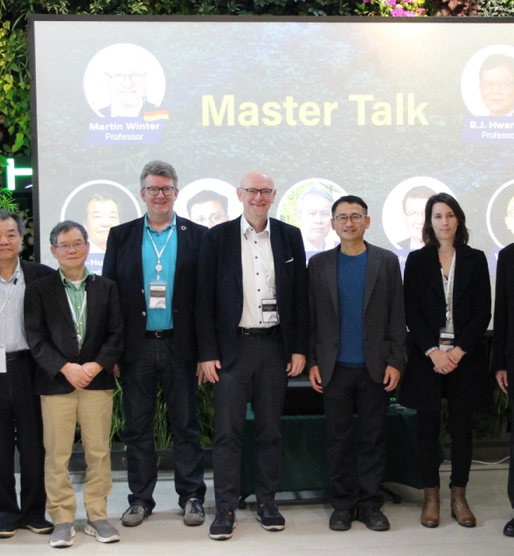
電池材料產學「Master Talk」
推展跨領域(跨國)學術研究
校級研究中心本校校級研究中心致力於前瞻性與實務性研究,結合多年專業實力與產業資源,與政府及民間組織合作,推動國家政策和永續發展目標(SDGs),強化校內研發與產業界的可持續關係,培養並引進高階產研人才。透過技術整合,開發多元領域的前瞻技術,與國內外專家合作,如辦理多項交流活動(如知名學人來訪、SEED 系列演講),與國內外學校/機構簽訂MOU或實際展開交流工作,或選送學生和年輕學者赴國外進修等,聚焦本校優勢領域,提升專業水準與技術研發能力,最大化產業效能。本校最新成立「技職賦能研究中心」及「製程淨零研究中心」,這兩所校級研究中心符合聯合國永續發展目標中的「4.優質教育」及「11.永續城市與社區」,並將繼續推動永續環境、永續社會和永續能源的發展。跨領域(跨國)學術研究第10屆國際先進科技論壇國際先進技術論壇由國立臺灣科技大學、日本德島大學輪流舉辦,第10屆國際先進技術論壇(International Forum Advanced Technology 2024)於3月8日在日本德島大學舉行,研究的相關議題包含奈米技術與先進材料、先進測量與等離子技術、光學工程與成像感測技術、工業管理與設計等,並邀請台日傑出青年學者到場展示和討論工程領域的研究趨勢,持續促進學術合作和科技應用。波蘭華沙理工大學來訪波蘭華沙理工大學(Warsaw University of Technology)由副校長Prof. Malinowski Mariusz帶隊於6月21日至本校拜訪,共同討論兩校未來學術合作的細節,研究領域聚焦於半導體雷射、光子集成電路、先進封裝路由與優化、生物醫學感測前端與刺激器、AI影像處理及機器學習設計優化等。本學術合作專題研究計畫由雙方共同出資研究經費,並於7月1日起徵件開放雙方研究人員申請,期待透過這些合作推動更深入的國際學術交流和創新研究。本校與臺北醫學大學學術研究成果發表會自2010年以來,本校與臺北醫學大學攜手合作,致力於推動跨領域整合研究,從單一計畫發展至跨領域應用研究團隊,共同研發創新醫療技術,促進了多元學術交流,強化彼此的研究實力,並充分發揮各自的優勢,實現了優勢互補,更促成了多個跨校整合團隊的成立。在兩校教研人員共同努力下,目前已建立超過140項合作計畫,涵蓋醫療器材、輔具、藥物應用、生醫材料開發及醫療影像等多個領域,並於6月19日舉辦兩校學術成果發表會,期望合作能持續造福社會。