跳到主要內容
:::
:::
13.3.2_臺科大氣候行動計畫_縮圖_514x556
NTUST's Climate Action Plan
NTUST's climate action plan is part of its mid- to long-term development plan and is led by the Center for Sustainable Development and Institutional Research. Its targets are 50% carbon neutrality by 2030 and 100% by 2049. This report draws on 15 news stories and public documents from 2022 to 2026, grouped into four themes:The plan and its carbon-neutral targets: Since 2023, NTUST has run greenhouse gas inventories under ISO 14064-1, verified by DNV. It issued a Net-Zero Declaration in 2025, and in 2026 opened Taiwan's first urban campus microgrid on its Huaxia campus.Sharing and planning with government: NTUST submitted its climate-friendly campus plan to the Ministry of Education, co-hosted youth climate action events with the Ministry of Environment, and has supported Taipei City's Disaster Prevention and Protection Programme since 2010. Its microgrid backs up a New Taipei City emergency shelter.Sharing with local communities: The university's USR team built a Resilient Community Disaster Prevention Center with Daxue Village and ran resilience workshops in Xuefu Village. Using the Chengnan area as a classroom, it shares green energy and local sustainability with high school students and residents.Youth and skills for climate action: NTUST brings carbon inventory and verification into the classroom, co-ran greenhouse gas verifier training for 245 people with National Dong Hwa University, and its student teams win net-zero competitions year after year.The table below summarises what NTUST does under each theme and the supporting evidence:1. The Climate Action Plan and Carbon-neutral Targets1.1 Clear targets and a dedicated unitNTUST, National Taiwan University, National Taiwan Normal University and other universities formed the Taiwan Sustainability Governance University Alliance. President Yen Chia-yu announced NTUST's low-carbon targets: 50% carbon neutrality by 2030 and 100% by 2049, now part of the university's mid- to long-term plan. The Commercial Times reported in December 2024 that NTUST won the 2024 National Sustainable Development Award (education category). The university has drawn up a decarbonisation roadmap and avoided about 218,913 kg of CO2 emissions in 2023.NTUST's revised plan for the Ministry of Education's 2024 Smart Climate-friendly Campus Pilot Programme (18 March 2024) states that the university began greenhouse gas inventories in 2023, using 2022 as the base year. The inventory follows ISO 14064-1:2018 and is verified by DNV. The Center for Sustainable Development and Institutional Research manages progress, writes the report, collects data from all units and runs internal verification. Nearly 90% of emissions come from electricity (Category 2) and from purchased goods and waste treatment (Category 4), which guides equipment replacement and energy saving. The plan also links smart electricity meters, smart water meters, air quality sensors and the energy management system (EMS) into a public sustainability information site. Ministry reviewers endorsed the 2049 target for 100% carbon neutrality.1.2 The Net-Zero Declaration and campus microgridOn 15 April 2025, at a forum and handover ceremony for a donated carbon inventory system, the President issued NTUST's Net-Zero Declaration, committing the university to net-zero emissions by 2049 through technology, teaching, research and industry partnerships. Alumni-founded Shuoda Systems donated the system, and the Center for Sustainable Development and Institutional Research provided inventory expertise and advice.In September 2026, NTUST presented its Huaxia campus microgrid. It was the first university in northern Taiwan selected for Taipower's university energy saving and power resilience programme. The system includes 229.68 kWp of solar panels, 2 MWh of battery storage, two 100 kW DC fast chargers, a 400 kW backup generator and an EMS. All solar power is used on campus, saving an estimated NT$540,000 a year in electricity costs.Table 2. NTUST's carbon-neutral pathway and milestones:News evidence for this sectionMinistry of Education (NTUST plan) (2024/03/18) NTUST revised plan for the Ministry of Education's 2024 Smart Climate-friendly Campus Pilot Programme: https://ws-proj.moe.edu.tw/001/Upload/568/relfile/13271/17428/784018ad-7cc4-4049-95c8-f309581b402f.pdfCommercial Times (2024/12/20) Building sustainability and social responsibility into its DNA, NTUST wins the 2024 National Sustainable Development Award: https://www.ctee.com.tw/news/20241220700579-431204NTUST News (2025/04/17) NTUST issues its Net-Zero Declaration at a forum and launches its sustainability transition: https://www.ntust.edu.tw/p/406-1000-135620,r167.php?Lang=zh-twCNA PR Newswire (2026/09/18) NTUST builds Taiwan's first urban campus microgrid, saving energy day to day and supplying power in disasters: https://www.cna.com.tw/postwrite/chi/444620Commercial Times (2026/09/18) NTUST builds Taiwan's first urban campus microgrid: https://www.ctee.com.tw/news/20260918701210-4312042. Climate Planning and Disaster Prevention with Local Government2.1 Sharing plans with national government and co-hosting youth climate actionThrough the Ministry of Education's Smart Climate-friendly Campus programme, NTUST submitted its inventory system, reduction targets, EMS and smart meter plans for government review (see 1.1), aligning with national net-zero green campus policy.In May 2026, NTUST and the Ministry of Environment co-hosted a talk in the Youth Climate Action Series for universities, titled Data, Technology and Civic Action: Co-creating Sustainable Cities. Nearly 130 students and members of the public attended. An analyst from the Climate Change Administration's Net-Zero Promotion Division spoke on transparent and accountable sustainability pathways from a government perspective. Speakers from Weather Risk Management, the Taiwan Green Energy Public Welfare Development Association and the Executive Yuan's Youth Advisory Committee discussed data integration, data visualisation and youth advocacy. The Center for Sustainable Development and Institutional Research said sustainability should be part of everyday learning and life.2.2 Disaster prevention work with Taipei CityCommonWealth Magazine reported in October 2022 that NTUST has supported Taipei City's Disaster Prevention and Protection Programme since 2010. Professor Chien-Kuo Chiu explained that national and city governments use the programme to model the Shanchiao Fault every year, updating the scale of rupture, affected areas and damage estimates, and Taipei uses the results to plan disaster prevention parks and shelters. Because the city can reach only about 12 of its more than 400 villages a year, NTUST launched its Community Renewal and Resilience USR project in 2020 to help neighbourhoods in Da'an, Wenshan and Zhongzheng districts. It also signed a disaster prevention memorandum with the Da'an District Office.For energy resilience, the Juyu Building on the Huaxia campus is one of New Taipei City's emergency shelters. If grid power fails, the microgrid switches to island mode and can run the whole campus for 4 hours, or 8 hours with large air-conditioning units shed, putting shelter lighting and communications first. Emergency sockets at the guardhouse let neighbours charge their phones during outages (see evidence in 1.2).📎 News evidence for this sectionNTUST News (2026/05/28) NTUST and the Ministry of Environment promote climate action as government, industry and academia explore data and technology for sustainable cities: https://www.ntust.edu.tw/p/406-1000-148240,r167.php?Lang=zh-twCommonWealth Magazine (2022/10/19) Thriving together with the neighbourhood: NTUST's Chengnan Unlimited Project shows how: https://www.cw.com.tw/article/51231893. Sharing and Practice with Local Communities3.1 Resilient communities: bringing disaster expertise to residentsOn the slopes of Toad Mountain, the USR team installed rainfall and tilt sensors, built an app that alerts village chiefs during heavy rain, and designed a LINE chatbot that shows the nearest shelter, fire hydrant and AED. The team also ran workshops in Xuefu Village on pre-disaster recovery planning and community resilience (CommonWealth Magazine, 2022).In November 2025, staff and students from the Departments of Civil and Construction Engineering and Architecture worked with Daxue Village in Da'an District to renovate an empty old building on Roosevelt Road, Section 3, into a Resilient Community Disaster Prevention Center with a disaster education room and a supplies room. Supplies are grouped for warning, evacuation and rescue, with stock and expiry tracking, and an evacuation route map for Daxue Village is mounted on the outside wall. Residents use the center to learn about disaster prevention and train.After extreme weather struck Hualien, on 4 October 2025 the NTUST Student Association and EDBA/EMBA Alumni Association brought 60 students and 34 alumni to Guangfu Township to help clear mud, with funds and supplies from the Alumni Association and campus vendors.3.2 Chengnan as a classroom: sharing sustainability with neighboursIn July 2026, the Center for General Education ran a summer school that took 13 high school students from across Taiwan and 15 NTUST undergraduates to Treasure Hill, Fanglan Mountain and Toad Mountain. Courses included green energy and design thinking, using technology to address local issues. In August 2026, the Chengnan College signed a memorandum with the Taipei Culture Foundation to bring teaching and building reuse to Huanmin New Village at Toad Mountain. Its course on cultural heritage and sustainable development looks at reusing the Japanese-era dormitories to benefit the community.📎 News evidence for this sectionCommonWealth Magazine (2022/10/19) Thriving together with the neighbourhood: NTUST's Chengnan Unlimited Project shows how: https://www.cw.com.tw/article/5123189NTUST News (2025/11/13) NTUST USR team and Daxue Village, Da'an District, turn an old building into a Resilient Community Disaster Prevention Center: https://www.ntust.edu.tw/p/406-1000-142185,r167.php?Lang=zh-twNTUST News (2025/10/14) Nearly 100 NTUST students and EMBA alumni help clear mud in Hualien after the disaster: https://www.ntust.edu.tw/p/406-1000-141169,r167.php?Lang=zh-twNTUST News (2026/08/13) Using Chengnan as a classroom, NTUST builds young people's cross-disciplinary skills: https://www.ntust.edu.tw/p/406-1000-150646,r167.php?Lang=zh-twNTUST News (2026/08/31) NTUST partners with Huanmin New Village at Toad Mountain, bringing general education into the Chengnan cultural corridor: https://www.ntust.edu.tw/p/406-1000-151078,r167.php?Lang=zh-tw4. Youth and Skills: Building Capacity for Climate Action4.1 Training carbon inventory and verification talentIn the Graduate Institute of Energy and Sustainability Technology's Sustainable Energy Strategy and Policy course, an industry speaker explained greenhouse gas inventory and third-party verification in practice. The course also coached students for the Ministry of Economic Affairs' iPAS Net-Zero Carbon Planning Manager certificate: about 75% of the class passed, against an official pass rate of 33.68% for the first 2025 entry-level exam (PeoPo, December 2025).In July 2026, NTUST and National Dong Hwa University's Carbon Neutrality Research Center ran a 40-hour ISO 14064-1:2018 lead verifier (auditor) course and an 8-hour iPAS exam review. 245 people took part: 79 from industry, 18 from government and public bodies, and 148 from schools and universities. 190 completed at least 32 hours. The course shared carbon management skills with government, business and schools in eastern Taiwan and nationwide.4.2 Net-zero technology competitionsAt the 2025 Net Zero Emissions Technology International Competition, organised by National Taiwan University and the TECO Technology Foundation with APRU, five NTUST teams reached the final and three won awards worth NT$1.12 million in total. In the 2026 competition, teams from Chemical Engineering and Applied Science won second place in the energy and sustainability categories for work on all-solid-state batteries, CO2 capture and battery recycling.📎 News evidence for this sectionPeoPo Citizen News (2025/12/19) Net zero is more than a slogan: NTUST brings carbon inventory and verification thinking into the classroom: https://www.peopo.org/news/832201CNA PR Newswire (2026/07/21) National Dong Hwa University and NTUST train net-zero talent through auditor training and iPAS exam review: https://www.cna.com.tw/postwrite/chi/439446NTUST News (2025/08/28) Five teams reach the final and three win awards: NTUST shines at the 2025 Net Zero Competition: https://www.ntust.edu.tw/p/406-1000-139612,r167.php?Lang=zh-twCommercial Times (2026/10/15) NTUST's net-zero technologies win awards, showing strength in energy storage: https://www.ctee.com.tw/news/20261015700216-439901Summary of News CoverageThis indicator is supported by 15 news stories and public documents, listed by date:Summary: NTUST's climate action plan aims for 50% carbon neutrality by 2030 and 100% by 2049. It is led by the Center for Sustainable Development and Institutional Research and delivered through ISO 14064-1 inventories verified by DNV, a Net-Zero Declaration and a campus microgrid. NTUST shares the plan and its results with the Ministry of Education, co-hosts youth climate action with the Ministry of Environment, and has supported Taipei City's disaster prevention programme since 2010. In the community, its USR team builds resilience with Daxue and Xuefu villages and uses the Chengnan area as a classroom for sustainability. Carbon inventory courses, verifier training and net-zero competitions give young people, government and industry the skills to act on climate.
13.2.1_臺科大低碳能源追蹤_縮圖_514x556
NTUST's Low-carbon Energy Tracking
1.OverviewNational Taiwan University of Science and Technology (NTUST) uses its Smart Energy Management System to track both where campus energy comes from and how much is used. The system records, in real time, the electricity generated by on-campus green (renewable) energy installations. It also records grid electricity purchased through the university’s two utility accounts (main campus 00-84-9650-11-0 and Research Building campus 00-84-9654-11-4) and consumed by each building. With both low-carbon generation and total consumption in one place, the university has the data it needs to calculate its share of low-carbon energy and the carbon emissions from electricity use.On the home page, the “Green Power Information” panel shows green-power generation for the current day and month; on 7 November 2026, for example, it showed 979 kWh for the day and 8,420 kWh month-to-date. In the Analysis module, “Annual Electricity Statistics” charts each account’s year-by-year consumption. Main-campus consumption fell from about 22.42 GWh in ROC year 105 (2016) to about 19.84 GWh in 108 (2019), and was about 21.24 GWh in 112 (2023). These charts let the university review the long-term effect of its energy-saving and carbon-reduction measures.2.How Low-carbon Energy Is TrackedReal-time renewable generation: Daily and monthly green-power generation updates continuously, so the contribution of self-generated low-carbon electricity is always visible.Grid consumption and emissions accounting: Consumption for each account and building can be exported by day, month and year. Combined with the grid emission factor, it gives electricity-related emissions and the share of total use met by green power.Long-term trend review: The “Annual Electricity”, “Yearly Electricity” and “Taipower vs. System” comparison functions show year-on-year changes in consumption and demand, so progress toward carbon-reduction targets can be checked.Analysing efficiency measures: Further analyses (optimal contract capacity, power factor, elevator regenerative energy, chiller COP, and the benefits of circulation fans and shading devices) track how much each low-carbon and energy-saving measure actually delivers.3.System LinkNTUST Smart Energy Management System: http://140.118.104.124/manage/pc/content/index.aspxFigure 1. NTUST Smart Energy Management System home pageFigure 2. “Green Power Information” showing daily and monthly on-campus green-power generation (7 Nov 2026: 979 kWh / 8,420 kWh) Figure 3. Analysis module “Annual Electricity Statistics”: main-campus consumption (kWh) for ROC years 104–112 (2015–2023), used to track long-term energy use and carbon reduction
環境部永續論壇
NTUST's Climate Action Campaigns
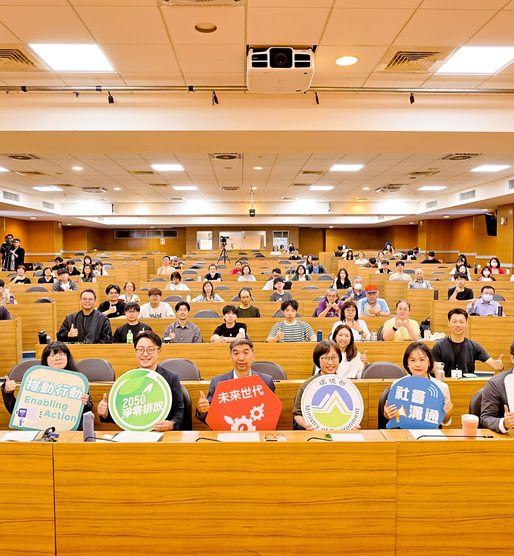
Climate Education and Awareness at National Taiwan University of Science and Technology (NTUST)1. Climate and Sustainability Courses1.1.General Education and Required CoursesNTUST offers general education and required courses that cover sustainable development and climate change, such as Introduction to Sustainable Development. Through the Center for General Education and its Social Practice Course System, the university builds sustainability thinking and climate change issues into the core undergraduate curriculum. The Center groups its courses and student social practice projects under SDG 13 ("Take urgent action to combat climate change and its impacts"). Examples include beach clean-ups, a mountain clean-up volunteer trip to Mt. North Dawu, campus tree care, and environmental and ecological education for rural communities (APUVA). In 2025 the Center launched the Interdisciplinary Micro-Program in Sustainable Development and Social Responsibility. Undergraduates who complete at least 9 credits receive a certificate. The required course is Introduction to USR and Sustainable Development, and electives include Sustainable Development and Society I and II and The EU, Globalisation and the SDGs.At the graduate level, courses include Climate Change Policy and Law (TM6170), offered by the Graduate Institute of Technology Management, which examines climate governance, regulation and decarbonisation pathways. According to the Commercial Times (December 2024), NTUST offers about 1,500 courses a year with SDG and USR content, with about 50,000 enrolments. The university was selected from 162 entries for the Executive Yuan's 2024 National Sustainable Development Award (Education category), recognising its smart energy management, greenhouse gas inventory and sustainability education.Related web pagesCenter for General Education: SDG 13 Climate Action courses and social practice outcomeshttps://cla.ntust.edu.tw/p/412-1076-9437.php?Lang=zh-twRegulations for the Interdisciplinary Micro-Program in Sustainable Development and Social Responsibility (2 May 2025)https://www.academic.ntust.edu.tw/var/file/48/1048/img/2550/147415661.pdfNTUST Social Practice Course Systemhttps://sp.cge.ntust.edu.tw/Commercial Times (20 Dec 2024): NTUST wins the 2024 National Sustainable Development Awardhttps://www.ctee.com.tw/news/20241220700579-4312041.2.Green-Collar Talent and Professional TrainingThe School of Continuing Education brings together NTUST experts in environmental engineering, green energy and management with industry practitioners. It runs practical courses on sustainability management and net-zero emissions that build skills in carbon inventory, ESG and climate change adaptation. One example is the third ESG Sustainability Management Practice Programme, a 300-hour pre-employment course running from 14 October to 22 December 2026. It is designed to prepare "green-collar" talent for employment. The School also runs a Carbon Inventory Practice Programme and an AI-Enabled Net-Zero Sustainability Practice Programme, which help employed and job-seeking learners move into net-zero transition careers.Related web pagesSchool of Continuing Education: ESG Sustainability Management Practice Programme (Cohort 3)https://sce.ntust.edu.tw/p/404-1074-150702.php?Lang=zh-twGreen-Collar Talent and Professional TrainingThe School of Continuing Education brings together NTUST experts in environmental engineering, green energy and management with industry practitioners. It runs practical courses on sustainability management and net-zero emissions that build skills in carbon inventory, ESG and climate change adaptation. One example is the third ESG Sustainability Management Practice Programme, a 300-hour pre-employment course running from 14 October to 22 December 2026. It is designed to prepare "green-collar" talent for employment. The School also runs a Carbon Inventory Practice Programme and an AI-Enabled Net-Zero Sustainability Practice Programme, which help employed and job-seeking learners move into net-zero transition careers.Related web pagesSchool of Continuing Education: ESG Sustainability Management Practice Programme (Cohort 3)https://sce.ntust.edu.tw/p/404-1074-150702.php?Lang=zh-tw2. Campus Climate Lectures and Cross-Sector ForumsNTUST works with government agencies, including the Ministry of Environment, to host lectures in the "Youth Participation in Climate Action for Universities" series. On 28 May 2026 the forum's theme was "Data, Technology and Civic Action: Co-Creating Sustainable Cities Across Disciplines". Speakers came from the Ministry of Environment's Climate Change Administration (Net-Zero Promotion Division), a weather risk management company, the Taiwan Green Energy Public Welfare Development Association and the Executive Yuan's Youth Advisory Committee. They joined NTUST faculty and about 130 students and members of the public to share practical experience in climate governance and sustainability transition from policy, industry, civic advocacy and youth perspectives.The panel discussion covered open data and its use, how young people can move from concern to action, and green jobs. Questions were collected live through Slido, and a Kahoot! quiz tested participants' climate knowledge. The Central News Agency (CNA) press release platform also covered the event.Related web pagesNTUST News (28 May 2026): NTUST and the Ministry of Environment promote climate action - government, industry and academia explore data and technology for sustainable citieshttps://www.ntust.edu.tw/p/406-1000-148240,r167.php?Lang=zh-twCNA press release platform (28 May 2026): external media coverage of the same eventhttps://www.cna.com.tw/postwrite/chi/4346663.University Social Responsibility (USR) and Sustainability PlatformThe NTUST Center for Sustainable Development and Institutional Research coordinates the university's sustainability report, greenhouse gas inventory and annual SDG report, and leads sustainability work on campus. NTUST began a campus-wide greenhouse gas inventory in 2023, checked by an internal verification team qualified under ISO 14064-1. The university has set targets of 50% carbon neutrality by 2030 and 100% by 2049. The same year, the NTUST Infinity Festival took the low-carbon campus as its theme. It included seven sustainability workshops, a photo competition, a sustainability book exhibition and a campus sustainability map, and promoted green consumption and green office practices.Through interdisciplinary social practice courses and projects, students apply decarbonisation, climate adaptation and community co-creation to local revitalisation, elderly care and international volunteering. In September 2026 NTUST hosted the Ministry of Education's USR capacity-building event "New Horizons for Sustainability: Innovation, Diffusion and International Cooperation". NTUST shared its experience building community resilience in the Nan-Gongguan settlement, as well as its Engineers in Action programme. That programme works over the long term with rural communities in Indonesia and Vietnam to improve sanitation and water use.For campus decarbonisation, the Office of Environmental Protection and Safety partnered with YouBike in 2026 to run an NTUST group in the YouBike "Carbon Savings Passbook" app. The group encourages faculty, staff and students to commute by public bike and track the carbon they save, which averages about 0.178 kg CO2e per ride. Participants who ride on at least 11 days and save at least 4 kg CO2e in a month meet the monthly target. When the group saves 1,000 kg in a quarter, members receive riding vouchers.Related web pagesOffice of Environmental Protection and Safety: Join the NTUST group in the YouBike Carbon Savings Passbookhttps://she.ntust.edu.tw/p/406-1068-151160,r1497.php?Lang=zh-twNTUST News (Nov 2023): NTUST Infinity Festival - sustainable development for a low-carbon campushttps://www.ntust.edu.tw/p/406-1000-119005,r167.php?Lang=zh-twNTUST Greenhouse Gas Inventory Reporthttps://po-r.ntust.edu.tw/var/file/59/1059/img/388016467.pdfCNA press release platform (21 Sep 2026): NTUST brings together USR practice from Taiwan, Japan, the US and Indonesiahttps://www.cna.com.tw/postwrite/chi/4447504. Environmental Education Activities and PhotosThe Office of Environmental Protection and Safety holds environmental education activities every year on energy transition, carbon issues, ESG, plastic reduction and climate action, and publishes photo albums of each event online. Climate-related activities include the 2025 Sustainability Week "Pedal Power Station" booth, where a pedal-powered YouBike generator lit a light bulb so participants could see how green electricity is made. The 2024 "Pedal for Green Power" experience introduced renewable energy and the net-zero transition. The 2024 lecture "Why Is ESG So Hot?" explained ESG and sustainability disclosure trends and how climate risk and carbon management affect industries and careers.The 2023 lecture "Carbon Issues Facing Businesses" looked at carbon inventory, carbon pricing and decarbonisation pathways for companies moving toward net zero. In 2023 the Office screened the climate documentary Tomorrow (Demain), which presents solutions to the climate crisis in farming, energy, the economy and education around the world. In 2022 the campus joined WWF's Earth Hour, switching off lights and promoting energy saving and carbon reduction.Related web pagesOffice of Environmental Protection and Safety: Environmental education activities and photoshttps://she.ntust.edu.tw/p/404-1068-83822.php?Lang=zh-tw2025 Sustainability Week - Pedal Power Station (album)https://photos.app.goo.gl/XjvfAMKorDaSZHJw52024 Pedal for Green Power Sustainable Energy Experience (album)https://photos.app.goo.gl/LPqAWAA89qirCbgE72024 Lecture: Why Is ESG So Hot? (album)https://photos.app.goo.gl/uAvrWmb2U6hsTq1962023 Lecture: Carbon Issues Facing Businesses (album)https://photos.app.goo.gl/xws1yxnZBS7ty38H82023 Film Screening: Tomorrow (Demain) (album)https://photos.app.goo.gl/g7TyoLUjZq2RFtRc82022 Earth Hour (album)https://photos.app.goo.gl/v24Hk5f2xEagrYz16Activity photosFigure 1 2025 Sustainability Week - Pedal Power Station activity photos (Source: NTUST Office of Environmental Protection and Safety)Figure 2 2024 Pedal for Green Power Experience activity photos (Source: NTUST Office of Environmental Protection and Safety)Figure 3 2023 Lecture: Carbon Issues Facing Businesses activity photos (Source: NTUST Office of Environmental Protection and Safety)
16.3.1
NTUST's Expert Advice to Government
National Taiwan University of Science and Technology (NTUST, Taiwan Tech) has long served as a bridge between industry and government decision-making. Its faculty experts and research teams provide professional advice, commissioned research and real-world testbeds to local, regional and national governments in engineering, information technology, smart manufacturing, green energy and sustainable development.Levels of governmentCybersecurity and Emerging TechnologiesNTUST runs a university-level Information Security Research and Teaching Center that brings together the Departments of Information Management and Computer Science and Information Engineering; it was among the first such centers at a Taiwanese university. Its director, Prof. Shi-Cho Cha (查士朝), leads a cross-university team in the Taiwan Information Security Center (TACC) on "Trustworthy Zero Trust Architecture for Critical Infrastructure", turning research into standards and tools that government and critical infrastructure operators can adopt.NTUST expert advice and contributionsZero-trust policy: supports the government in promoting zero-trust architecture and gives strategy recommendations to organizations adopting cybersecurity measures (national level).Financial regulation: helps financial institutions adopt zero trust and meet regulators' requirements for dynamic access control.Healthcare security: helps hospitals keep information secure while moving to hybrid cloud.Testing standards: builds a certification test platform for zero-trust products (also able to evaluate AI-based security products) to help competent authorities set inspection standards.Smart transport and unmanned vehicles: uses NTUST's ISO 17025-aligned laboratory to draft security test standards for smart-vehicle components, an evidence base for regulating smart transport and autonomous vehicles.National cyber talent: the Department of Computer Science and Information Engineering runs two sub-projects of the MOE Advanced Cybersecurity Practical Talent Program and co-organizes the MOE AIS3 summer school with the Department of Information Management.Related news reports and website linksNews reports:[2023-02-17] DIGITIMES | NTUST excels in cybersecurity talent development and keeps linking Taiwan's security industry (in Chinese)Websites:TACC – NTUST team: Trustworthy Zero Trust Architecture for Critical Infrastructure 2. Sustainable Development and Green Energy NTUST uses its campus as a Living Lab: results from its microgrid, energy storage and energy management systems become concrete recommendations on urban energy resilience, low-carbon circularity and net-zero pathways. The Sustainable Electrochemical Energy Development (SEED) Center and Prof. Tsai-Chi Kuo (郭財吉) of the Department of Industrial Management contribute expertise on electrochemical storage, circular economy and sustainability governance.NTUST expert advice and contributionsTaiwan's first urban campus microgrid (regional/local): NTUST was the first northern-region school in Taipower's University Energy Saving and Power Resilience project. The Huaxia Campus microgrid, completed in early 2026, combines 229.68 kWp of solar PV, 2 MWh of storage, two 100 kW DC fast chargers and a 400 kW diesel backup generator, funded by a NT$100 million Taipower subsidy and over NT$50 million from NTUST.Urban energy resilience: in a grid outage it switches to island mode, powering the whole campus for 4 hours, or 8 hours for priority loads. One campus building is also a New Taipei City emergency shelter where residents can charge devices, a model for disaster-ready urban power.Net-zero pathway: estimated savings of about NT$540,000 a year, rising to about NT$1.26 million with green-certificate sales. NTUST targets 50% carbon neutrality by 2030 and 100% by 2049.National recognition: NTUST received the Executive Yuan's 2024 National Sustainable Development Award (education category), presented by the Minister of Environment, for smart energy management, greenhouse gas inventory and sustainability education.SEED Center: battery, thin-film and hydrogen research teams carry out an NSTC academic summit research program and host the 2026 Lithium Battery & Electrochemical Energy Storage Industry–Academia Summit.Prof. Tsai-Chi Kuo: researches sustainable development, circular economy and smart manufacturing. As Secretary-General of the Taiwan Institute for Sustainable Energy, he spoke on university sustainability in the net-zero transition at the 2023 Net-Zero Emissions Technology Forum, held under the guidance of the MOE and NSTC.Related news reports and website linksNews reports:[2026-09-18] Commercial Times | NTUST builds Taiwan's first urban campus microgrid (in Chinese)[2026-09-21] 1111 Job Bank campus news | NTUST's urban campus microgrid saves energy daily and supplies power in disasters (in Chinese)[2024-12-20] Commercial Times | NTUST wins the 2024 National Sustainable Development Award (in Chinese)[2023-12-08] Commercial Times | Supporting the carbon economy: 2023 Net-Zero Emissions Technology Forum (in Chinese)Websites:Sustainable Electrochemical Energy Development Center (SEED)SEED: 2026 Lithium Battery & Electrochemical Energy Storage Industry–Academia SummitProf. Tsai-Chi Kuo, Department of Industrial Management3. Smart Manufacturing and Industrial UpgradingNTUST combines mechanical engineering, automation, AI and semiconductor technology through its Intelligent Manufacturing Innovation Center (IMIC) and its Heterogeneous Integration Silicon Photonic IC Center (HiSiPIC). Both inform smart factories, industrial transformation and the strategic chip supply chain, and open state-funded equipment to users across Taiwan.NTUST expert advice and contributionsIMIC: led by Chair Professor Shun-Feng Su (蘇順豐), it focuses on data centers, 5G networks, smart manufacturing (robotics, digital twins, AI, cyber-physical systems), sustainable energy and information security, and shares a site with the Industry 4.0 Implementation Center, a demonstration and training ground for SME upgrading.HiSPA alliance: on 9 April 2024 HiSiPIC and the Photonics Industry & Technology Development Association (PIDA) launched the International Silicon Photonics Heterogeneous Integration Alliance (HiSPA), linking industry, government, academia and research to build a silicon-photonics "Team Taiwan".National chip policy: NTUST set up the Graduate Institute of Advanced Semiconductor Technology and a Semiconductor Innovation and Application Research Center. Silicon-photonics measurement and packaging equipment funded by the NSTC Chip Innovation Program is open to researchers and companies nationwide through the TSRI sharing platform.Related news reports and website linksNews reports:[2024-12-28] United Daily News | Taiwan Tech launches semiconductor institute and research center for silicon photonics and advanced packaging (in Chinese)[2024-06-15] Business Next | "Silicon Photonics Team Taiwan" kickoff: the HiSPA alliance (in Chinese)Websites:Intelligent Manufacturing Innovation Center (IMIC)Heterogeneous Integration Silicon Photonic IC Center (HiSiPIC)HiSiPIC news archive 4.AI Applications and Talent DevelopmentNTUST hosts the Northern Taiwan AI Resource Center, linking 15 technical and vocational colleges in Taipei, New Taipei, Taoyuan and Hsinchu. Course design follows the MOE Future Talent AI Competency framework, so schools with fewer resources can share AI tools, instructors and teaching materials.NTUST expert advice and contributionsRegional AI capacity building: runs on three principles (shared resources, open cross-school enrolment and co-created, openly licensed materials). Courses map to the MOE's four competencies: learning with AI, using AI responsibly, solving problems with AI, and abilities AI cannot replace.Scale: 408 cross-school AI courses at 15 schools in the first semester of academic year 2026–27 (ROC year 115), plus 6 capacity-building courses run by the center this term.Related news reports and website linksWebsites:Northern Taiwan AI Resource Center – NTUST5.USR Projects and Local Government PartnershipsThrough University Social Responsibility (USR) projects and MOUs with local governments, NTUST brings engineering and management expertise to communities and young entrepreneurs, helping local governments solve local problems.NTUST expert advice and contributionsNew Taipei Youth Affairs Bureau MOU (16 July 2024): NTUST Dean of Industry–Academia Collaboration Cheng-Fa Yang (楊成發) and Bureau Director Chao-Mei Chiu (邱兆梅) signed an entrepreneurship resource-sharing MOU covering venues, equipment and expert talent. NTUST's incubation center has been named an Outstanding Incubator by the MOEA SME and Startup Administration ten times. The Bureau helps match startups to the B2G market, and NTUST-incubated Andgreen joined the city's startup procurement list.Gongguan–Chengnan disaster-resilience USR: led by Prof. Chien-Kuo Chiu (邱建國), the team works with the chiefs and residents of Fushui, Shuiyuan and Xuefu villages on town meetings, disaster-preparedness courses and evacuation-map workshops, is building an AI disaster-information chatbot, and is planning smart slope monitoring at Treasure Hill.Advice to a central agency on heritage repair: the team assessed the "Anzhai No. 3" building in Xueren Village for the Ministry of National Defense and recommended emergency repairs, then drafted reuse plans with residents. Its showcase drew MND units and Zhongzheng District village chiefs.Related news reports and website linksNews reports:[2024-07-16] NTUST Secretariat news (English) | Taiwan Tech and New Taipei City Government Youth Department sign MOU to promote interdisciplinary cooperation[2024-07-16] NTUST news (Chinese) | Taiwan Tech x New Taipei Youth Affairs Bureau sign MOU to advance youth entrepreneurship (in Chinese)[undated] NTUST USR website | Improving disaster resilience in the Gongguan–Chengnan settlements through community renewal (in Chinese)6. Summary of News CoverageCoverage by levelNote: the microgrid reports count under both Regional (Taipower northern region) and Local (New Taipei shelter). News and evidence list
13.3.5
NTUST's Environmental Education Collaborate with NGO
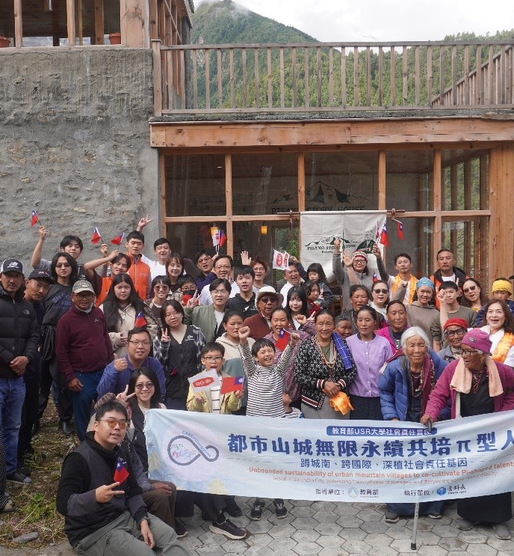
National Taiwan University of Science and Technology (NTUST, Taiwan Tech) actively collaborates with non-governmental organizations (NGOs), charitable foundations, industry associations and international partners to promote environmental education and climate adaptation projects. In 2025–2026, these efforts focused on two themes: (1) transnational University Social Responsibility (USR) projects and educational initiatives built on university–industry–NGO collaboration, and (2) green-collar talent development and professional certification.Under the first theme, NTUST's "Urban Mountain City" USR project has worked for years with the Taipei Zhuzhu Mama Child Education Care Association in Upper Pisang, a village in Nepal's Annapurna region, on heritage revitalization, evacuation planning and earthquake-preparedness education for children. The "Engineers in Action" (EIA) program links the Atayal community of Dongyue in Yilan with partner universities in Indonesia, Japan and Vietnam. Its teams restore greenhouses, build composting and irrigation systems, install drinking-water systems and teach renewable-energy concepts, and the program was invited to exhibit at Expo 2025 Osaka. NTUST's Graduate Institute of Applied Science and Technology also works with the Dandelion Hope Foundation (蒲公英希望基金會) on green-energy and sustainability lessons for Indigenous and disadvantaged children.Under the second theme, the NTUST School of Management works with the Taiwan Institute for Sustainable Energy (TAISE) to run the "Corporate Sustainability Manager Certification Training Program". The program covers CSR case practice, sustainable (green) finance and corporate decarbonization, and trains front-line talent for sustainability and the green transition. NTUST also works with the Logistics Association of the R.O.C., National Dong Hwa University, the Ministry of Environment and corporate partners on ESG logistics training, greenhouse-gas verification training and iPAS net-zero carbon management courses, turning sustainability principles into practical workforce skills.1. Transnational USR Projects and Educational Initiatives (University–Industry–NGO Collaboration)1.1 Urban Mountain City USR Project and the Zhuzhu Mama Child Education Care Association in Nepal (2025/09/23)In summer 2025, NTUST's USR team "Urban Mountain City: Cultivating Sustainable Talent – Rooted in Chengnan, Reaching Internationally" returned to Upper Pisang in Nepal's Annapurna region for the fourth consecutive year. The Taipei Zhuzhu Mama Child Education Care Association, a long-term NGO partner, supported the project by facilitating cross-border communication and overcoming language and cultural barriers. The team built a new retaining wall in front of a century-old house, installed road signs and a guide map, mapped evacuation routes and assembly points, and produced an earthquake-preparedness leaflet for residents. It also taught earthquake safety through games at a primary school in Manang and repaired facilities at two orphanages in Kathmandu. GO-IN Engineering joined for the first time to assess power improvements, and ties with Kathmandu University's Department of Civil Engineering were strengthened.Related reports:l NTUST News (ZH): 臺科大深耕尼泊爾山城 共築地方創生與防災教育 (2025/09/23): https://www.ntust.edu.tw/p/406-1000-140536,r167.php?Lang=zh-twl NTUST News (EN): Taiwan Tech empowers Nepal's mountain communities with local revitalization and disaster education: https://www.secretariat.ntust.edu.tw/p/16-1063-140987.php?Lang=enl CNA Press Release Platform (2025/09/23): https://www.cna.com.tw/postwrite/Chi/4131001.2 Opening of the Pisang Story House and Continued Disaster Education (2026/10/14)In summer 2026, Professor Po-Chien Hsiao (蕭博謙) of the Department of Civil and Construction Engineering led 11 students back to Upper Pisang, where the restored century-old "Pisang Story House" officially opened as a space for cultural exchange and for travelers to rest. The team installed tourist signs, launched a tourism website, produced a promotional video and ran interactive disaster-preparedness lessons on self-protection and evacuation at a primary school in Manang. The Zhuzhu Mama Child Education Care Association again facilitated cross-border communication. GO-IN Engineering provided the power system for the Story House, several construction companies and the department's alumni association donated funds, and the team discussed disaster-mitigation research with Kathmandu University. Together these partners form a university–NGO–industry–academic collaboration model.Related reports:l NTUST News (ZH): 臺科大持續深耕尼泊爾山城 攜手企業推動觀光與防災教育 (2026/10/14): https://www.ntust.edu.tw/p/406-1000-152618,r167.php?Lang=zh-twl CNA Press Release Platform (2026/10/14): https://www.cna.com.tw/postwrite/chi/446917l PChome News (2026/10/14): https://news.pchome.com.tw/living/cna/20261014/index-17919436030606718009.html1.3 Engineers in Action with Japanese and Indonesian Partners in Dongyue Community, Yilan (2025/06/30)Under the Ministry of Education's USR program, NTUST's "Engineers in Action" (EIA) has worked with the Atayal community of Dongyue in Nan'ao Township, Yilan, since 2020. From 7 to 16 June 2025, about 60 students and teachers from NTUST, Songshan Agricultural and Industrial Vocational High School, Osaka Institute of Technology (Japan) and Widya Mandala Catholic University (Indonesia) restored the Babaw Kulu trail, which a typhoon had closed for years. They cleared drainage ditches using eco-friendly methods, installed a solar-powered guide wall, and designed eight STEAM sustainability lessons for Dongao Elementary School covering homemade generators, saponification and carbon footprints.Related reports:l NTUST News (ZH): 臺科大行動工程師攜手日本印尼深耕東澳,翻轉偏鄉再升級 (2025/06/30): https://www.ntust.edu.tw/p/406-1000-138039,r167.php?Lang=zh-tw1.4 Engineers in Action in Indonesia, Japan and Vietnam: Resource Circulation and Disaster Preparedness (2025/10/08)In summer 2025, EIA teams worked with Institut Teknologi Sepuluh Nopember (ITS), Osaka Institute of Technology (OIT), Widya Mandala Catholic University and Can Tho University (CTU). In Pacet Village, Indonesia, they repaired greenhouses, built a crop dryer and a composting system to support resource circulation, and ran soap-making and eco-bag workshops. In Gubug Lazaris, Indonesia, they restored an abandoned organic greenhouse and installed automatic irrigation. In Kawakami Village, Nara, Japan, they installed a rapid post-earthquake building safety assessment system and multilingual evacuation signs. In Vietnam, they improved learning spaces at Long Tuyen 2 Primary School.Related reports:l NTUST News (ZH): 臺科大行動工程師深耕印尼、日本、越南 展現超群實踐力 (2025/10/08): https://www.ntust.edu.tw/p/406-1000-140988,r167.php?Lang=zh-twl NTUST News (EN): Taiwan Tech Mobile Engineers excel in Indonesia, Japan, and Vietnam: https://www.secretariat.ntust.edu.tw/p/16-1063-142060.php?Lang=en1.5 Engineers in Action Showcased at Expo 2025 Osaka (2025/12/03)From 25 to 27 September 2025, EIA was invited to co-host a booth with Osaka Institute of Technology in the "Future Life Village" zone of Expo 2025 Osaka. The booth presented NTUST's USR work in Yilan, Indonesia, Japan and Vietnam. It was the only Taiwanese USR program exhibited at the Expo and drew more than 600 visitors over three days.Related reports:l NTUST News (ZH): 臺科大USR國際能見度大躍進 行動工程師計畫受邀登上大阪世博 (2025/12/03): https://www.ntust.edu.tw/p/406-1000-142778,r167.php?Lang=zh-twl NTUST News (EN): Taiwan Tech USR Program, Engineers in Action, gains global spotlight at Osaka World Expo: https://www.ntust.edu.tw/p/16-1000-143617.php?Lang=en1.6 Engineers in Action 2026: Water Resources and Circular Agriculture (2026/09/24)In summer 2026, EIA again worked with ITS, UKWMS, CTU and OIT. In Gubug Lazaris, Indonesia, the team repaired leaking ponds and irrigation channels, maintained greenhouse irrigation, ran a workshop on making charcoal bricks from agricultural waste and built a solar-powered aquaponic greenhouse that combines renewable energy with circular farming. At Hoa-An 1 Primary School in Vietnam, the team installed a reverse-osmosis drinking-water system and a hydroponic rack that reuses water, improving sanitation and water access. It also ran environmental lessons such as candle-making from used cooking oil and waste-sorting games.Related reports:l CNA Press Release Platform: 臺科大行動工程師前進印尼、越南、日本 以工程專業回應社區需求 (2026/09/24): https://www.cna.com.tw/Postwrite/Chi/4451251.7 Engineers in Action Wins the 2026 Global Views USR Award (2026/04/30)At the 7th Global Views USR Awards, Professor Meng-Jiy Wang's (王孟菊) "Engineers in Action" program won a Merit Award in the Sustainable Curriculum category. Associate Professor Chia-Chun Ho's (何嘉浚) team won a Model Award in the Industry Co-creation category for its project protecting the Feitsui Reservoir watershed. The awards recognize NTUST's environmental education and cross-sector collaboration.Related reports:l NTUST News (ZH): 展現技職永續實力 臺科大榮獲2026《遠見》USR雙項大獎 (2026/04/30): https://www.ntust.edu.tw/p/406-1000-147199,r167.php?Lang=zh-tw1.8 Green-Energy and Sustainability Education for Children with the Dandelion Hope Foundation (2026/04/22, 2026/07/16)Professor Hung-Lung Chou's (周宏隆) team at NTUST's Graduate Institute of Applied Science and Technology works with the Dandelion Hope Foundation on a "Sustainable Green Energy Education Action". On Earth Day 2026, Indigenous pupils from Fuguo and Kueihui Elementary Schools in Fuxing District, Taoyuan, visited the foundation's sustainable ecological park. They tried solar-power models, hand-crank generators and pedal-powered generators, learned about native plants and practised making organic fertilizer. In July 2026 the partners co-hosted a sustainability summer camp themed "Explore Green Energy, Practise Sustainability", where disadvantaged children learned about renewable energy through flywheel generators and solar-panel demonstrations.Related reports:l Commercial Times (ZH): 蒲公英地球日最有感一課!原鄉學童用雙腳發電 親身感受綠能魅力 (2026/04/22): https://www.ctee.com.tw/news/20260422702078-431208l Taiwan Reports (ZH): 蒲公英基金會攜臺科大 推永續綠能教育: https://taiwanreports.com/archives/981590l Commercial Times (ZH): 孩子踩出綠電也踩出希望!蒲公英攜手台科大打造全台最有電的永續夏令營 (2026/07/16): https://www.ctee.com.tw/news/20260716701809-431204Green-Collar Talent Development and Professional Certification2.1 Corporate Sustainability Manager Training with the Taiwan Institute for Sustainable Energy (TAISE)The NTUST School of Management has a long-standing partnership with TAISE to run the "Corporate Sustainability Manager Certification Training Program". NTUST provides venues and teaching assistants, and Professor Tsai-Chi Kuo (郭財吉) of NTUST's Department of Industrial Management serves as Secretary-General of the Taiwan Academy of Corporate Sustainability (TACS, 台灣企業永續學院), TAISE's training arm. The 10-week, 80-hour program covers sustainability standards and regulations, CSR case practice, sustainable (green) finance and corporate decarbonization, with brainstorming and hands-on exercises. At the certification ceremony on 29 June 2024, 70 participants from many industries, including many mid- and senior-level managers, received their certificates after passing the examination. Speakers from Billion Watts Technologies and Cathay Financial Holdings shared approaches to net-zero emissions and corporate sustainability transformation. TAISE continues to offer the program.Related reports:l NTUST News (ZH): 臺科大與臺灣永續能源研究基金會合作開辦「企業永續管理師證照培訓班」 培養永續金融人才: https://www.ntust.edu.tw/p/406-1000-126882,r167.php?Lang=zh-twl NTUST News (EN): Taiwan Tech and Taiwan Institute for Sustainable Energy Research launch 'Corporate Sustainability Manager Certification' Training: https://www.secretariat.ntust.edu.tw/p/16-1063-127457.php?Lang=enl TAISE course page: Corporate Sustainability Manager Certification Training (2026.11–2027.01): https://taise.org.tw/events/courses/%E5%AF%A6%E9%AB%94%E4%BC%81%E6%A5%AD%E6%B0%B8%E7%BA%8C%E7%AE%A1%E7%90%86%E5%B8%AB%E8%AD%89%E7%85%A7%E5%9F%B9%E8%A8%93%E7%8F%AD2026-11-2027-01%E6%9C%88/2.2 ESG Smart Logistics Engineer Program with the Logistics Association of the R.O.C. (2025/04/15)The NTUST School of Management and the Logistics Association of the R.O.C. launched the first "Smart Logistics Technology Integration Engineer Program". It offers 48 hours of coursework and 6 hours of company site visits, covering sustainable smart logistics and ESG implementation to help the logistics industry cut carbon emissions through digital transformation.Related reports:l NTUST News (ZH): 臺科大攜手物流協會開設智慧物流工程師班 聚焦ESG推動產業數位轉型 (2025/04/15): https://www.ntust.edu.tw/p/406-1000-135513,r167.php?Lang=zh-tw2.3 Net-Zero Green-Collar Talent: GHG Lead Verifier and iPAS Net-Zero Carbon Manager Training (2026/07)The NTUST office of the Ministry of Education's Industry–Academia Talent Cultivation Platform and National Dong Hwa University's Department of Natural Resources and Environmental Studies jointly ran an ISO 14064 Greenhouse Gas Lead Verifier course (6–10 July 2026, 40 hours) and an iPAS Net-Zero Carbon Manager (Entry Level) course (13 July 2026, 8 hours). The courses were open to school teachers, government officials and corporate ESG and GHG inventory staff, with 150 in-person places and unlimited online participation.Related reports:l Course brochure: iPAS Net-Zero Carbon Planning Manager Practical Training (NDHU & NTUST Talent Platform Office): https://www.ccsh.tn.edu.tw/newsupload/iPAS%20%E6%B7%A8%E9%9B%B6%E7%A2%B3%E8%A6%8F%E5%8A%83%E7%AE%A1%E7%90%86%E5%B8%AB%E5%AF%A6%E5%8B%99%E6%87%89%E7%94%A8%E7%A0%94%E7%BF%92%E8%AA%B2%E7%A8%8B1150609.pdfl Course announcement: https://news.stust.edu.tw/id/948052.4 Carbon Inventory System Donation and Net-Zero Forum (2025/04/15)NTUST held a carbon inventory system donation ceremony and net-zero forum, where it issued its Net-Zero Declaration. Industry and academic experts discussed carbon management, digital enablement and sustainability transformation. The donated carbon inventory system is now used in campus governance and teaching to build practical carbon-management skills.Related reports:l NTUST News (ZH): 臺科大舉辦論壇發表淨零宣言 啟動永續轉型 (2025/04/17): https://www.ntust.edu.tw/p/406-1000-135620,r167.php?Lang=zh-tw2.5 Youth Climate Action Series with the Ministry of Environment (2026/05/28)NTUST and the Ministry of Environment co-hosted a campus lecture in the "Youth Participation in Climate Action" series, themed "Data, Technology and Civic Action: Co-creating Sustainable Cities". Nearly 130 students and members of the public took part and discussed how young people can use data and technology in climate action.Related reports:l NTUST News (ZH): 臺科大攜手環境部推動氣候行動 產官學共探數據科技邁向永續城市 (2026/05/28): https://www.ntust.edu.tw/p/406-1000-148240,r167.php?Lang=zh-tw3.Summary of News CoverageNote: Compiled from NTUST official news, the CNA press release platform, Commercial Times, the TAISE website and course brochures (retrieved 2026/11/04). Links marked (ZH) are in Chinese.
13.3.4
NTUST's Climate Disaster Warning Support
National Taiwan University of Science and Technology (NTUST) leverages its institutional capacity to provide local and regional governments with early warnings, monitoring data, and practical support for climate change-related disasters. Between 2025 and 2026, these efforts materialized through two main pillars: Technological Research and Disaster Prevention Applications, and Community Disaster Support and Personnel Training (USR).In technological research, NTUST's Engineering and Disaster Prevention Innovative Technology Research Center (EDP) focuses on disaster engineering protection, slope monitoring, and structural resilience under extreme climate conditions. The Department of Construction Engineering utilizes AI models to accurately predict deep-seated landslide displacements, providing local authorities with critical 1-day and 7-day slope disaster warnings. Meanwhile, the Department of Electronic and Computer Engineering developed an edge AI platform that enables drones and satellites to efficiently execute disaster monitoring. Furthermore, NTUST partnered with Taiwan Power Company to build Taiwan's first urban campus microgrid, which supplies emergency power during typhoon or earthquake outages and serves as a disaster resilience hub to maintain vital city operations.Regarding community disaster prevention and social responsibility, the EDP Center operates as a disaster preparedness training institution approved by the Ministry of the Interior, actively cultivating grassroots resilience. NTUST's USR team collaborated with the Taipei City Fire Department to pioneer disaster training camps for elementary school students and partnered with Daxue Neighborhood in Taipei's Da’an District to establish a Resilient Community Disaster Prevention Center. These relief efforts have also expanded outward, contributing to post-disaster recovery in Hualien's Guangfu Township and promoting disaster prevention education in the mountain towns of Nepal, fully demonstrating NTUST's profound contributions to climate disaster warnings and local resilience building. 1. Technology R&D and Disaster Prevention Applications1.1 Center for Engineering and Disaster Prevention Innovation Technology (EDP)The EDP Center grew out of the Center for Ecology and Disaster Prevention Engineering, set up in August 2002 with Ministry of Education funding, and later merged with the Occupational Disaster Prevention Center for the Construction Industry, established in February 2007 under a Council of Labor Affairs commission. It brings together NTUST experts across departments and external partners to work on engineering protection against extreme-weather disasters, slope monitoring and structural resilience, covering urban geotechnics, earthquakes, soil liquefaction, debris flows and slope failures, and hazards in green-energy construction. Its priorities include disaster-prevention technology for buildings, earthquakes and slopes, and urban disaster-management planning (hazard-potential analysis, disaster maps, public education, review of the disaster-response system and information integration). Through an industry-academia platform, the center takes on engineering and disaster-prevention research commissioned by government and industry and transfers its results to government agencies and industry.Related news:l EDP Center home page: https://edp.ntust.edu.tw/index.php?Lang=zh-twl EDP Center history: https://edp.ntust.edu.tw/p/426-1112-1.php?Lang=zh-twl EDP Center mission: https://edp.ntust.edu.tw/p/426-1112-2.php?Lang=zh-twl EDP R&D goals and strategy: https://edp.ntust.edu.tw/p/426-1112-3.php?Lang=zh-tw1.2 AI Forecasting of Deep-Seated Landslide Displacement for Early Warning (6 January 2025)Prof. Jui-Sheng Chou's team in the Department of Civil and Construction Engineering, working with National Chi Nan University, studied the deep-seated landslide on the northern slope of Lushan, Ren'ai Township, Nantou County. Using eight years of surface displacement, groundwater-level and weather monitoring data, the team compared machine-learning, time-series deep-learning and convolutional neural network (CNN) models and tuned them with the AEIO optimisation algorithm. The best model, AEIO–MobileNet, predicted next-day displacement at monitoring station E-2 with a mean absolute percentage error (MAPE) of only 2.81%. One-day forecasts support rapid evacuation of residents and seven-day forecasts give time to move machinery and property, and both are linked to the displacement alert levels of the TGS-SLOPEM106 slope-monitoring standard. The results give local governments and slope-management agencies a basis for landslide warning and evacuation decisions. The study was published in Natural Hazards and Earth System Sciences.Related news:l NHESS paper: Predicting deep-seated landslide displacement on Taiwan's Lushan: https://nhess.copernicus.org/articles/25/119/2025/l DOI: 10.5194/nhess-25-119-2025: https://doi.org/10.5194/nhess-25-119-20251.3 Edge-AI Disaster Monitoring Platform Wins FutureTech Award (13 October 2025)Prof. Pei-Chun Li's team in the Department of Electronic and Computer Engineering won a 2025 FutureTech Award from the National Science and Technology Council for an area-efficient, low-voltage sparse neural-network accelerator. Their edge-computing platform uses two-stage model compression to run cloud removal, farmland segmentation and disaster monitoring on the device itself, cutting bandwidth and storage needs. The team plans to package it as an AI module for drones and satellites, so that imagery can be interpreted and monitored in real time when disasters occur.Related news:l Commercial Times: Five NTUST technologies win FutureTech Awards (13 Oct 2025): https://www.ctee.com.tw/news/20251013700706-4312041.4 Taiwan's First Urban Campus Microgrid: Saving Energy Daily, Supplying Power in Disasters (18 September 2026)Under Taiwan Power Company's University Energy Conservation and Power Resilience programme (NT$100 million from Taipower and over NT$50 million from NTUST), NTUST built Taiwan's first urban campus microgrid at its Huaxia campus. It comprises 229.68 kWp of solar PV, a 2 MWh battery storage system, a 400 kW backup diesel generator and an energy management system. When typhoons or earthquakes cut grid power, the system switches automatically to island mode and can supply the whole campus for about four hours, or about eight hours when power goes first to the emergency shelter. Six emergency sockets at the Juyu Building guard station let nearby residents charge their phones during outages, making the campus a disaster-resilience hub for the city.Related news:l CNA press platform: NTUST builds Taiwan's first urban campus microgrid (18 Sep 2026): https://www.cna.com.tw/postwrite/chi/444620l Commercial Times (18 Sep 2026): https://www.ctee.com.tw/news/20260918701210-431204l 1111 Job Bank News: https://www.1111.com.tw/news/jobns/1675351.5 Seminar on Disaster-Resilient Solar PV Systems (31 March 2026)NTUST's Energy Management Systems Industry-Academia Technology Alliance and the Industrial Technology Research Institute (ITRI) co-hosted a seminar on disaster-resilient solar PV systems, with NTUST's Department of Electrical Engineering and Institute of Energy and Sustainability Technology as co-organisers. More than 200 experts from industry, academia and research attended. Using the Huaxia campus microgrid as a demonstration site, the seminar showed how grid-forming technology restores stable voltage and frequency within milliseconds after a grid failure, keeping communications, medical equipment and lighting running. This serves as a reference for local governments planning disaster shelters and resilient energy facilities.Related news:l Yam News: Inside NTUST's disaster-resilient microgrid 'energy fortress' (2 Apr 2026): https://n.yam.com/Article/20260402341566Community Disaster Support and Disaster Prevention Specialist Training (USR)2.1 Disaster Prevention Specialist Training Institution Certified by the Ministry of the InteriorSince 11 March 2024, the EDP Center has been a Disaster Prevention Specialist training institution certified by the Ministry of the Interior. It trains groups from companies, public agencies and local communities (up to 40 people per regular class, or 70 for off-site classes in Greater Taipei). Structured teaching and hands-on drills build trainees' basic disaster-prevention knowledge, emergency-response skills and ability to support community disaster prevention. Trainees who complete the course and pass the test receive the Ministry's Disaster Prevention Specialist certificate, adding to the community disaster-response workforce that local governments rely on.Related news:l EDP Disaster Prevention Specialist training page: https://edp.ntust.edu.tw/p/426-1112-6.php?Lang=zh-twl National Fire Agency, Disaster Prevention Specialist Training website: https://rtp.nfa.gov.tw/dp/introl National Fire Agency, list of certified training institutions: https://rtp.nfa.gov.tw/dp/training-institution2.2 Taiwan's First Disaster Prevention Specialist Camp for School Pupils, with the Taipei City Fire Department (16–17 July 2026)NTUST's Urban Mountain Village USR project and the Taipei City Fire Department held a summer Disaster Prevention Specialist camp. It was the first in Taiwan to extend this training to pupils in the middle grades of primary school, as well as junior and senior high-school students. Nearly 100 students and teachers completed the intensive two-day course and all passed the test. Topics included the duties of a Disaster Prevention Specialist, Taiwan's disaster-management system, recent disaster patterns, opening and running community evacuation shelters, household preparedness and personal protection, and CPR, AED and Heimlich training by fire-department instructors. A pre-test found that about one in five trainees held mistaken beliefs about disaster safety, and post-tests showed clear gains across all age groups.Related news:l NTUST News: Taiwan's first Disaster Prevention Specialist training for young students, with the Taipei City Fire Department (7 Sep 2026): https://www.ntust.edu.tw/p/406-1000-151392,r167.php?Lang=zh-twl CNA press platform: https://www.cna.com.tw/postwrite/Chi/443471l PChome News: https://news.pchome.com.tw/living/cna/20260907/index-17887477324425318009.htmll Yam News: https://n.yam.com/Article/202609076734122.3 Resilient Community Disaster Prevention Center, Daxue Village, Da'an District, Taipei (13 November 2025)Since 2024, NTUST's USR team (students and staff from Civil and Construction Engineering and Architecture) has worked with Daxue Village in Da'an District, Taipei, to turn a vacant old building beside No. 25, Lane 283, Section 3, Roosevelt Road into a Resilient Community Disaster Prevention Center, with a Disaster Education Center and a Disaster Resource Room. The team repaired structural cracks, added roof waterproofing and insulation, renovated the outer walls, improved drainage and mounted an evacuation-route map for the village on the outer wall. Inside, supplies are grouped by alert, evacuation and rescue functions, with colour-coded shelves and stock and expiry tracking, strengthening the community's readiness for heavy rain, earthquakes and other disasters.Related news:l NTUST News: Taiwan Tech USR Team transforms old building into Resilient Community Disaster Prevention Center: https://www.ntust.edu.tw/p/16-1000-142930.php?Lang=enl NTUST News (Chinese): https://www.ntust.edu.tw/p/406-1000-142185,r167.php?Lang=zh-twl CNA press platform: https://www.cna.com.tw/Postwrite/Chi/418450l Taiwan Shin Sheng Daily News: https://www.tssdnews.com.tw/?FID=46&CID=839093l PChome News: https://news.pchome.com.tw/living/cna/20251113/index-17630021334777718009.html2.4 Evacuation Planning and Earthquake Education in Pisang, Nepal (23 September 2025)Since 2022, the Civil and Construction Engineering USR team has worked in Upper Pisang in Nepal's Annapurna region. In 2025 it built a new retaining wall in front of a century-old house, installed new signs and guide maps, planned evacuation routes and assembly points, and produced a disaster-preparedness brochure giving residents guidance on responding to earthquakes and other hazards. The team also ran earthquake-preparedness lessons at an elementary school in Manang and exchanged disaster-reduction research with Kathmandu University's Department of Civil Engineering, taking Taiwan's community disaster-prevention experience to mountain settlements abroad.Related news:l NTUST News: Taiwan Tech empowers Nepal's mountain communities with local revitalization and disaster education: https://www.ntust.edu.tw/p/16-1000-141506.php?Lang=enl NTUST News (Chinese): https://www.ntust.edu.tw/p/406-1000-140536,r167.php?Lang=zh-twl CNA press platform: https://www.cna.com.tw/postwrite/Chi/4131002.5 Continuing Work in Nepal's Mountain Villages: Tourism and Disaster Education (14 October 2026)In 2026 the USR team took 11 students back to Upper Pisang, where the restored century-old Pisang Story House officially opened. At Manang Primary School the team used interactive games and drills to teach children self-protection and evacuation. GO-IN Engineering provided the power system for the Story House, construction-industry partners and the department's alumni association donated funds, and the team continued exchanges on engineering technology and disaster-reduction research with Kathmandu University.Related news:l NTUST News (Chinese): NTUST continues work in Nepal's mountain villages, promoting tourism and disaster education with industry partners: https://www.ntust.edu.tw/p/406-1000-152618,r167.php?Lang=zh-twl CNA press platform: https://www.cna.com.tw/postwrite/chi/446917l PChome News: https://news.pchome.com.tw/living/cna/20261014/index-17919436030606718009.html2.6 Post-Typhoon Mud Clearance and Recovery in Guangfu Township, Hualien (4 October 2025)After typhoon rains caused severe flooding in Guangfu Township, Hualien, in 2025, the NTUST Student Union and the EDBA/EMBA Alumni Association sent 60 students and 34 alumni to Guangfu during the Mid-Autumn holiday. In line with local recovery needs, they helped residents clear mud and clean their homes. Places filled within 24 hours of the call for volunteers, and the NTUST Alumni Association and campus partners provided funding and supplies.Related news:l NTUST News (Chinese): Nearly 100 NTUST students and EMBA alumni clear mud in Hualien (14 Oct 2025): https://www.ntust.edu.tw/p/406-1000-141169,r167.php?Lang=zh-twl CNA press platform: https://www.cna.com.tw/postwrite/Chi/4151323.Summary of News CoverageNote: This document draws on the EDP Center website, NTUST news releases, an international journal article and media coverage (retrieved 4 November 2026).